


SBI Closes at Rs 1,028.90 on September 3 as Gross NPA Hits 20-Year Low of 1.47%
Category: Financial
Share
Archive
Like
MUMBAI — State Bank of India shares settled at Rs 1,028.90 on Wednesday, a gain of Rs 8, or 0.78%, over Tuesday's close of Rs 1,020.90, even as the Nifty 50 shed 0.17% to close at 23,873. The divergence was the point: in a session where the headline index retreated, the Nifty PSU Bank index advanced 1.12% to 8,606.75, and SBI, the index's anchor, moved with it.
The catalyst was a June quarter that rewrote SBI's asset quality story in terms that are difficult to argue with. Gross non-performing assets fell to 1.47% of total advances, the lowest in two decades. Net NPA dropped to 0.38%. Net advances grew 18% year-on-year. The bank's domestic net interest margin held at 3.00%, up 7 basis points from the March quarter.
Those conditions produced net profit of Rs 21,121 crore for Q1 FY27, up 10.2% from the same period a year earlier. Interest income reached Rs 46,992 crore, a 14.88% rise. Operating profit came to Rs 33,529 crore, up 9.77%. Return on equity registered at 17.87%. Management guided credit growth for the full FY27 year at 14–15%.
The June quarter's asset quality figures carry more weight than they might appear. A gross NPA ratio of 1.47% is not merely a good quarter: it marks a 20-year low. SBI spent the better part of a decade absorbing the stress created by aggressive infrastructure and corporate lending in the 2010s. The bank took large provisions, wrote off substantial accounts, and rebuilt its underwriting standards under successive management teams. The number at 1.47% is the result of that decade of repair, not a single quarter's decision.
The implication for Wednesday's session is that the 0.78% gain reflected institutional buyers who see that repair work as durable, not as a one-quarter phenomenon subject to reversal. Among the 39 analysts covering the stock, the average price target is Rs 1,262, a 22.7% premium to Wednesday's Rs 1,028.90 close. The consensus rating is 'Strong Buy.'
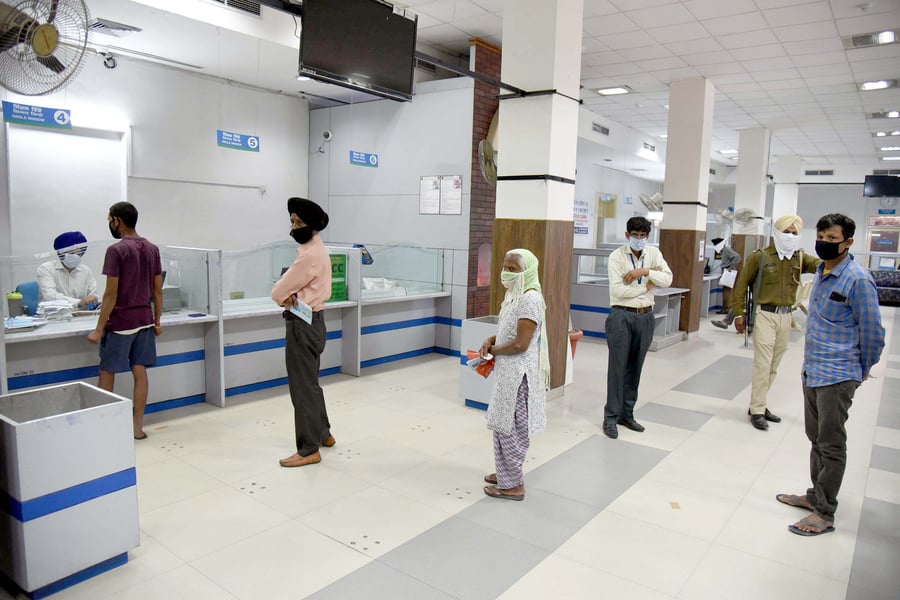
India's public sector banking sector, led by State Bank of India, posted record asset quality in Q1 FY27. [Image Source: Xinhua]That consensus deserves scrutiny. The gap between the average analyst target and the current price is not new. SBI traded near Rs 1,234.70, its 52-week high, at a point when the earnings trajectory looked similar. The stock is currently about 16.5% below that level. The distance is the market's current estimate of what is unresolved: the pace of deposit repricing, the RBI's policy direction, and whether the 14–15% credit growth target translates into actual disbursals in a second half that depends substantially on government capex spending.
SBI's structural position in the Indian banking system provides a cost-of-funds advantage that rarely shows up in quarterly comparisons. The bank operates more than 22,000 branches and roughly 65,000 ATMs. The float, current account and savings account balances, that flows through that infrastructure gives SBI a deposit cost profile that smaller lenders cannot replicate. When deposit competition tightened through FY26, as it did, that structural advantage maintained NIM in a range that would have compressed more sharply for a bank without that retail depth.
On Wednesday, SBI's peers in the private banking sector showed mixed trajectories. HDFC Bank added 1.13% during the session, Axis Bank rose 1.04%, while ICICI Bank ended at its session low after touching Rs 1,452 in the morning. SBI's 0.78% gain was modest by comparison but notable in one respect: it held its advance through the session without reverting.
The market cap at Wednesday's close was approximately Rs 9.17 lakh crore. That figure places SBI among the five largest listed companies in India by market capitalization. The index weight that comes with that size means institutional rebalancing flows move through the stock routinely, a factor that can both amplify and dampen moves that would look more idiosyncratic at a smaller company.
According to Fortune's Global 500 rankings, SBI remains India's highest-ranked bank in the global listing, a position that reflects both scale, more than Rs 64 lakh crore in total assets, and the role it plays as a proxy for the Indian economy's credit expansion.
What the session also revealed is that the PSU banking sector's recovery from its NPA cycle has entered a different phase. A 1.47% gross NPA ratio was the threshold that analysts set years ago at which SBI's valuation discount to private-sector peers would begin to close. That threshold has now been breached. The question the market is working through is whether the discount should close further, and at what pace.
The answer depends on factors SBI's management can influence but not control: the RBI's monetary policy path, the trajectory of government capital expenditure, and the competitive pressure on deposit rates as the banking system grows its loan books at 14–15% annually while deposit growth lags. The Reserve Bank of India has held the repo rate at 6.25% since February 2026, a pause that has cushioned NIM for all lenders. According to RBI policy communications, the current stance remains focused on withdrawal of accommodation while supporting growth, a formulation that leaves the timing of any rate cut dependent on durable inflation convergence toward 4%.
What is confirmed: Wednesday's close at Rs 1,028.90 represented the fifth consecutive session above Rs 1,000. Gross NPA is at a 20-year low. The analyst consensus points to Rs 1,262. The PSU banking sector outperformed the Nifty 50 by roughly 130 basis points on the day.
What is not resolved: whether the second half of FY27 credit growth materializes at 14–15%, and whether NIM stability at 3.00% holds through a rate cycle that has not yet turned.
A note on cookies
Newshunt uses essential cookies to keep you signed in and to remember your language and country, so the site works the way you expect. With your permission, we'd also like to use analytics cookies to understand how people use Newshunt and improve it over time.
Accepting only affects analytics. To learn more, view our Privacy Policy or Terms & Conditions.
(0)Comments