


Elliott Smith at the Mirimax Table
Category: Entertainment
Share
Archive
Like
The filmmaker Gus Van Sant started listening to Elliott's music in 1995, while working on the black comedy To Die For. 'There was a scene where there was kind of raucous music playing,' he says, something the older generation wouldn't understand. He asked a friend, the musician Steve Birch, for recommendations. Steve mailed a handful of CDs from the Portland record store Locals Only, including Roman Candle and Elliott's self‑titled record. The albums left over from the edit, Gus says, 'kind of lived in the car' as he crossed the country with his then-boyfriend Derek‑Jan Haanraadts, who goes by D‑J. They drove hundreds of miles, listening.
'Throughout the whole trip—which was, like, what, twenty hours?—we only played Elliott,' D‑J says, laughing. He knew Elliott from working at La Luna, where he bartended with Joanna and ran Queer Night on Mondays. 'All the bartenders loved to work on Queer Night because the tips were so much better,' he says. 'The gays were great tippers. Except for the lesbians, at least the ones in Portland at that time.' He remembers seeing Elliott and Neil come in on Monday nights. Elliott sat at the bar with a stoic expression, 'but then you would be nice to him, and he would crack a smile, and his face would change.'
Once D‑J brought in a local drag queen who was also a Tupperware ambassador. 'I have this image of the Tupperware party, which is happening in the bar during Queer Night, and Elliott, in his enthusiasm, just buying stuff,' he says. 'Somehow he had an experience of Tupperware,' he muses. 'It felt to me like a childhood memory, something he cherished.'
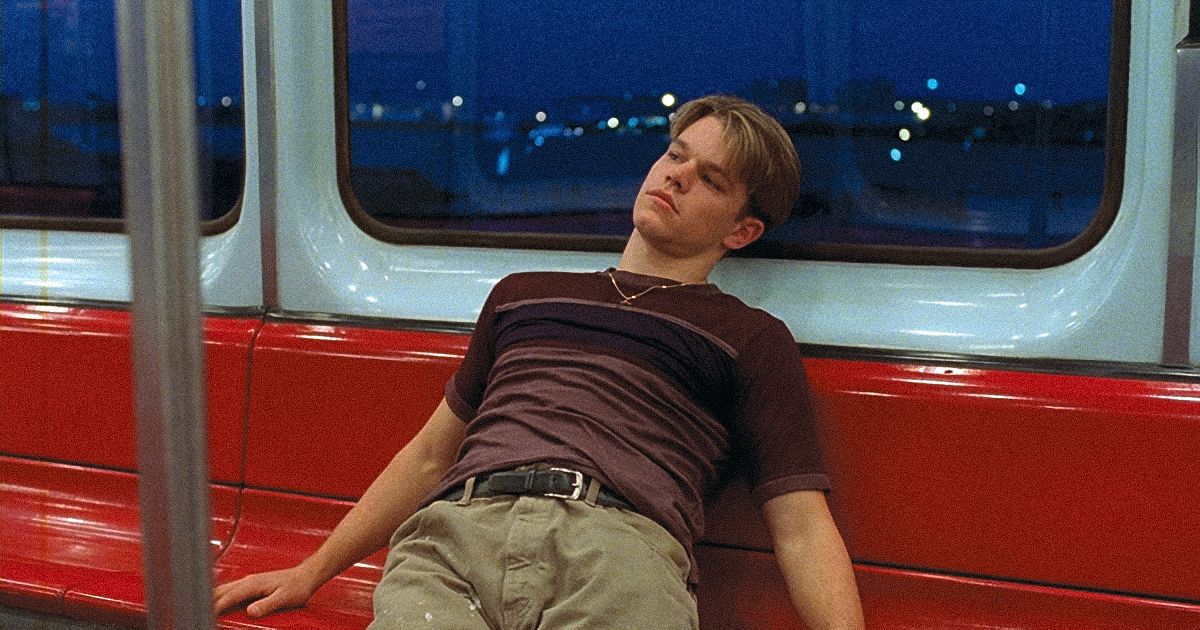
The next movie Gus made was Good Will Hunting, in the spring of 1997. The script was written by Ben Affleck and Matt Damon, then little-known actors who had appeared in independent films. 'In the script, it was sort of delineated as 'world music,'' Gus says. 'So we tried that.' Nothing really fit until he suggested Elliott. He ended up using songs from Either/Or throughout the film. 'There was sort of an attempt to emulate The Graduate,' he says. 'Because Simon & Garfunkel really tied together the whole movie. And it just seemed to be this perfect sound.' Then he laughs. 'I was told when I met Elliott, 'Don't mention Simon & Garfunkel.''
At a meeting in a bar, Gus asked for permission to use the songs. He explained he had been using Elliott's music in a movie he was making. 'Oh, that's interesting,' Elliott said. Gus invited him over to see for himself.
'We edited in Portland at my house,' Gus says. 'It was this big Victorian house that I bought a few years earlier in the West Hills, overlooking the city.' He had worked on My Own Private Idaho there, using the living and dining area as an editing room. 'And so he sat in a room and we put it on in my house,' he says. 'He watched the whole movie to see what we had done. And then he said, 'I can see you're playing a bigger game.''
Years later, Elliott made the same point in interviews, elaborating on it. 'I think what he was trying to do was play a bigger game and not get stuck in a little corner making Gus Van Sant movies for the rest of his life,' he said. 'So I think it was a brave move, and I think it turned out pretty well.' Elliott compared it to the reach he was about to make with XO. 'I was kind of on the same wavelength at the time,' he said.
He thought the songs had been well placed, although as he pointed out dryly, when he was writing Either/Or, 'I didn't have any idea that Matt Damon and Minnie Driver would be making out with one of my songs in the background.' He also liked the fact that Gus made music of his own; he'd been working with a TASCAM for years. 'So we'd talk about microphones and sing the praises of fifty‑sevens, which are really underrated mics,' Elliott said. He enjoyed those conversations and trusted Gus. And so he licensed the songs to Miramax.
'I'm pretty sure that all came to be while he was crashing in the living room,' Dorien Garry says. She remembers him explaining it: 'So there's this filmmaker …' Rough edits of the film kept coming in the mail for Elliott to review, fragments on VHS. She describes Elliott's attitude at that point as skeptical, unsure that anything would come of it. 'I don't think that he understood—I mean, maybe none of us did—the magnitude of it,' she says. Watching one of the first tapes that came to the apartment, a dramatic Robin Williams scene, she thought, This is a different bag than we all thought it was.
In the fall, Elliott was repeatedly flown out to Los Angeles, where the final editing was being done. 'They really wanted Gus around for promotion,' says D‑J, who was an assistant editor on Good Will Hunting. 'Harvey Weinstein and Lawrence Bender, they were really pushing very hard to get an Oscar nomination.' When D‑J took the movie to an exhibition in New York, Miramax paid for an extra first‑class seat next to him on the plane, where the film canister sat, seat belt buckled. In November, as the release date approached, Elliott described being flown out four times in a little over a week, and it's not clear that he was joking.
'I'd just kind of show up for an hour and then split,' Elliott said. 'I mean, it's Gus's movie, I'm not going to sit there and be like, 'Hey, don't.'' 'There wasn't a lot of heads‑up, I know that,' Dan Mapp says. He always made meticulous itineraries, and traveling with Elliott that fall, he remembers Miramax plucking them up out of nowhere. 'We were just touring in our Ford Taurus, and they flew us out to California first‑class, and we go to meet Danny Elfman, and he's with the orchestra and everything, and then they fly us back first‑class and we're back in our Taurus,' Dan says, laughing.
He watched Elliott work with Elfman, who was conducting a live orchestral version of 'Between the Bars' for the soundtrack. 'He wanted to have Elliott play with the orchestra,' Gus says. It was a full eight‑piece ensemble, Elliott sitting in with his guitar. 'He just seemed amazed at first,' Dan says. 'Then he was really relaxed and happy.' Elfman was 'exactly how you'd picture him,' Elliott told Garrick later, scrunching up his face in an impression of a nervous rat.
Weinstein is the reason that 'Miss Misery' ended up in the movie, and nominated for an Oscar. 'Harvey Weinstein said, 'We need an original song for the Academy Awards,'' Gus says. 'I asked Elliott if there was a new song, and he was working on a song, 'Miss Misery.' And so we used that as the final cue.' Larry remembers the brief charade of having to pretend the song was written for the film. 'I recorded that song before Gus ever heard it,' he says. At one point, he wrote an article about the process of recording it, and Margaret called him up. 'You can't say that!' she said. 'Say he wrote it for the movie!'
Elliott took Jenny Eliscu to one of the screenings in New York. 'It was insane how out of place we were,' she says. 'I didn't know it was a screening with the cast, and I didn't know we were going to end up at a dinner after. We were dressed like normal. On the way, he's like, 'This is Gus Van Sant,' and I was like, 'Get the fuck out of here.'' Jenny laughs. She remembers sitting next to Elliott during the movie, watching the scene where Robin Williams tells Matt Damon it isn't his fault, and bawling. 'It was too Elliott's story,' she says.
Afterward they went to a big dinner with Matt Damon, Minnie Driver, and the Affleck brothers. They ducked out after a while and ate at Paquito's, a little Mexican place in the East Village with a pending sanitation grade and an ATM built into the storefront. It's one of Jenny's favorite memories.
'It was like a crash course in hanging out with celebrity people,' Joanna says. Elliott took her to the premieres in New York and LA; they had gotten back together by then, but so tentatively that when we talk, she had forgotten it. She felt like Gus made a point of inviting them to screenings and premieres in part because it was a relief for him having regular people around. 'Well, that's for sure,' Gus says, laughing. In LA, she was introduced to the Weinstein brothers. After the screening in New York, Gus invited them to ride in the limo to Elaine's, the legendary Upper East Side restaurant, where they had dinner with Ben Stiller, Liv Tyler, and Joaquin Phoenix, who tried to set Elliott up with Angelina Jolie while Joanna was in the bathroom. 'Harvey just invited a whole bunch of us, so we all went and sat at the Miramax table,' Gus says. It was the kind of place where there was a Miramax table.
The story of Elliott in New York is partly the story of Elliott and celebrity, for reasons that have nothing to do with Oscar campaigns. Max Fish's Harry Druzd was engaged to Audrey Bernstein, who used to throw a Monday‑night party called Mothra. 'They became these huge, huge things, like crazy,' Audrey says. The parties were held at a restaurant on Houston called E&O, in a downstairs room, with a Mad Libs assortment of guest deejays, from Moby to Michael Stipe. At some point, Audrey asked Elliott.
Max Fish bartender Brandon Holley remembers sitting on the floor to watch him play before his set, everyone craning their necks, enchanted, bewildered. 'I mean, at that point, it was Jesus Lizard—everything was loud, especially in the Lower East Side music scene,' she says. 'I was like, 'Who is this strange, quiet person? How could he ever play in front of people?''
Elliott and Josh used to deejay there together. 'We took turns, you know?' Josh says. 'It was like the Kinks and sixties stuff like that.' They were mostly Chris Rage's records: the Supremes, James Brown on organ, an album by the soul‑funk group Rasputin's Stash. 'They call him Cool.' 'Who?' 'Mr. Cool.' 'We would just play the whole album, but it was the last song—we're always like, 'Ahhh, here it comes!!'' Chris says. Elliott met Kirsten McCord there, a cellist with a sound he loved; he wanted her to play on XO. 'Going to bars wasn't really my thing because I was sober,' she says. 'But I think he liked the fact that I was sober.' She had the sense sometimes that she was a 'Band‑Aid friend' at a time when his trust in other people felt tentative, post‑intervention.
'Mothra was really a moment in time,' Brandon says. 'The bathrooms were crazy. You never knew what you were going to see.' She laughs. 'There was nothing else going on at that time except, like, Palladium.' Claire Danes, Tony Danza, Laurence Fishburne, and Liev Schreiber made appearances. In a piece on Mothra, The New York Times warned there was a nontrivial risk of going home with Gene Simmons. Eventually, Audrey branched out into karaoke. 'David Lee Roth from Van Halen would show up and karaoke his own song,' Brandon says. He did his trademark jump.
That was a different time in New York, and in celebrity culture. 'You could talk to pretty much anyone,' Barbara Rushkoff says. 'I used to see Adam Yauch riding his bike, Russell Simins ordering food. I used to see Fred from the B‑52s buying records.' One night at Fez, Kirsten remembers sitting at a table with Elliott, Dorien, and the Wainwrights. Elliott was crying, Dorien was comforting, and Joaquin Phoenix came over trying to make conversation. 'So you're a Portland boy?' he asked, as Elliott wept over his hummus.
The more successful Elliott became, Dorien points out, the more he had to deal with 'people that just didn't make sense to him.' 'I mean, there's the Matt Dillon story,' she says. It happened one night at Mothra. Josh and Elliott were deejaying, surrounded by the cast of Good Will Hunting, and Matt walked up and said, appreciatively, 'There's a lot of hot sluts in here tonight.' Elliott just looked at him, aghast.
'It was just totally unnecessary,' Josh says with emotion, 'just the most toxic male shit, how Elliott and I imagined dudes talked to each other, which is real. We didn't talk that way. And that's the kind of world that you're partially stepping into, these people that have no idea what your ethos is—that that's not how you view the world, as a collection of sluts and hos and bros.'
'When you guys came back to the house later that night, you were both so upset,' Dorien says. 'You were like, 'You tell her.' 'No, you tell her. I can't even tell her.'' She laughs. 'I remember just loving both of you so much by how upset you were.'
'Who talks like that?' Josh asks.
'It was sort of being catapulted into this thing that just feels gross,' she says. 'I think Elliott became kind of twisted and mixed up about like, 'Do I want this? How much of this do I want?' But at that point, you don't really have any control anymore.'
A note on cookies
Newshunt uses essential cookies to keep you signed in and to remember your language and country, so the site works the way you expect. With your permission, we'd also like to use analytics cookies to understand how people use Newshunt and improve it over time.
Accepting only affects analytics. To learn more, view our Privacy Policy or Terms & Conditions.
(0)Comments