


UC Davis Health Opens New Electroconvulsive Therapy Clinic
Category: Health
Share
Archive
Like
UC Davis Health has expanded treatment options for people with serious mental illness by opening a new electroconvulsive therapy (ECT) clinic. It gives people in the greater Sacramento region access to highly effective treatment for severe psychiatric illnesses that have not improved with other therapies. The clinic is located in the state-of-the-art 48X Complex on the Sacramento campus. ECT is effective treatment for severe mental illness
John Onate, who practices both internal medicine and psychiatry at UC Davis Health, is the clinic's medical director. During ECT treatment, a controlled electrical stimulus is delivered to the brain while a patient is under anesthesia.
"ECT is very effective for the treatment of a variety of severe mental illnesses, such as treatment-resistant depression, bipolar disorder, schizophrenia or catatonia," Onate said. "I'm excited to expand access to this life-saving treatment to a wider population and to help reduce the stigma surrounding ECT and mental health care in general."
ECT is a type of brain stimulation therapy that has been used for decades, but Onate notes that misunderstandings persist. "ECT is very safe. Patients are under anesthesia throughout the procedure, and our multidisciplinary team carefully monitors them before, during and after treatment. For some individuals who have not improved with other therapies, ECT can offer meaningful symptom relief and restore quality of life."
ECT is typically delivered as a series of treatments, usually two to three times each week. During each treatment session, a brief, carefully controlled electrical stimulus is delivered to a targeted area of the brain while a patient is under anesthesia. Onate notes the amount of electricity is small — the equivalent of briefly turning on a small flashlight.
An ECT session lasts only a few minutes. However, appointments generally take a few hours because patients receive anesthesia and require monitoring before and after the procedure.
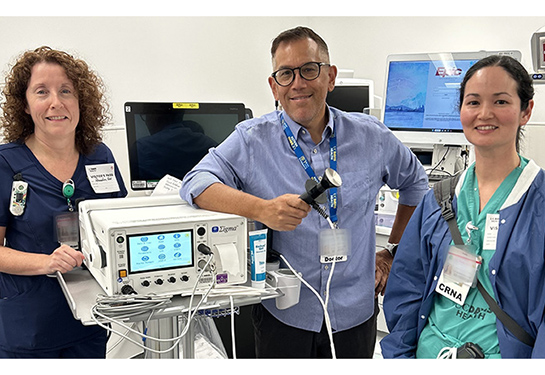
Most patients receive between nine and 15 sessions, although treatment plans are individualized based on a patient's needs and response. Left to right: Fiona Madigan, nurse educator; John Onate, medical director; Suzy Birkeland, certified registered nurse anesthetist. UC Davis Health offers hope for hard-to-treat psychiatric illnesses
The new clinic is part of a broader effort by the Department of Psychiatry and Behavioral Sciences to greatly expand access to advanced psychiatric therapies. The goal is to improve care for patients with treatment-resistant depression and severe mental health conditions.
"For individuals with severe depression and other complex psychiatric conditions, ECT can be a highly effective treatment," said Helen Kales, chair of the Department of Psychiatry and Behavioral Sciences. "Opening the new clinic allows us to provide care at an academic medical center with expertise across multiple medical specialties."
In addition to the ECT clinic, the department's Advanced Psychiatric Therapeutics (APT) Clinic provides transcranial magnetic stimulation (TMS) and esketamine therapy (delivered as a nasal spray) for difficult-to-treat neuropsychiatric conditions such as major depressive disorder and obsessive-compulsive disorder.
"We want patients to know that if multiple antidepressants and other medications have not helped, other treatments are available at UC Davis Health," Kales said. "By focusing on evidence-based therapies that are proven to be effective, we can offer hope grounded in science to people who continue to struggle despite previous treatments." Who is a candidate for ECT?
ECT is for adults 18 and older with serious psychiatric conditions. Research has shown it can effectively treat:
Learn more about ECT, including common side effects. How to get referred to ECT and APT clinics
A note on cookies
Newshunt uses essential cookies to keep you signed in and to remember your language and country, so the site works the way you expect. With your permission, we'd also like to use analytics cookies to understand how people use Newshunt and improve it over time.
Accepting only affects analytics. To learn more, view our Privacy Policy or Terms & Conditions.
(0)Comments