


Engine Oil Filter Replacement Parts Market Expands as Routine Servicing Sustains Aftermarket Demand
Category: Business
Share
Archive
Like
Engine Oil Filter Replacement Parts Market Expands as Routine Servicing Sustains Aftermarket Demand
Engine Oil Filter Replacement Parts Market
https://www.futuremarketinsights.com/reports/sample/rep-gb-33259
https://www.futuremarketinsights.com/reports/engine-oil-filter-replacement-parts-market
https://www.futuremarketinsights.com/methodology
https://www.futuremarketinsights.com/reports/adblue-pump-and-injector-replacement-parts-market
https://www.futuremarketinsights.com/reports/heavy-duty-truck-air-suspension-replacement-parts-market
https://www.futuremarketinsights.com/reports/engine-and-transmission-remanufacturing-service-programs-market
https://www.futuremarketinsights.com
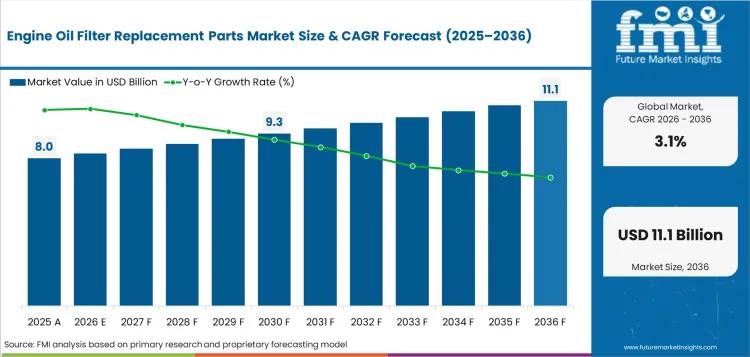
The engine oil filter replacement parts market is gaining steady aftermarket demand as routine oil servicing continues across internal combustion engine and hybrid vehicles. Workshops, quick-service centers, dealerships, and fleet garages continue replacing oil filters during scheduled maintenance, while changing service intervals are increasing the importance of filtration performance and exact-fit replacement parts.Future Market Insights (FMI) finds that the engine oil filter replacement parts market was valued at USD 8.0 billion in 2025 and is estimated to reach USD 8.2 billion in 2026. Demand is forecast to reach USD 11.1 billion by 2036, expanding at a 3.1% CAGR from 2026 to 2036. Routine oil service is expected to account for 61.0% of service type demand in 2026, while the independent aftermarket is forecast to represent 58.0% of sales channel demand.Get detailed market forecasts, competitive benchmarking, and pricing trends:Why are engine oil filter replacements gaining commercial importance?Engine oil filters remain a recurring maintenance component because vehicles with combustion engines require clean oil circulation to protect internal engine components. During regular oil service, workshops typically inspect and replace the filter to prevent accumulated contaminants from circulating through the lubrication system.The aftermarket remains particularly important because a large installed vehicle base continues to require scheduled maintenance after leaving the original equipment channel. Independent workshops and quick-service centers serve a substantial share of this vehicle population, creating demand for replacement filters that can be identified and installed quickly.Changing service intervals are also influencing product selection. Longer oil service periods can require filter media capable of maintaining filtration performance over extended operating cycles. This is encouraging workshops and distributors to consider media construction, filtration efficiency, durability, and application-specific fitment rather than treating every replacement filter as a basic commodity.Hybrid vehicles add another layer of service demand. Although battery-electric vehicles eliminate conventional engine oil servicing, hybrids continue to use combustion engines and therefore retain demand for engine oil and filtration components. Suppliers serving both conventional and hybrid applications can maintain broader catalog coverage as vehicle powertrain technology changes.Which filter formats and service applications are shaping demand?Spin-on filters remain an important replacement format because the complete filter unit can be removed and replaced during routine servicing. Their straightforward installation makes them suitable for busy workshops and quick-service operations where technicians need to complete oil changes efficiently across multiple vehicle applications.Cartridge filters are increasingly used in newer engine designs, where the filter housing remains installed while only the filter element is replaced. This configuration can reduce the quantity of metal discarded during servicing and supports a different replacement workflow for workshops handling newer vehicle platforms.Cellulose media is expected to remain widely used because it provides practical filtration performance at competitive prices. Synthetic and blended media are gaining relevance where engines operate with longer service intervals or require higher filtration performance. Microglass media also forms part of the market as suppliers address applications requiring more specialized filtration characteristics.Passenger cars are expected to account for 52.0% of demand in 2026, reflecting the size of the passenger vehicle population and the frequency of scheduled oil servicing. Light trucks, heavy trucks, and off-highway engines provide additional demand through commercial and equipment maintenance channels.What does the analyst see as the key commercial issue?"Engine oil filter replacement demand follows the rhythm of workshop service. Filters move through quick-service lanes, dealer bays and fleet garages. Suppliers with broad catalog coverage and simple fitment data will be preferred by distributors and repair centers."- Nikhil Kaitwade, Principal Consultant at Future Market InsightsMarket Snapshot• Market value, 2025: USD 8.0 billion• Market value, 2026: USD 8.2 billion• Forecast market value, 2036: USD 11.1 billion• Global CAGR, 2026-2036: 3.1%• Incremental opportunity, 2026-2036: USD 2.9 billion• Leading service type: Routine oil service, with a 61.0% share in 2026• Leading sales channel: Independent aftermarket, with a 58.0% share in 2026• Leading filter type: Spin-on filters, with a 43.0% share in 2026• Leading media type: Cellulose media, with a 45.0% share in 2026• Leading vehicle type: Passenger cars, with a 52.0% share in 2026• Fast-growing markets: India at 4.2% CAGR and China at 3.8% CAGRWhat is driving near-term demand?Service planning is becoming more important for engine oil filter replacement as fleets face tighter inspection schedules and wider vehicle coverage. California's Clean Truck Check emissions testing became effective on October 1, 2024, with testing deadlines beginning January 1, 2025. Covered vehicles require periodic testing, encouraging fleet operators to coordinate inspection, repair, and maintenance activities. For commercial fleets, combining routine oil and filter service with planned maintenance can help reduce vehicle downtime.Filter catalog expansion is also strengthening aftermarket coverage. In February 2024, MANN-FILTER stated that its 2024-2026 catalogs added more than 125 new filter types for passenger car and off-highway models. Broader application coverage gives distributors and workshops more options for servicing mixed vehicle fleets and reduces the risk of unavailable or difficult-to-identify replacement parts.Heavy-duty filtration remains another important area of aftermarket activity. In February 2025, Atmus reported full-year 2024 net sales of USD 1.67 billion and highlighted its aftermarket presence across truck and construction equipment markets. Continued service requirements for commercial vehicles and off-highway equipment support demand for replacement filtration components beyond passenger cars.Product availability and fitment accuracy are becoming increasingly important as vehicle catalogs expand. Workshops may handle multiple generations of vehicles within the same service bay, requiring filters with accurate application data and reliable availability. Suppliers with broad part-number coverage can therefore strengthen relationships with distributors, fleet garages, and independent repair networks.How are India, China, and mature service markets shaping demand?India and China are expected to support above-global-average growth in engine oil filter replacement parts. India is forecast to expand at a 4.2% CAGR, while China is projected to grow at 3.8% through 2036. Large vehicle populations, expanding service networks, and increasing maintenance activity support replacement filter demand in both markets.India's growing network of independent garages creates demand for affordable filters with straightforward fitment. China combines a large vehicle population with expanding aftermarket distribution, creating opportunities for suppliers capable of supporting multiple passenger car and commercial vehicle applications.The United States continues to provide a large and established aftermarket through high vehicle utilization and quick-service oil change networks. Germany and Japan present more application-specific opportunities, particularly where premium vehicles and hybrid powertrains require accurate replacement components.Across these markets, suppliers are competing not only on filter price but also on catalog breadth, media quality, availability, and application accuracy. These factors become particularly important for distributors and workshops that need to minimize fitment errors and keep frequently serviced vehicle applications moving through their bays.Why is filtration media becoming more important?The transition toward longer service intervals is changing how workshops evaluate replacement filters. A filter used across an extended oil service period must continue to capture contaminants while maintaining appropriate oil flow. This creates opportunities for suppliers offering synthetic, blended, and microglass media alongside established cellulose products.The shift does not eliminate demand for conventional filter formats. Instead, it creates a broader product hierarchy in which filter construction and media selection are matched more closely to engine requirements and service intervals. Suppliers able to clearly communicate application coverage and media specifications can improve purchasing confidence among distributors and repair centers.Hybrid vehicle adoption is also making catalog accuracy more important. While battery-electric vehicles remove engine oil filtration from the maintenance cycle, hybrid vehicles retain combustion-engine servicing. Suppliers therefore need to distinguish between vehicle architectures and ensure that filter catalogs accurately identify applicable engine and hybrid platforms.Engine Oil Filter Replacement Parts Market DefinitionThe engine oil filter replacement parts market covers aftermarket oil filters and related service parts used during engine oil changes. The market includes replacement filtration products supplied to passenger vehicles, light trucks, heavy trucks, and off-highway engines through independent aftermarket and authorized service channels.Engine Oil Filter Replacement Parts Market InclusionsThe market includes spin-on filters, cartridge filters, bypass filters, magnetic filters, cellulose media, synthetic media, blended media, and microglass media. Distribution covers independent aftermarket, authorized service, online retail, and fleet contracts. The scope includes products supplied through filter manufacturers, media suppliers, parts distributors, workshops, fleet service providers, and other aftermarket participants.The market also covers demand generated through routine oil service, fleet maintenance, heavy-duty service, and performance service applications during the 2026-2036 forecast period.Engine Oil Filter Replacement Parts Market ExclusionsThe scope excludes factory-installed oil filters shipped with new engines, fuel filters, cabin filters unless included in a clearly identified oil service kit, hydraulic filters, and transmission filters that are not used for engine lubrication service.Engine Oil Filter Replacement Parts Market Research MethodologyPrimary Research: FMI analysts review aftermarket distributors, filter manufacturers, workshop operators, fleet service providers, and purchasing behavior across major vehicle service markets.Desk Research: Research incorporates vehicle production, vehicle parc, travel and utilization data, transport statistics, supplier disclosures, industry publications, and aftermarket information.Market Sizing and Forecasting: Market size is developed using replacement intervals, vehicle parc estimates, service frequency, filter replacement rates, product pricing, and aftermarket channel participation.Data Validation: Forecast assumptions are cross-checked against vehicle utilization, filter media upgrades, supplier activity, fleet maintenance requirements, and aftermarket distribution trends across key markets.Market Segmentation AnalysisThe engine oil filter replacement parts market is segmented by filter type, media type, vehicle type, sales channel, and service type. By filter type, the market covers spin-on filters, cartridge filters, bypass filters, and magnetic filters, with spin-on filters expected to account for 43.0% of demand in 2026. By media type, the market includes cellulose media, synthetic media, blended media, and microglass media, with cellulose media forecast to hold a 45.0% share.By vehicle type, the market covers passenger cars, light trucks, heavy trucks, and off-highway engines, with passenger cars expected to represent 52.0% of demand in 2026. By sales channel, the market is divided into independent aftermarket, authorized service, online retail, and fleet contracts, with the independent aftermarket forecast to account for 58.0% of sales channel demand. By service type, the market includes routine oil service, fleet maintenance, heavy-duty service, and performance service, with routine oil service projected to lead at 61.0% in 2026.About the ReportFuture Market Insights' latest study examines the global engine oil filter replacement parts market across filter type, media type, vehicle type, sales channel, and service type. The study evaluates replacement demand generated through routine oil service, fleet maintenance, heavy-duty service, and performance-oriented applications.The report assesses spin-on and cartridge filtration formats alongside bypass and magnetic filters. Media analysis covers cellulose, synthetic, blended, and microglass technologies, while vehicle coverage includes passenger cars, light trucks, heavy trucks, and off-highway engines.The study provides market sizing and forecasts from 2026 to 2036, with analysis of major aftermarket markets. India is projected to grow at a 4.2% CAGR and China at 3.8% CAGR during the forecast period.The research is designed to support filter manufacturers, aftermarket distributors, workshop operators, fleet service providers, automotive parts suppliers, investors, and other stakeholders evaluating replacement demand, product positioning, service-channel opportunities, and competitive dynamics in the engine oil filter replacement parts market.Exhaustive Market Report: A Complete StudyAccess the Complete Report Methodology Now!Browse More Industry Reports :AdBlue Pump and Injector Replacement Parts MarketHeavy-Duty Truck Air Suspension Replacement Parts MarketEngine and Transmission Remanufacturing Service Programs MarketFuture Market Insights Inc.Christiana Corporate, 200 Continental Drive,Suite 401, Newark, Delaware - 19713, USAT: +1-845-579-5705For Sales Enquiries: sales@futuremarketinsights.comWebsite:Future Market Insights, Inc. (FMI) is an ESOMAR-certified, ISO 9001:2015 market research and consulting organization, trusted by Fortune 500 clients and global enterprises. With operations in the U.S., UK, India, and Dubai, FMI provides data-backed insights and strategic intelligence across 30+ industries and 1200 markets worldwide.
A note on cookies
Newshunt uses essential cookies to keep you signed in and to remember your language and country, so the site works the way you expect. With your permission, we'd also like to use analytics cookies to understand how people use Newshunt and improve it over time.
Accepting only affects analytics. To learn more, view our Privacy Policy or Terms & Conditions.
(0)Comments