


WEF wants philanthropies, foundations to be stewards of nature: report
Category: Politics
Share
Archive
Like
Unelected globalists want other unelected globalists to lord over land, air, and sea: perspective
The World Economic Forum (WEF) argues that philanthropies and foundations should be stewards of nature, according to a recent white paper.
The WEF
report
, '
The Catalysts: Unlocking Markets for a Sustainable Economy
,' builds upon the globalist idea that everything in nature should be monitored, catalogued, and
put on a balance sheet
.
Corporations and governments alone aren't up to the task of realizing this vision at speed and scale, so the WEF is calling on what it calls 'catalytic actors' — particularly philanthropies and foundations — to use their money, resources, and influence to lord over the land, air, and sea.
These groups are rich and patient enough to fully realize how much they could make from managing and
financializing everything in nature
.
'Catalytic actors are not in a position to lead systemic transformation – that is the role of governments, businesses and communities. However, they are uniquely placed to apply their policy influence and values-based stewardship to accelerate promising ideas into sustainable, commercial opportunities that deliver prosperity within planetary boundaries'
WEF, '
The Catalysts: Unlocking Markets for a Sustainable Economy
,' August 2026
Source: WEF
'Debt-for-nature swaps could free up $100 billion for nature and climate: These allow countries burdened by external debt to reduce repayments in return for redirecting funds into nature conservation and climate resilience. Analysis reported by the Forum shows such swaps could free up $100 billion to restore damaged ecosystems and protect vulnerable communities from floods, drought and wildfires'
WEF, '
The Catalysts: Unlocking Markets for a Sustainable Economy
,' August 2026
The surface-level idea for unlected rich and powerful groups to becomes stewards of nature is to ensure that '
finance flows towards climate- and nature-positive solutions – rather than towards harmful practices that drive emissions and ecosystem degradation
,' but this '
will depend largely on public policy support and private sector investment
.'
One of the 'nature-positive' schemes in which the WEF champions is something called debt-for-nature swaps, which '
enable countries to exchange loan repayments for investment in conservation
.'
Is your country millions, billions, or trillions in debt? No problem!
With debt-for-nature swaps, you can restructure your nation's debt just by letting somebody else come in and take control of your natural resources under the guise of conservation and restoration.
However, this grants them the power to force your country to '
take out private insurance policies to
'
mitigate the financial impact of natural disasters
'
as well as
'
political risk
,'' as investigative journalists
Whitney Webb and Mark Goodwin
report in
Bitcoin Magazine
.
While the WEF report concedes that it is the role of governments, businesses, and communities to take the lead on 'systems change,' the architects of the great reset once again propose public-private partnerships with 'catalytic actors' to identify 'which opportunities offer the clearest path to growth within planetary boundaries.'
However, when it comes to taking stewardship over mother earth, the report places philanthropies, foundations, NGOs, and other unelected 'catalyst actors' on a pedestal higher than elected officials who are supposed to work on behalf of the people.
According to the report, '
The catalytic actors who will matter most in the decades ahead are those capable of holding onto both financial and planetary logic at the same time: deploying capital with the precision of a skilled investor, while practicing the patience of a long-term steward who responds to the urgency of the present crisis by creating a more sustainable future
.'
'A band of actors whose potential remains largely untapped: foundations, philanthropies, family offices, impact investors and select institutional investors. Together, this 'catalytic community' possesses both the financial and non-financial resources to help unlock progress in times of volatility'
WEF, '
The Catalysts: Unlocking Markets for a Sustainable Economy
,' August 2026
Source: WEF
'
Catalytic actors – especially philanthropies and foundations – can unlock nature- and climate-positive solutions across ocean, forest and energy systems
'
WEF, '
The Catalysts: Unlocking Markets for a Sustainable Economy
,' August 2026
So, we have catalytic actors and catalytic investors working towards another made-up term — catalytic capital.
For the WEF, 'Catalytic capital accepts disproportionate risk and/or concessionary return to generate positive impact and enable third-party investment that otherwise would not be possible.'
The authors say, 'Catalytic investors ask: Which solutions, backed with capital, credibility and legitimacy, have the potential to reshape markets, reorientate economies and generate returns that are positive for people and planet – not just portfolios?'
Not just portfolios?
This is the World Economic Forum that's saying this — of course it's going to highlight the economic returns by highlighting 't
he potential to deliver strong environmental outcomes and attractive financial returns
,' along with delivering '
10-fold returns over the long run
' to the catalytic actors who buy-in to the idea of become stewards of nature.
'
We can't do business on a dead planet. If we're going to protect natural systems, one of the solutions is to bring nature onto the balance sheet
'
Lindsay Hooper, WEF Annual Meeting of the New Champions, 2024
"We can't do business on a dead planet. If we're going to protect natural systems, one of the solutions is to bring nature onto the balance sheet; bring nature into the ways that decisions are made within business to allocate a value to it" Lindsay Hooper WEF
#AMNC
Summer Davos
pic.twitter.com/Y1dpjMgmS6
— Tim Hinchliffe (@TimHinchliffe)
June 27, 2024
'
Nature is treated within the economy as though it's unlimited, and predominantly as though it's free'
Lindsay Hooper, WEF Annual Meeting of the New Champions, 2024
"The ways in which we have grown our economies.. have been incredibly successful for global prosperity. The unintended consequences of current models of growth are simply not sustainable on a finite planet" Lindsay Hooper, WEF
#AMNC
Summer Davos
pic.twitter.com/h2ZEyppdkh
— Tim Hinchliffe (@TimHinchliffe)
June 27, 2024
'Without these forms of value, these forms of natural capital, we won't have economies. They are the fundamental building blocks of our economies'
Lindsay Hooper, WEF Annual Meeting of the New Champions, 2024
Financializing, tokenizing, and monetizing everything in nature is all part of the
great reset
agenda to reshape the global economy and revamp social contracts.
And with BlackRock CEO Larry Fink and Swiss pharmaceutical heir Andre Hoffmann co-chairing the WEF board of trustees, this agenda is accelerating.
The WEF
leadership page
says that in their work on the board of trustees, '
members do not represent any personal or professional interests
.'
However, all these 'nature positive' policy proposals have the potential to serve the interests of both Fink and Hoffmann through their various organizations.
As part of their new economic order and global financial reset, powerful organizations want to put a price on everything in nature, from the water we drink to the air we breathe.
Now, unelected globalists want other unelected philanthropies and foundations to lord over land, air, and sea.
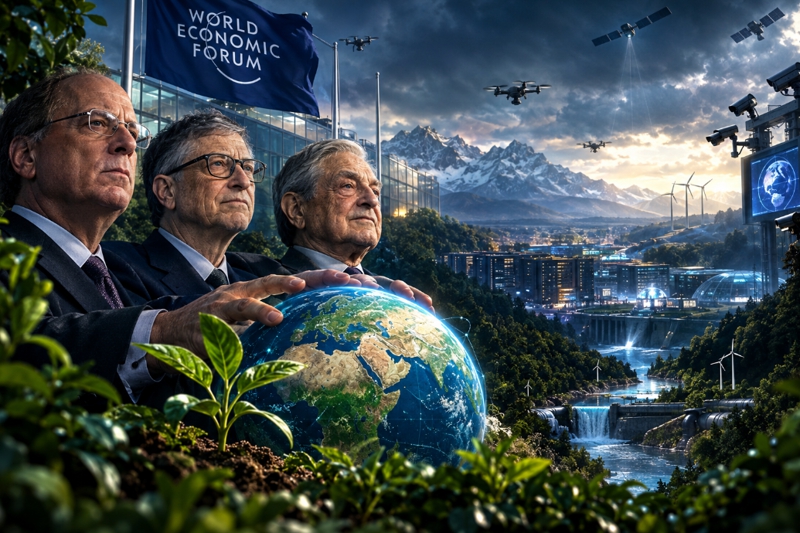
Image Source: AI generated with ChatGPT
WEF publishes blueprint to monetize everything in nature
'Bring nature onto the balance sheet, we can't do business on a dead planet': WEF 'Summer Davos' in China
'Carbon is going to be very close to a currency,' tokenizing nature is next: COP27
Who is Andre Hoffmann? WEF interim co-chair, Swiss billionaire & big pharma heir advancing Agenda 2030, stakeholder economy
G20 announces initiative to crackdown on climate change disinformation
A note on cookies
Newshunt uses essential cookies to keep you signed in and to remember your language and country, so the site works the way you expect. With your permission, we'd also like to use analytics cookies to understand how people use Newshunt and improve it over time.
Accepting only affects analytics. To learn more, view our Privacy Policy or Terms & Conditions.
(0)Comments