


The Six-Year Itch
Category: Politics
Share
Archive
Like
There was a time when Labour Day meant something in American politics. For much of the postwar era, the first Monday in September marked the unofficial beginning of the fall campaign. Summer was over, voters were returning from vacations, children were going back to school, and candidates who had spent August raising money, organizing and positioning themselves would finally turn their full attention to the electorate. Television advertising intensified. Campaign schedules filled up. Reporters returned to the trail. The political class shifted from preparing for an election to actually fighting one.
That calendar now seems almost quaint.
American politics has become a permanent campaign in which governing, campaigning and political communication increasingly blur into one another. Candidates announce earlier, advertising begins earlier, fundraising never really stops, and social media has eliminated whatever remained of the old political off-season. There is no longer a clean moment when Americans collectively turn their attention toward an election because, increasingly, the previous election never entirely ended.
Labour Day nevertheless retains some of its old symbolic importance. It is a useful dividing line: the moment when speculation begins to give way to something more concrete, when there are few enough days remaining that polling movements matter more, campaign mistakes become harder to repair, and political narratives begin to solidify.
And so, we are now roughly two months away from the 2026 American midterm elections. The campaign is entering its decisive phase, and the basic contours of the contest are becoming considerably clearer.
For Republicans, they are not particularly encouraging.
Donald Trump's approval ratings have fallen to levels even worse than those he carried into the 2018 midterms. Democrats hold a substantial lead on the generic congressional ballot. Republicans are defending a paper-thin House majority. And Senate contests that once looked like long shots - in Iowa, Alaska, Ohio and even Texas - have moved into the competitive column. The temptation is to call this 2018 all over again. That comparison is useful, but incomplete. Trump is no longer a first-term president facing his first electoral rebuke. He is a second-term president approaching the traditional curse of the sixth year: the Six-Year Itch.
Since the Civil War, parties holding the White House for six consecutive years have almost invariably suffered in the following midterm. Trump makes 2026 an unusual variation: this is only the second year of the current Republican administration, but it is his sixth cumulative year as president, his second presidential term and his final midterm. The normal first-midterm backlash and the fatigue associated with a second-term president are arriving at the same time.
The pattern is not mystical. Second terms accumulate disappointments, scandals, fatigue and broken promises. The coalition that elected the president begins to fray. Opposition voters are energized, while presidential supporters have less reason to turn out when the president is no longer on the ballot and, under the Constitution, will never be on a national ballot again.
That makes 2026 more than a rerun of 2018. It contains elements of Ronald Reagan's 1986; George W. Bush's 2006 and Trump's own 2018. Each election offers a different warning. Together, they explain why Democrats are favoured to capture the House and yet still cannot be certain of controlling the Senate.
There are exceptions to almost every electoral rule, but the sixth-year pattern is unusually persistent. The two most recent Republican presidents to reach it illustrate the range of possible outcomes.
Ronald Reagan provides the optimistic scenario for Republicans. He had won 49 states in 1984 and remained extraordinarily popular two years later. His Gallup approval rating stood at approximately 63 percent immediately before the 1986 midterms: political capital Donald Trump plainly does not possess.
That popularity cushioned the House result. Republicans lost only five seats, an exceptional performance by midterm standards. But it did not save the Senate. Republicans lost eight Senate seats and control of the chamber.
The lesson is simple: even a highly popular second-term president cannot necessarily protect his party from the Six-Year Itch. Trump enters 2026 without Reagan's cushion, while his party has far less room for error in the House.
George W. Bush provides the nightmare scenario. After winning reelection in 2004 and expanding Republican congressional majorities, his political position deteriorated rapidly. The Iraq War had become deeply unpopular, Hurricane Katrina damaged perceptions of competence, congressional scandals multiplied and Bush's approval rating fell to roughly 38 percent. The result was not a correction but a repudiation. Republicans lost 30 House seats and six Senate seats, surrendering both chambers.
The issues in 2026 are different, but the electoral structure is familiar: an unpopular second-term Republican president; widespread dissatisfaction with the direction of government; an unpopular war; an opposition benefiting more from anger at the administration than from enthusiasm for itself; and governing-party candidates forced to defend a president whose name will never again appear on a national ballot.
Trump has, of course, been here before. In 2018, his approval rating stood around 41 percent and Republicans lost 40 House seats. Democrats captured the House in an unmistakable anti-Trump wave. But Republicans gained two Senate seats. Democrats won the national House vote by a substantial margin and still emerged with fewer senators. Why? Because every House seat is contested at once, while only about one-third of Senate seats are. A House wave can wash across the country. A Senate wave can only break where the map provides a shoreline.
That makes 2018 less a template than a warning: winning the national argument does not automatically mean winning the Senate. That distinction may again define 2026.
As of today, the shape of the midterm election is becoming increasingly difficult for Republicans to ignore. Democrats hold a national advantage of roughly six to eight points, while Donald Trump's net approval rating hovers around minus 20: near the low point of his second term and considerably worse than at the comparable stage before the 2018 Democratic wave. None of this guarantees what happens in November. But the burden of proof has shifted. The question is no longer whether Republicans face a difficult political environment. It is whether the structural advantages they still possess - particularly in the Senate - are enough to withstand it. The House and Senate tell two very different versions of that story.
The House: Where History Is Most Dangerous
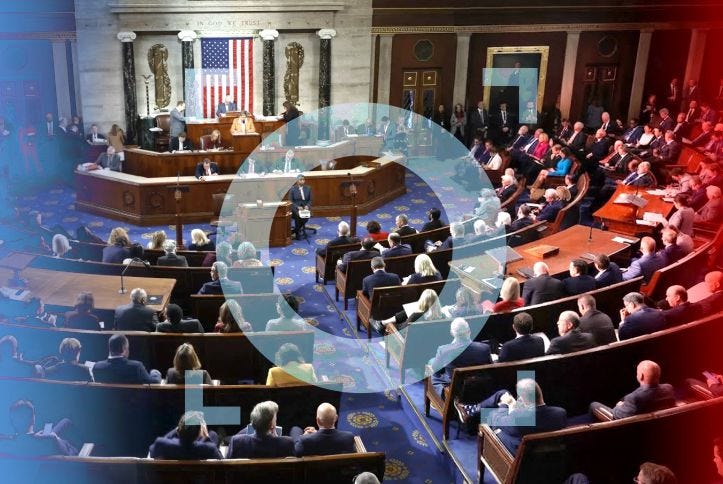
The House is where history and the current political environment point most clearly in the same direction. Republicans hold a razor-thin majority. Democrats therefore need a net gain of only three seats. That is an extraordinarily low threshold in an election taking place during the sixth year of a presidency with approval ratings deeply underwater.
Democrats do not need a repeat of the 2018 wave. They do not even need anything resembling a wave. A relatively modest national movement is enough to change control of the chamber. Republican-friendly redistricting provides some additional protection, but there are limits to what district boundaries can accomplish. Gerrymandering cannot guarantee protection if the national tide rises high enough.
More importantly, the battlefield appears to be expanding. The familiar suburban battlegrounds of Pennsylvania and New York remain important, but competitive races increasingly stretch into the Midwest and even parts of Florida and Texas. That is usually the more ominous sign for an incumbent party. When campaigns begin spending time and money defending places they once assumed were safe, the problem is no longer a handful of vulnerable districts. It is the national environment itself.
The central House question, then, is no longer whether Democrats can find the three seats they need. It is whether Republicans can keep their losses anywhere close to that number. If the national Democratic advantage remains near its current level, control of the House may be the least suspenseful part of election night.
The Senate: Where Geography Fights the Wave
The Senate is another matter entirely. Republicans hold a comfortable majority, meaning Democrats need a net gain of four seats for outright control. They must accomplish that while defending vulnerable seats of their own in Michigan and Georgia.
This is where the peculiar geography of the Senate becomes the Republican Party's greatest protection. A national Democratic wave does not automatically produce a Democratic Senate. The party must win in the particular states voting in 2026. The good news for Democrats is that the map is expanding considerably. North Carolina and Maine represent their clearest opportunities, but Ohio, Alaska, Iowa and even Texas are now competitive enough to matter.
North Carolinais probably the essential first step. Former Democratic governor Roy Cooper brings the statewide profile and crossover appeal needed to compete in a state that remains closely divided. It is difficult to construct a realistic Democratic Senate majority that does not include a North Carolina victory.
Mainepresents a different challenge. Susan Collins has repeatedly demonstrated an ability to outperform the Republican brand and survive in a Democratic-leaning state. But 2026 provides perhaps the most severe test yet of that personal political identity: a Republican senator seeking reelection in a Democratic-leaning state during an unpopular Trump presidency.
Then come the states that measure the potential size of the wave.
Ohio is perhaps the most intriguing. Sherrod Brown, defeated in 2024 after three terms in the Senate, is attempting an immediate political comeback in the special election for the seat vacated by J.D. Vance. Brown has something few Democrats still possess in an increasingly Republican state: a well-established personal brand built around organized labour, economic populism and working-class voters. His return transforms what might otherwise have been a relatively safe Republican seat into a genuine contest against appointed Senator Jon Husted.
The same dynamic, in different forms, is expanding the battlefield elsewhere. Mary Peltola gives Democrats a candidate with statewide experience and unusual crossover appeal in Alaska. Joni Ernst's retirement creates an opening in Iowa. And Texas is competitive enough that Democrats can at least contemplate a breakthrough that would have seemed implausible earlier in the cycle.
These races are therefore more than individual contests; they are measures of the depth of the backlash. North Carolina is the kind of state Democrats probably need to win to have a good night. Ohio is the next test: if Brown can overcome the state's Republican drift only two years after losing his seat, the Democratic advantage is reaching well beyond the most obvious battlegrounds. Alaska or Iowa falling would provide even stronger evidence of a national wave. And Texas turning blue would signal something altogether different: an electoral earthquake.
But consider what an exceptional Democratic night looks like. They hold Georgia and Michigan. They flip North Carolina. They defeat Collins in Maine. Sherrod Brown wins Ohio. That represents a substantial Democratic victory and still leaves them one seat short of outright Senate control. They need another breakthrough in Alaska, Iowa, Texas or somewhere equally difficult.
First, Trump's approval. A net rating near minus 20 places him closer to Bush's danger zone than Reagan's protective popularity. Any further deterioration would strengthen the wave analogy.
Second, the generic ballot. A stable Democratic lead near seven points should be sufficient for the House. If it expands, the Senate's outer battlegrounds become increasingly credible.
Third, North Carolina. A durable Cooper lead would show that national dissatisfaction is translating into an actual Republican Senate loss.
Fourth, Michigan. If El-Sayed holds the seat, Democrats preserve the foundation of their Senate strategy. If he falters, every pickup becomes less valuable.
Fifth, Iowa and Texas. Their move to Toss-Up status is the clearest evidence that the map has expanded. If Democrats are still tied or leading there in late October, Republicans are no longer containing the Six-Year Itch.
There is a Canadian lesson in all of this, and we are already living through it.
In 2025, Canadians elected Mark Carney as prime minister in an election in which his perceived ability to manage Donald Trump was arguably his main political qualification. Whatever one thinks of Carney's broader credentials, Trump transformed the choice Canadians thought they were making. Experience, temperament and economic credibility were filtered through a remarkably immediate question:Who do you trust to deal with the man in the White House?
There was obvious logic to that calculation. Trump was threatening tariffs, questioning the bilateral relationship and even challenging Canadian sovereignty. But there was also a problem with the timeline. Trump leaves office in January 2029. Carney's mandate extends beyond that date. Canadians therefore chose a government that will govern for at least part of its mandate in a post-Trump world, largely on the basis of its perceived ability to deal with Trump.
Now the same dynamic is appearing elsewhere.
In Quebec, Trump again intrudes on an election that should fundamentally be about what Quebecers want their province to become. The parties offer profoundly different choices on sovereignty, the economy, immigration, public services, language and Quebec's relationship with the rest of Canada. Yet Trump inevitably becomes part of the calculation. And the temporal mismatch is even greater: a majority government elected in October 2026 could remain in office until 2031: roughly two years after Trump leaves the White House.
Alberta provides another example. The debate over independence is supposed to be about the long-term viability of Alberta as a sovereign country: its economy, currency, pensions, borders, trade, Indigenous treaties, debt, defence and relationship with the rest of Canada. Yet our research shows Trump increasingly entering that calculation as well. A temporary American president is becoming a factor in how Albertans think about a potentially permanent constitutional decision.
Put those three cases together and a pattern emerges. Canadians are increasingly allowing a president whose constitutional expiry date is already fixed to shape decisions whose consequences extend years beyond his departure.
This is where the economic concept ofdiscounting the futurebecomes useful. A high discount rate means that we assign enormous importance to what is immediately in front of us while progressively diminishing the importance of consequences further into the future. Trump encourages precisely this kind of political discounting because he is immediate, disruptive and impossible to ignore. The threat is today; the consequences of choosing the wrong government - or making the wrong constitutional decision - may not become apparent for years.
The real Canadian challenge, then, is to get the discount rate right.
Politics inevitably privileges the present. Voters worry about today's mortgage payment, today's hospital wait, today's trade dispute and today's threat. Governments operate under the same pressures. The immediate is visible and politically urgent; the future is uncertain and therefore easily discounted.
Donald Trump magnifies that tendency enormously. He is impossible to ignore precisely because his actions can have immediate consequences. A tariff announced tomorrow matters tomorrow. A threat against Canadian sovereignty demands an answer today.
But political decisions must be evaluated across a longer time horizon.
Trump's presidency ends in January 2029 and can be severely curtailed in about two months. Canada's economic challenges will not. Our productivity problem will not. Health care, immigration, energy, federalism and national unity will not. Nor will the consequences of decisions Quebecers make about their provincial government or Albertans make about their place within Canada.
The mistake would therefore be to discount those future consequences so heavily that the ability to manage one temporary American president overwhelms every other criterion by which governments and constitutional choices should be judged.
Trump matters. But time matters too.
The defining political question of 2026 may appear to be who can best deal with Donald Trump. The more consequential question is what Canada will look like when nobody has to deal with him anymore.
A note on cookies
Newshunt uses essential cookies to keep you signed in and to remember your language and country, so the site works the way you expect. With your permission, we'd also like to use analytics cookies to understand how people use Newshunt and improve it over time.
Accepting only affects analytics. To learn more, view our Privacy Policy or Terms & Conditions.
(0)Comments