


MY RECURRENT RASH(BROOKE)
Category: Politics
Share
Archive
Like
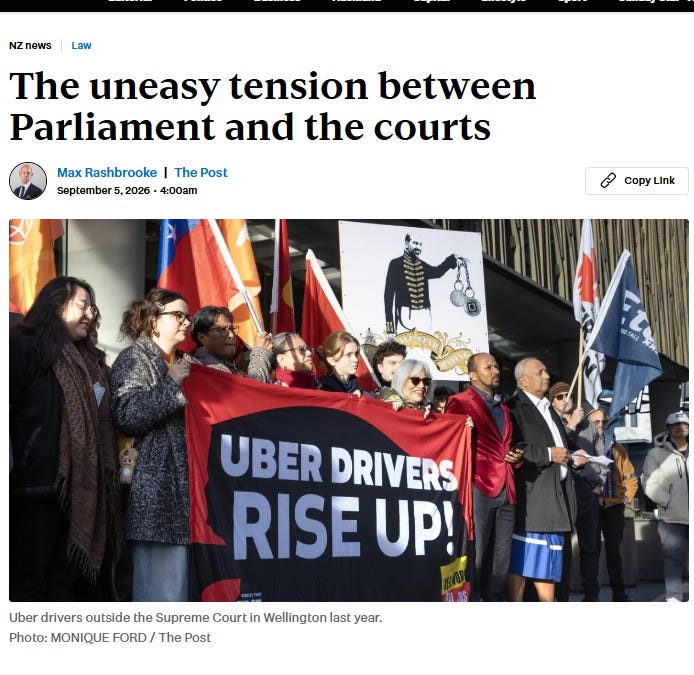
My muse Max Rashbrooke's latest opinion piece inStuff'sTHE POST(5 September) is titled,The uneasy tension between Parliament and the courts. I've lovingly covered Max for a while now:
Max states towards the end of his latest piece:
John's Substack is a reader-supported publication. To receive new posts and support my work, consider becoming a free or paid subscriber.
'But even if – as I personally think – Parliament should continue to be supreme, the ultimate arbiter of what is legal, it remains an imperfect institution.'
Belief that Parliament should be New Zealand's supreme law-making body parallels belief in free speech. If you hear, 'I believe in free speech except…', you're not getting that from someone who genuinely believes in free speech. It's the same for Parliamentary supremacy, and Rashbrooke is no Parliamentary supremacist. His 'Parliament should continue to be supreme' is a deflection that founders on the fact that he dedicates the rest of his piece to trying to undermine the worth and legitimacy of Parliamentary supremacy.
Rashbrooke starts by focusing on a 2016 headline in Britain'sDaily Mail. The heading wasENEMIES OF THE PEOPLE.
The alleged enemies were three British Supreme Court judges who decided that Britain could not leave the European Union without Britain's Parliament voting to approve the exit. At first blush, the judges' decision was an assertion of Parliamentary supremacy. But it wasn't. It was an attack on democracy of the people, and Parliamentary supremacy is an essential ingredient of a properly functioning democracy.
The anti-Brexit judges' assertion that Britain couldn't leave the EU without Parliamentary approval was a judicial expression of their personal hope the British Parliament would override the Brexit referendum in which a majority of Brits had voted to leave the EU. Fortunately, Parliament ultimately endorsed Brexit and the rest – as they say – is history.
Max asserts:
'Such ugliness [the Daily Mail headline] is part of a wider conservative push to paint judges as a left-wing elite imposing liberal [i.e., illiberal Woke] ideology. ACT leader David Seymour joined this unpleasant fray last week with a promise to reign in 'activist judges'.'
Mad, Maddening Max then vents against his perceived (paranoid delusional or disingenuous) 'risk' of that retrospective legislation will mean that, 'No-one can do anything without worrying the Parliament will retrospectively render it illegitimate'. As if ordinary New Zealanders are being paralyzed by such worry!
In brave desperation, Max tries to characterize departing ACT Minister Brooke van Velden's tweaks to pay-equity legislation – which will save New Zealand taxpayers almost $13 billion dollars that we simply couldn't have afforded – as 'essentially retrospective'.
While retrospective lawmaking can be undesirable, it's no argument whatsoever against Parliamentary supremacy.
Senior Researcher Rashbrooke then fulminates that 'governments shouldn't legislate over the top of already launched court cases'. Max invokes Brooke van V's legislation deeming Uber drivers to be contractors to, and not employees of, Uber – a status that lots of Uber drivers actually wanted.
What Max is saying, in no uncertain terms, is that it's illegitimate, in any circumstances, for Parliament to overrule Court decisions. That notion is not Parliamentary supremacy. It would be constitutional supremacy of the unelected Judiciary .
As sure as sunshine follows rain, Max then denounces the fact that 'the Government legislated over the top of activist Mike Smith's lawsuit against climate mega-polluters like Fonterra, a case the courts have said should be heard.' I've previously covered Vandal Smith's absurd Court actions, actions that even the Supreme Court said couldn't realistically succeed even with the Supreme Court's endorsed new cause of action - in Rashbrooke's words, 'a novel 'tort' – a harm, in essence – of climate pollution'.
Max finds an ideological ally in Victoria law professor Dean Knight, whom Max quotes as claiming that Parliament and the Courts, 'sit in dialogue, and in tension, with each other'. The tension in the 'dialogue' comes from judges sticking their fingers in their ears, shouting 'La, La, La, La, La' and ignoring express, clear wording of Parliament's enacted legislation.
Max then goes completely off the insular Vic Uni reservation. Deferring to 'One retired High Court judge, speaking anonymously' who 'told me the law could become 'stultified'', Max insinuates that it would be open to the Courts to judicially update the Adoption Act 1955 because unnamed 'Officials' have claimed that legislation 'no longer meets the needs of our society' – whatever that's supposed to mean. Ye gads.
In fact, Parliament is more than capable of moving with the times. Take, for example, Parliament's 2013 gay marriage legislation, which Helen Clark and hubby Peter Davis were naturally ecstatic about.
Regarding the Ellis case – in which New Zealand's Supreme Court invented a new Maori custom (tikanga) in order the quash the criminal convictions of Pakeha Peter Ellis after Ellis' death – Max is again amorous towards his Knight in Shiny Arse Armor:
'Knight views the Ellis decision as merely the courts 'catch[ing] up' with the wider adoption of tikanga by Kiwis – and indeed Parliament.'
…As if New Zealanders are all running around feverishly adopting tribal Maori customary behaviors and rituals. Pull the other one.
Then comes my favourite:
'Indeed such claims [that 'the judiciary is running amok'] represent an attempt to import UK and US culture-war arguments into this country.'
Here's a reality check for you Max. Conservatives such as myself haven't imported culture wars from overseas. We're just trying to hold the line against you and your burgeoning Western globalist crowd of antidemocratic postmodernists. We're battling to defend New Zealand's traditional freedoms and democracy.
Max then froths at 'would-be strongmen' such as…Shane Jones?! (Max, Jones aint no would-be authoritarian 'strongman'. He's simply a patriot committed to New Zealand's democratic traditions.)
Max ends by regurgitating a rotten old chestnut; that the Waitangi Tribunal's powers are 'merely advisory', so there's nothing to see or worry about. But of course New Zealand's Courts are constantly transforming the Waitangi Tribunal's unaccountable utterances into binding common law Treaty Principles, tikanga and other such twaddle.
Under its coalition agreement with New Zealand First, the Nation Party committed to:
'Amend the Waitangi Tribunal legislation to refocus the scope, purpose, and nature of its inquiries back to the original intent of that legislation.'
In May 2025, the Government belatedly established an advisory group to implement that commitment. The group delivered its report to the Government in late 2025 but Cabinet has still not considered it. It's another National Party renege, one more good reason why it appears that less than 30% of New Zealanders now support The Do-Nothing Nats.
John's Substack is a reader-supported publication. To receive new posts and support my work, consider becoming a free or paid subscriber.
A note on cookies
Newshunt uses essential cookies to keep you signed in and to remember your language and country, so the site works the way you expect. With your permission, we'd also like to use analytics cookies to understand how people use Newshunt and improve it over time.
Accepting only affects analytics. To learn more, view our Privacy Policy or Terms & Conditions.
(0)Comments