


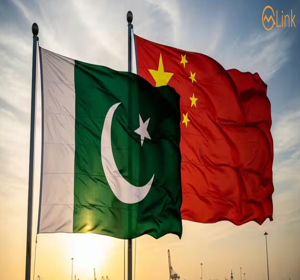
Pakistan, China sign over $22bn in business deals over two years
Category: Business
Share
Archive
Like
MG News
September 08, 2026 (MLN): Pakistan and China academic and economic engagement continues to deepen, which marks 75 years of diplomatic relations, with officials citing more than $22 billion in B2B agreements signed over the past two years and accelerating cooperation across technology, energy and education sectors.
An international academic symposium commemorating the 75th anniversary of the establishment of diplomatic relations between China and Pakistan was held at Peking University from September 4-7, 2026, bringing together around 100 scholars, think-tank researchers, diplomats and business representatives from the two countries, APP reported.
Addressing the symposium, Pakistan's Ambassador to China, Khalil Hashmi, reviewed the momentum behind the accelerating B2B engagement, noting that agreements worth more than $22 billion had been signed between Chinese and Pakistani businesses over the past two years, with nearly 30% of that figure, or about $7 billion, linked to enterprise-relocation efforts.
The ambassador said four new centres for Pakistan studies had been opened over the past two years, in Shenzhen, Shandong, Hangzhou and Shenyang, with a sharper focus on technology-related fields such as chemical technology and artificial intelligence compared to traditional Pakistan-studies programmes.
Mao Keji, Associate Research Fellow at the International Cooperation Centre of China's National Development and Reform Commission, said the green transition is no longer just a tool to cut emissions but has become a safety asset.
Citing an empirical analysis of monthly data from 12 South and Southeast Asian economies between 2025 and 2026, he noted that a 10-percentage-point increase in a country's dependence on imported oil and gas was associated with a roughly 3.6% rise in green-energy imports and a 7.9% increase in electric-vehicle imports following a crisis.
He added that Pakistan's cumulative solar panel imports had crossed 55,700 MW (55.7 GW) by the end of May 2026, with the State Bank of Pakistan estimating that a shift from fossil-fuel generation to solar power could eventually cut the country's annual energy-import bill by between $5.2 billion and $7.8 billion.
The strategic value of the green transition extends beyond decarbonisation, he argued, as it can shorten the transmission chain through which geopolitical shocks reach domestic energy markets and inflation, effectively turning renewable energy into a form of risk management.
He further noted that solar installations, despite requiring large upfront capital, can replace years of recurring dollar-denominated fuel purchases, with financing structured in currencies including the renminbi potentially easing external financing constraints.
Liu Yonggang, Assistant CEO, Chief Compliance Officer and Chief Legal Advisor at China Three Gorges South Asia Investment Limited (CSAIL), said the Karot Hydropower Project is meeting the electricity needs of around five million local people, having generated more than 12 billion kWh cumulatively, saving roughly 1.4 million tonnes of standard coal annually, and cutting carbon-dioxide emissions by about 3.5 million tonnes.
He noted the project would be transferred to Pakistan free of charge as a permanent state asset upon conclusion of its concession period, adding that the company's wind-power projects in Pakistan had reached a combined installed capacity of 150 MW with cumulative generation of 3.2 billion kWh, complementing hydropower in a more diversified clean-energy mix.
Zhang Shulan, Director of the Center for South Asian Studies at Shandong University, highlighted the increasingly specialised nature of subnational cooperation, citing Xinjiang's expertise in cotton production and desertification control, Shaanxi's role in talent development, and Hubei's strengths in seeds and agricultural technology.
On the Pakistani side, she noted Sindh's exploration of contract farming and export supply chains to China, including chillies to Sichuan and mangoes; Punjab's introduction of new technologies such as hybrid rice, maize and cauliflower through demonstration farms; Gilgit-Baltistan's potential in border markets; and Balochistan's opportunities in higher-value agricultural chains including cold storage and logistics.
Zhou Yuan and Xiao Xueqin of Beijing Foreign Studies University said CPEC is evolving from an infrastructure project into a platform for human development, pointing to female empowerment initiatives including expanded school-assistance programmes in Balochistan that have opened pathways to further study for around 550 girls.
They noted that girls accounted for nearly 44% of the first intake at the Gwadar Vocational and Technical Institute, with courses spanning artificial intelligence and e-commerce, while a planned Ban Mo College is expected to deepen school-enterprise cooperation and train digital talent.
They also cited the She Power initiative, which aims to distribute hygiene kits to 70,000 girls alongside teacher training in personal hygiene. Bilateral cooperation, Xiao said, is expected to expand from economic empowerment to comprehensive social empowerment.
Copyright Mettis Link News
A note on cookies
Newshunt uses essential cookies to keep you signed in and to remember your language and country, so the site works the way you expect. With your permission, we'd also like to use analytics cookies to understand how people use Newshunt and improve it over time.
Accepting only affects analytics. To learn more, view our Privacy Policy or Terms & Conditions.
(0)Comments