


City Ground expansion ‘recommended for approval' ahead of 16 September planning meeting
Category: Sports
Share
Archive
Like
Rushcliffe Borough Council has recommended approval of Nottingham Forest's City Ground redevelopment plans ahead of a confirmed planning committee meeting on Wednesday 16 September.
Reports released today recommend that councillors approve two linked applications which could eventually increase the stadium's capacity to 52,500, subject to legal agreements and extensive conditions covering transport, crowd safety, construction, flood protection and the impact on neighbouring homes.
The recommendations include 58 conditions for the Peter Taylor Stand and Trent End redevelopment and 48 for the separate Brian Clough Stand application.
However, officers make clear that their support depends on securing a solution to the additional pressure on river crossings. The report says the application would warrant refusal without the required safeguards.
The recommendations are not planning permission. Councillors will consider the proposals at the meeting, and approval would remain subject to completion of the legal agreements.
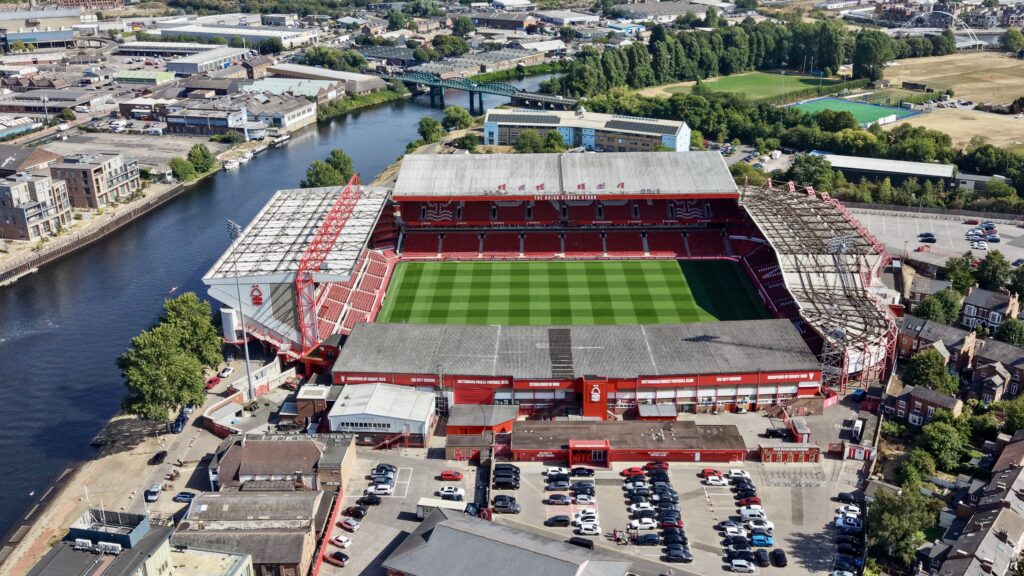
The full application would redevelop the Peter Taylor Stand and Trent End, increasing capacity from the current certified figure of 31,212 to 45,000, alongside new public spaces and associated works.
The separate outline application seeks approval for the scale of a redeveloped Brian Clough Stand, adding up to another 7,500 seats. Its access, appearance, layout and landscaping would require subsequent approval.
The meeting follows the council's confirmation, reported on Monday, that the proposals would be considered at a dedicated session rather than its regular planning meeting on 10 September.
A central issue remains how thousands of additional supporters would cross the River Trent safely.
Forest's submitted transport proposals include permanently removing two traffic lanes from Trent Bridge to provide more pedestrian space. Neither Nottinghamshire County Council nor Nottingham City Council, as the highway authorities, supports that approach on the evidence submitted.
Officers say the transport modelling has not been sufficiently validated. They also report that the proposed pedestrian provision falls below the requirement identified by the club's consultants and relies on a queuing arrangement previously trialled at the ground and found unworkable.
The report says permanent lane reductions would affect bridge users throughout the year, including bus services, to address demand arising on around 39 event days annually.
Instead, the proposed Section 106 agreement would require council approval of an initial river-crossing and crowd-flow scheme before development could begin. A comprehensive scheme would have to be delivered before the stadium could operate above the capacity threshold specified in the agreement.
That threshold is 31,712 people, the current certified capacity plus a 500-person margin intended to accommodate minor seating changes during the works.
Officers believe a deliverable alternative can be developed, but make clear that the recommendation depends on securing it. The reports do not amount to approval of a final design for a new river crossing.
The full application also includes £4,171,297 in agreed financial contributions, excluding certain monitoring fees and additional sums still to be settled.
This includes £1.75 million towards bus services, £990,000 for parking restrictions, £424,900 for walking and cycling and £386,397 for park-and-ride facilities. The Wire previously reported the proposed £4.17 million transport package in August.
Further transport contributions associated with expansion beyond 45,000 would need to be agreed for the Brian Clough Stand scheme.
Proposed conditions would require approved bus and shuttle-service arrangements before the full scheme could operate above the defined existing-capacity threshold. These include services to and from Queens Drive and Racecourse park-and-ride sites.
A matchday parking strategy would have to identify the sites being relied upon, demonstrate sufficient availability at event times and set out replacement arrangements if any parking site became unavailable. It would be reviewed annually.
The conditions also require at least 140 cycle-parking spaces. Vehicle access from Colwick Road into the eastern car park would be restricted to emergency use, excluding routine deliveries, servicing and spectator traffic.
Officers acknowledge that the redevelopment would cause harm to some neighbouring properties.
The report identifies an overbearing impact and loss of outlook affecting homes on the northern side of Rosebery Avenue. Officers give this limited weight in their assessment because the affected properties are owned by the club.
The noise assessment predicts matchday increases of up to nine decibels at 20 Colwick Road and 2 Orston Road East. Officers recognise this as a significant adverse effect, but conclude it would not be unacceptable given the frequency and duration of events and the stadium's established use.
Conditions would require privacy screening for balconies overlooking gardens on Rosebery Avenue and Colwick Road, approval of boundary treatments and controls on external lighting.
A noise-management plan would cover the public-address system and amplified music. No more than 12 non-football licensable events would be permitted in a calendar year.
Construction would require an approved management plan covering working hours, vehicle routes, dust, noise and vibration, together with a named contact and complaints procedure for residents.
It would also need to address protection and finishing works where demolition leaves the adjoining half of a semi-detached property exposed.
Accessibility remains another concern. Officers note that on-site accessible parking would remain at 41 spaces despite the larger stadium.
Conditions would require an inclusive-access strategy prepared in consultation with Nottingham Forest Disability Association, alongside a separate strategy addressing accessible parking, drop-off arrangements and routes into the ground.
Flood safeguards include approved drainage arrangements, compensatory floodplain storage, protection of access for flood-defence maintenance and safe refuge areas within the stands.
The legal agreement would also secure replacement rowing facilities affected by the redevelopment. Officers acknowledge the loss of the Britannia Boathouse as a heritage harm, with a condition requiring a detailed historic record before demolition.
In recommending approval, officers give substantial weight to economic benefits, improved stadium facilities and the creation of new public spaces around the ground.
They conclude that those benefits outweigh the identified harm, provided the river-crossing and crowd-management obligations are secured.
Councillors will consider both applications on 16 September.
A note on cookies
Newshunt uses essential cookies to keep you signed in and to remember your language and country, so the site works the way you expect. With your permission, we'd also like to use analytics cookies to understand how people use Newshunt and improve it over time.
Accepting only affects analytics. To learn more, view our Privacy Policy or Terms & Conditions.
(0)Comments