


Financials Surge: XLF Breaks Higher from Blue Box Zone
Category: Financial
Share
Archive
Like
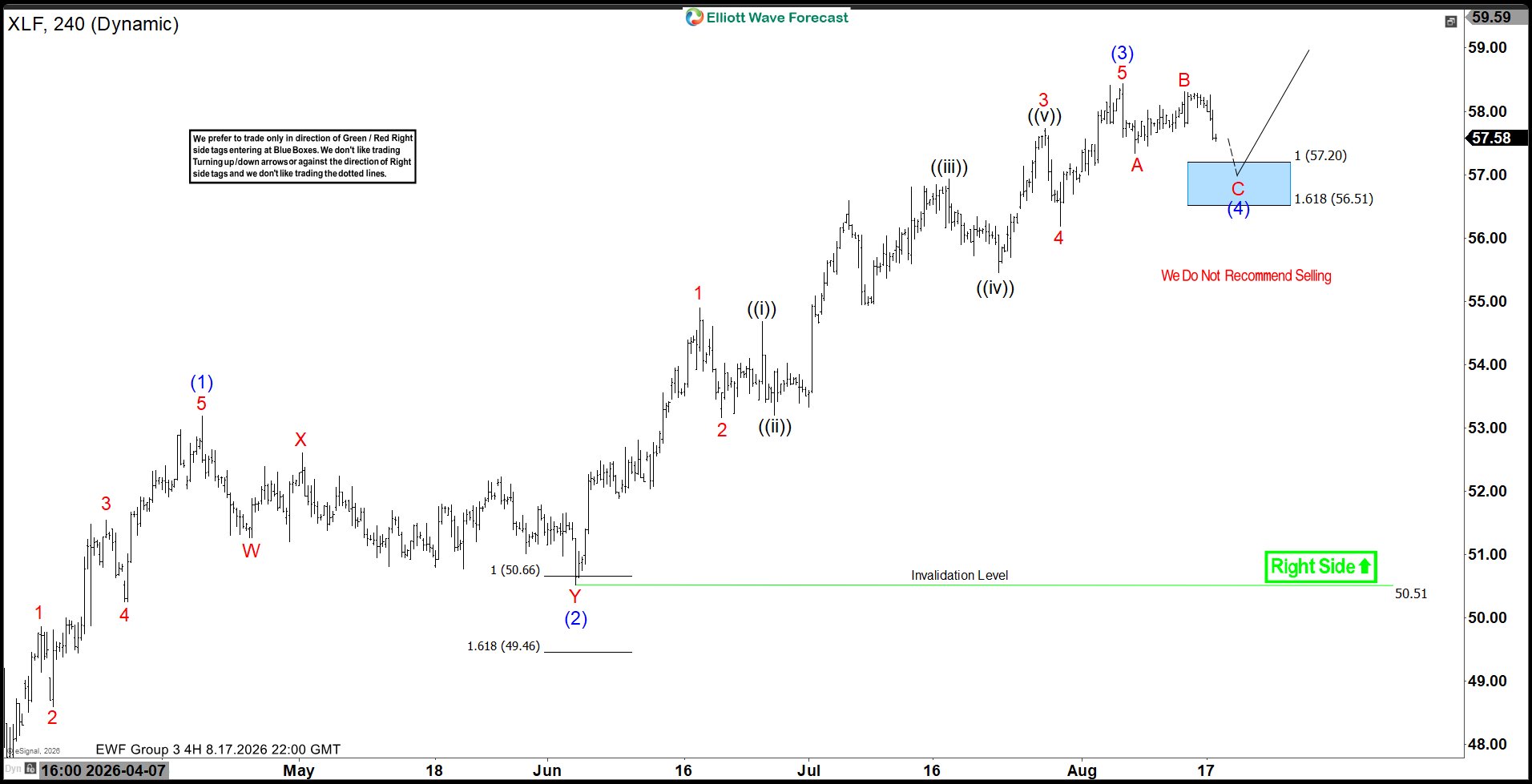
XLF (State Street Financial Select Sector SPDR ETF) has shown a bullish impulse since the June 3, 2026 low. The 4‑hour Elliott Wave structure favors further upside as the ETF continues to make higher highs and higher lows. Our guidance for members was to avoid selling and instead buy corrective dips in 3, 7, or 11 swing sequences at clearly defined blue box areas. Ticker: XLF
XLF Name: State Street Financial Select Sector SPDR ETF
State Street Financial Select Sector SPDR ETF Timeframe: 4‑hour Elliott Wave analysis
4‑hour Elliott Wave analysis Trade style: Tactical buy‑the‑dip approach while the impulse structure remains intact
The advance from the June 3 low is unfolding as an impulse. Key structure points: Wave (3) completed at $58.43 .
completed at . Wave (4) corrected as a zigzag: Wave A ended at $57.34 . Wave B bounced to $58.31 . Wave C reached the blue box at $57.20–$56.51 (equal‑legs zone).
corrected as a zigzag:
The blue box offered a low‑risk long entry where buyers were expected to step in for at least a three‑wave bounce and potentially the next impulsive leg higher. After the blue‑box reaction, XLF produced a clean rally that allowed members to convert positions to risk‑free once protective stops were in place.
once protective stops were in place. A break above the prior $58.43 high confirmed the next leg higher.
high confirmed the next leg higher. Initial upside targets are $58.78–$59.38 before a likely profit‑taking pullback that may unfold in 3 or 7 swings. Entry: Buy corrective dips into the blue box using 3, 7, or 11 swing sequences.
Buy corrective dips into the blue box using 3, 7, or 11 swing sequences. Stops: Place stop‑losses below the blue box to define invalidation and enable risk‑free management once price confirms.
Place stop‑losses below the blue box to define invalidation and enable risk‑free management once price confirms. Targets: Scale out into the $58.78–$59.38 minimum extension zone.
Scale out into the minimum extension zone. Timeframe: Favor short to medium tactical holds; avoid passive long exposure without active risk controls.
Favor short to medium tactical holds; avoid passive long exposure without active risk controls. Position sizing: Keep size conservative relative to unleveraged ETFs and adjust for market volatility.
The blue‑box framework blends Elliott Wave structure with measured risk zones, allowing traders to: Enter with defined risk and clear invalidation levels.
and clear invalidation levels. Convert positions to risk‑free quickly after confirmation.
quickly after confirmation. Capture high‑probability moves while limiting downside exposure through disciplined stops and scaling.
Maintaining discipline in risk and money management, along with a working knowledge of Elliott Wave and cycle relationships, is essential to execute this plan consistently.
Source: https://elliottwave-forecast.com/bluebox-wins/financials-surge-xlf-breaks-higher-from-blue-box-zone/
A note on cookies
Newshunt uses essential cookies to keep you signed in and to remember your language and country, so the site works the way you expect. With your permission, we'd also like to use analytics cookies to understand how people use Newshunt and improve it over time.
Accepting only affects analytics. To learn more, view our Privacy Policy or Terms & Conditions.
(0)Comments