


Fuel expenses jump 39% to Rs22b
Category: Financial
Share
Archive
Like
Govt spent Rs6b more than budgeted on fuel in FY25, car monetisation policy violated
Photo: AFP
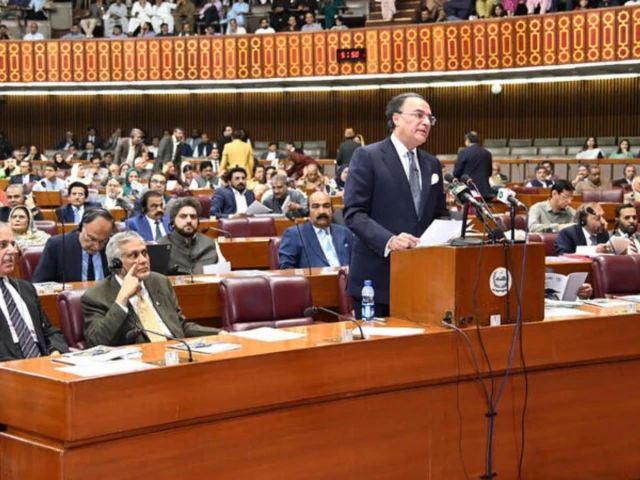
Despite enforcing a car monetisation policy that gives cash for transport to top bureaucrats, the federal government's annual budget expenditure on fuel jumped to nearly Rs22 billion – an increase of 39% – even before the Middle East war began, according to details submitted by Finance Minister Muhammad Aurangzeb in the National Assembly this week.
The government spent Rs21.8 billion on fuel in fiscal year 2024-25, an increase of 39% or Rs6.1 billion.
The government did not disclose fuel expenses for the just-ended fiscal year 2025-26, in which war broke out and caused an unusual surge in prices in the local and global markets.
Member of National Assembly (MNA) Syed Rafiullah had sought details of estimated and annual expenditure on fuel by all government ministries, divisions, attached departments and autonomous bodies during the last five years. The government provided information related to costs incurred from the federal budget but did not provide FY26 figures.
Many federal ministers, ministers of state and federal secretaries are using vehicles above their entitlements. The majority of ministers now prefer SUVs, while federal secretaries favour 1800 cc brand new cars.
The government introduced the car monetisation policy for grade 20 to 22 bureaucrats 15 years ago. It later allowed them to use official cars only for office work. However, there is visible violation of this policy, with official cars seen dropping and picking children of bureaucrats from schools, in markets and on motorways.
Aurangzeb informed that from FY21 to FY25, a total Rs69 billion was spent on fuel – Rs16 billion during the PTI tenure and the remaining mostly by the Shehbaz Sharif government, with a caretaker period from August to February 2022-23.
During FY25, the PML-N-led coalition government allocated Rs16 billion for fuel but spent Rs21.8 billion, Rs6 billion more than the original allocation. In FY23, the original fuel cost budget was Rs9 billion but the coalition government spent Rs15.7 billion, an increase of 73%.
Pakistan Peoples Party (PPP) MNA Mirza Ikhtiar Baig also raised questions about savings from austerity in the last fiscal year, particularly on account of fuel. Aurangzeb informed that saving on petrol and diesel was Rs2.1 billion during FY26.
The finance minister further informed the lower house that a transport monetisation policy was introduced in December 2011, replacing the provision of official staff cars for BS-20, BS-21 and BS-22 officers with a fixed monthly cash allowance. The objective was to cut government expenditure on vehicle procurement, maintenance, petrol, oil and lubricants (POL), and drivers, while reducing misuse and bringing transparency.
He said federal secretaries were made responsible for implementing the policy, holding them responsible for obtaining certificates from each entitled officer. The secretaries must also certify that officers under them are not using any project vehicle or operational vehicle in their ex-officio capacity. Annual audits are regularly conducted by the Auditor General of Pakistan.
However, Aurangzeb stated in writing that "no audit has been carried out specifically on monetisation of transport policy of the federal government".
He said the policy was reviewed by the Institutional Reforms Cell headed by Dr Ishrat Hussain, the-then Advisor to the Prime Minister on institutional Reforms & Austerity in 2019. With cabinet approval, two more paragraphs were inserted to ensure transparency and check misuse of official vehicles. No other corrective measures have been issued by the Cabinet Division.
Ironically, the Cabinet Division issues vehicles to federal ministers beyond their entitlements.
While the government spends heavily on fuel, it also charges high taxes on it from consumers. Petroleum Minister Ali Pervaiz Malik informed the National Assembly on Friday that the levy rate on diesel was again raised to Rs80 per litre from August 20.
Malik stated that the petroleum levy rate, reduced during exceptional international market volatility to cushion consumers, has been restored in phases in line with the approved budgetary target.
He said the federal budget 2026-27 provides a target of Rs1.68 trillion based on an average levy rate of Rs80 per litre on petrol and diesel. He admitted that no separate assessment of the impact on specific consumer groups has been undertaken by the Petroleum Division, as petroleum levy targets form part of the approved federal budget and are committed under associated fiscal commitments with international financing institutions.
A note on cookies
Newshunt uses essential cookies to keep you signed in and to remember your language and country, so the site works the way you expect. With your permission, we'd also like to use analytics cookies to understand how people use Newshunt and improve it over time.
Accepting only affects analytics. To learn more, view our Privacy Policy or Terms & Conditions.
(0)Comments