


Scientists Recruit Narwhals to Understand How Atlantic Waters Are Speeding Up Arctic Ice Melt
Category: SciTech
Share
Archive
Like
September 8, 2026
Humans are virtually everywhere on the planet, but there are still areas that only other animals can reach.
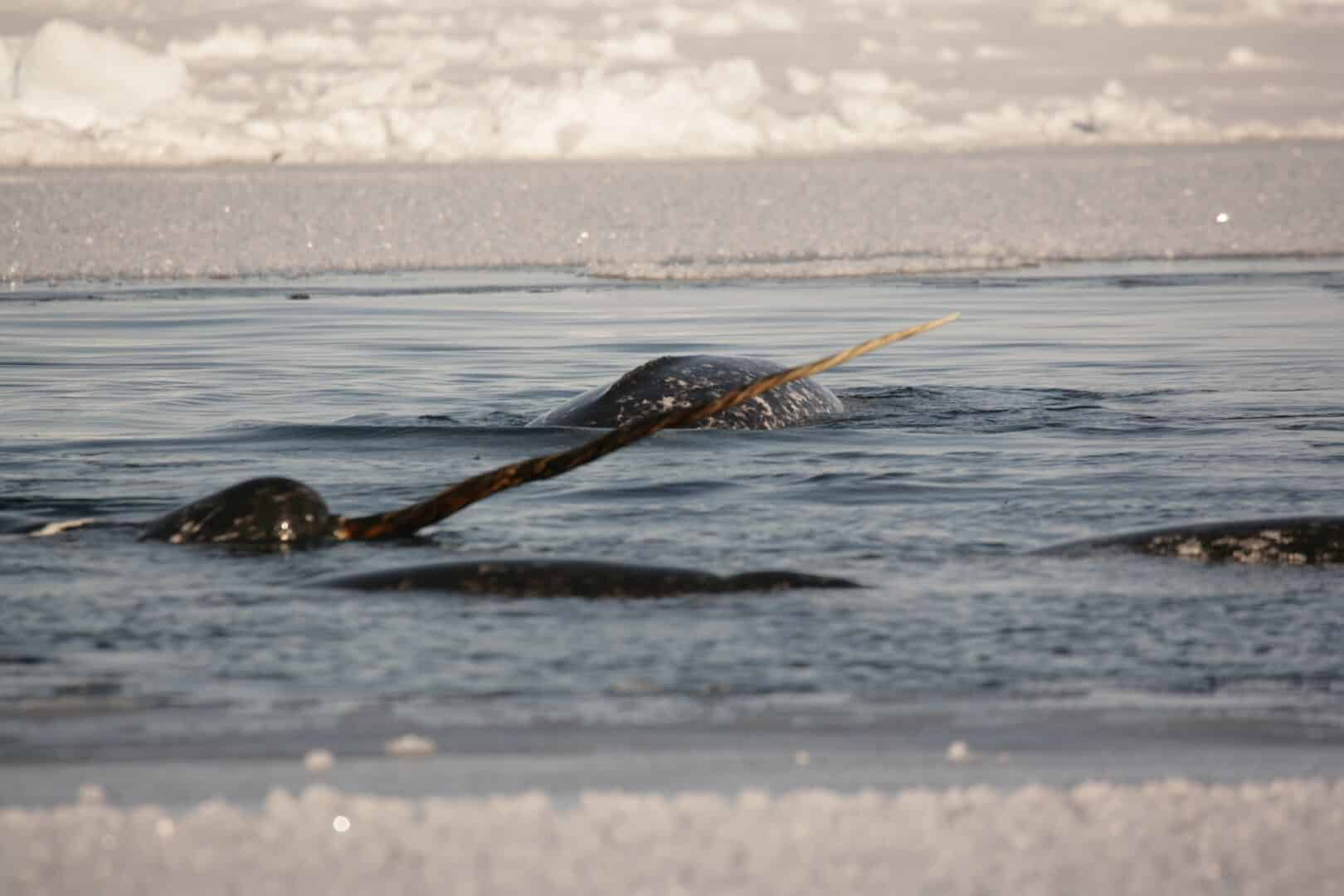
It was this realization that led a group of Danish scientists to turn to the help of narwhals ( Monodon monoceros ) to study the ice melt in the eastern region of Greenland, more specifically in the Scoresby Sound fjord system, about which few data had been collected until then due to the difficulty of access by boat.
Thus, the researchers equipped six narwhals in the area with sensors, which, during the animals' natural movements, gathered data between 2017 and 2019 on how deep they dived, as well as on the water's temperature and salinity. With the data collected by the narwhals, the scientists say they will be able to better understand the environmental changes taking place in that region, characterized by a mix of colder Arctic waters and warmer, saltier waters from the Atlantic Ocean. Scientists place sensors on one of the six narwhals in the Scoresby Sound fjord system. Photo: Carsten Egevang.
The team combined the narwhal measurements with historical oceanographic data, which allowed them to create a model showing the relationships between temperature, salinity, and depth over time.
In an article published in the journal Science Advances, the data point to an eastern Greenland 'Atlantification,' in which 'the layer consisting of Atlantic water has become thicker, while the upper layer of polar water has become thinner,' as explained by Susanne Ditlevsen, of the University of Copenhagen and coauthor of the study.
The narwhals allowed the team to realize that the warmer Atlantic water reaches several hundred kilometres inland from the coast, through the fjords, arriving at the glacier basins.
'This water is the one helping it melt the glaciers,' says Mads Peter Heide-Jørgensen, from the Greenland Institute of Natural Resources and the first author of the article. 'We show how warm water can contribute to accelerate the rate at which glaciers lose ice,' he adds.
Although this work focuses on eastern Greenland, the team believes that the results have implications that go well beyond the study area, potentially helping to improve how we anticipate what may lie ahead in a planet that is growing increasingly warmer.
'In the large climate models used to project future climate changes, glacier melt plays a significant role,' notes Ditlevsen. 'It is, therefore, essential that we deepen our understanding of this, especially because Greenland contains such a vast amount of ice,' she adds.
A note on cookies
Newshunt uses essential cookies to keep you signed in and to remember your language and country, so the site works the way you expect. With your permission, we'd also like to use analytics cookies to understand how people use Newshunt and improve it over time.
Accepting only affects analytics. To learn more, view our Privacy Policy or Terms & Conditions.
(0)Comments