


Kazakhstan Unveils Massive Financial Push to Revolutionize National Tourism Sector
Category: Tourism
Share
Archive
Like
Kazakhstan Unveils Massive Financial Push to Revolutionize National Tourism Sector
Written By:
Arpita Bhowmick
I'm from Jamshedpur, Jharkhand. Raised in Tatanagar, I carry the balanced spirit of the Steel City and greenery of the city with me- resilient, gritty,grounded, and committed to excellence yet calm and composed in times of tenacity. I value integrity, teamwork, and delivering results with honesty. Sacred Heart Convent School was the place where I built my foundation of discipline and curiosity and completed schooling. Then moved to Bhawanipur Education Society College, Kolkata, there I broadened my perspective and developed strong academic roots and also got first big exposure to a metro city & diverse cultural heritage. Currently I'm a student of ICFAI Business School, Mumbai , where I'm evolving my business acumen and leadership skills and working for your company Travel and tour world as a freelancer. I love to watch movies and travel, through them I collect stories, not just memories. They shape my personality by making me curious, creative, adaptive and more understanding of people. I'm always eager to learn, explore and contribute to organizations that prioritize people, purpose, and performance and keep learning and growing. Arpita Bhowmick
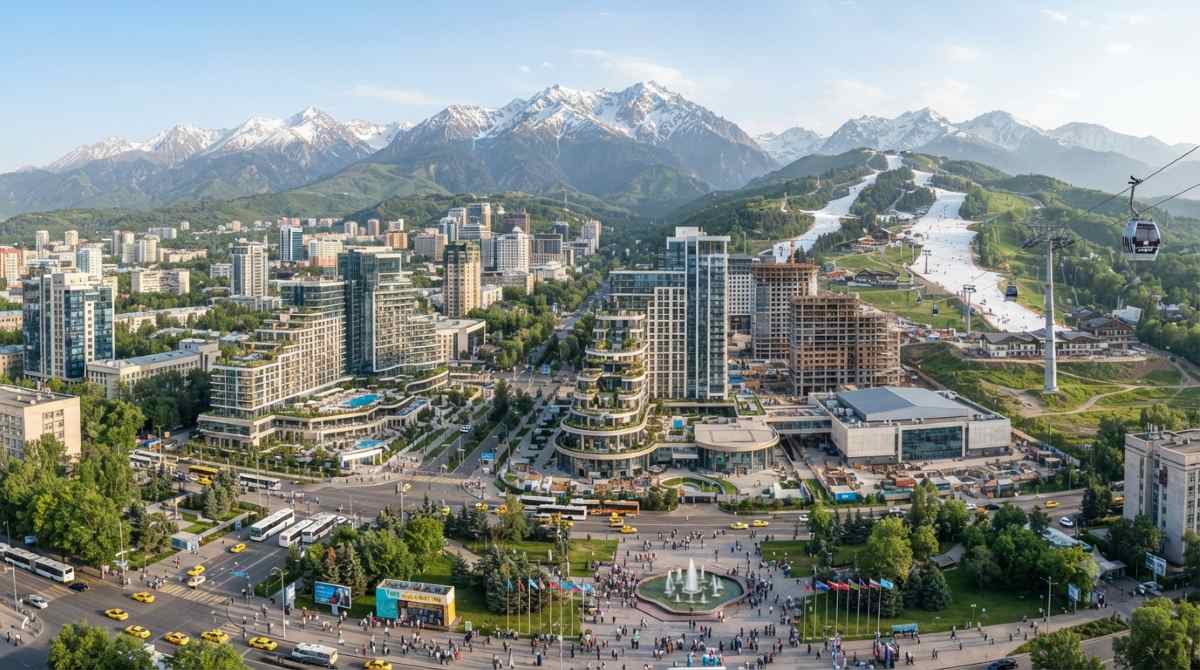
Image generated with Ai
Strategic financial commitments and targeted government initiatives have successfully positioned Kazakhstan at the forefront of regional development, sparking an extraordinary tourism surge across multiple domestic and international markets. Comprehensive economic reviews published by official state resources indicate that the overarching financial contribution of the leisure and hospitality sector reached approximately $11 billion by the close of 2025.
This massive influx of economic activity currently sustains employment for more than 600,000 individuals throughout the country. Capital investments have demonstrated exponential upward trajectories over recent years, moving from roughly $1.72 billion in 2023 to $2.08 billion in 2024—a 20.3 percent increase—before rising by an additional 32.6 percent to hit $2.74 billion in 2025. Consequently, cumulative investments across the 2024 to 2025 period have surpassed the $4.8 billion threshold.
Background and Context
The ongoing modernization of the national economy is heavily tied to targeted structural reforms and long-term planning championed by the government. Over the past few years, administrative frameworks have been systematically overhauled to transition the nation into a premier destination for international travelers and domestic explorers alike.
The implementation of specific master plans, such as the Roadmap for the development of resort areas spanning 2026 through 2029, has provided a clear roadmap for regional growth. Tailored strategic blueprints are actively being deployed in targeted regions, including the Mangystau and Shchuchinsk-Borovskaya resort locations, alongside the ambitious Almaty mountain cluster. These cohesive efforts reflect a deliberate policy shift aimed at diversifying the economy away from traditional industrial sectors by leveraging the country's vast natural landscapes, geographical diversity, and historical heritage.
Advertisement
Impact on Travellers
Visitors arriving within the borders of the country encounter a rapidly transforming landscape characterized by vastly improved accessibility and elevated service standards. The sheer volume of international arrivals climbed dramatically from 9.2 million in 2023 to 15.7 million by the end of 2025, with roughly 11.1 million officially classified as tourists whose cumulative expenditures reached approximately $2.9 billion. Domestic travelers have likewise embraced local vacation opportunities, with native holidaymakers increasing from 7.1 million in 2023 to 8.7 million in 2025.
During the initial quarter of 2026, professional lodging establishments welcomed nearly 2 million guests, which included upwards of 802,000 visitors exploring major resort zones. Furthermore, natural beauty spots have captured widespread public interest, with national park attendance leaping from 2.4 million visitors in 2023 to 3.7 million in 2025, and an additional 1.7 million nature enthusiasts recorded during the first half of 2026 alone.
Industry Insights
Market observers and industry experts note that the rapid scaling of the hospitality infrastructure is creating unique opportunities for investors and business operators. At present, 328 distinct tourism-related projects with an estimated combined value of $2.85 billion are progressing through various stages of implementation across the nation.
Upon finalization, these ventures are projected to generate approximately 10,000 permanent employment positions while introducing 25 new international-standard hotels. To maintain this momentum, authorities are actively reviewing proposals for the construction of 24 world-class hotels across 11 different regions, backed heavily by preferential financial loans and investment incentives. Additionally, targeted financial assistance continues to be channeled directly to tour operators, who receive a state subsidy of roughly $33 for every international tourist successfully brought into the country.
Practical Information
Substantial logistical upgrades are being prioritized to ensure seamless transit for all categories of visitors. Throughout 2026, 33 major infrastructure projects valued at approximately $287 million are scheduled for execution, improving nearly 11,000 kilometers of regional roadways. Simultaneously, critical aviation enhancements are underway, featuring the construction of brand-new regional airports in Katon-Karagai, Zaysan, and Kenderli, alongside the full restoration of Arkalyk Airport, the reopening of Balkhash Airport, and comprehensive terminal remodeling at Urjar.
Accommodation networks have scaled in tandem, expanding from 992 registered facilities in 2023 to 4,482 by the end of 2025, and surpassing 4,500 facilities by April 1, 2026. Revenues generated from these accommodation services jumped from approximately $502 million in 2023 to $768 million in 2025, with first-quarter figures for 2026 reaching $152 million—marking a 13.9 percent rise compared to the corresponding timeframe in the previous year.
Comparison with Previous Policies or Developments
When measured against earlier developmental phases, the current strategic posture represents a marked departure from decentralized, uncoordinated regional growth toward a highly unified, state-backed modernization campaign. Historically, the hospitality sector operated with limited capital injection and fragmented transport networks, which restricted deep exploration of remote natural attractions.
Previous frameworks relied heavily on localized management without the benefit of multi-billion-dollar federal road initiatives or standardized eco-trail networks—which now encompass 179 established tourist routes and 42 ecological paths. Furthermore, previous policies lacked the expansive vision seen in current mega-initiatives like the Almaty mountain cluster development, which aims to interconnect multiple ski zones, install 30 modern cable cars, lay out 161 kilometers of ski trails, and ultimately attract up to 5 million annual visitors.
Advertisement
Share On:
Gtranslate
A note on cookies
Newshunt uses essential cookies to keep you signed in and to remember your language and country, so the site works the way you expect. With your permission, we'd also like to use analytics cookies to understand how people use Newshunt and improve it over time.
Accepting only affects analytics. To learn more, view our Privacy Policy or Terms & Conditions.
(0)Comments