


Fifty years after the city saved them, La Jolla's Red Rest and Red Roost cottages face more challenges
Category: Tourism
Share
Archive
Like
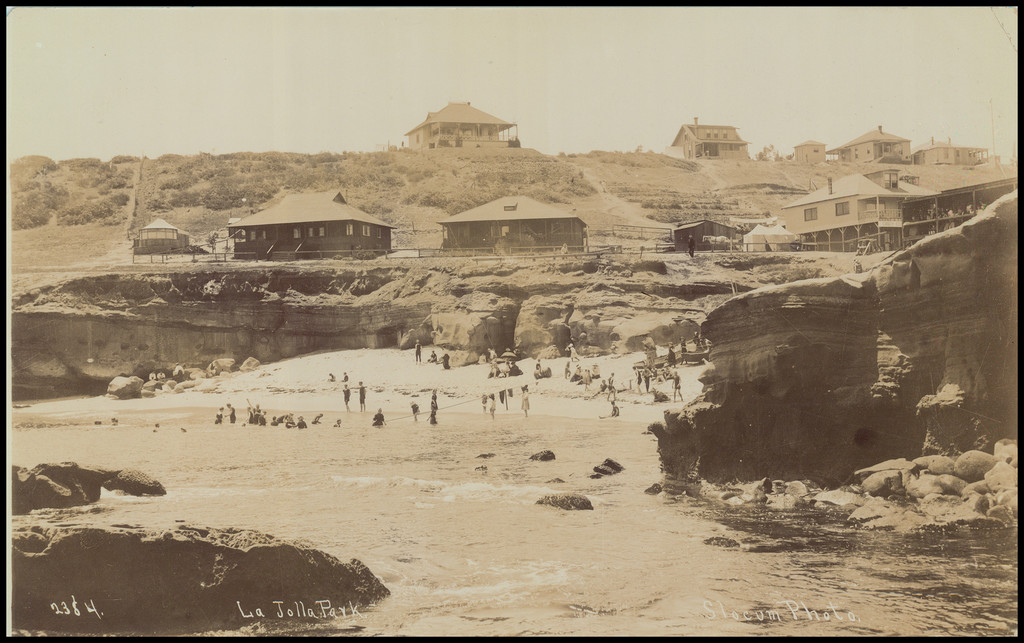
Historic photo from Bruce Coons of SOHO of the two turn-of-the-century beach cottages,
the Red Roost & Red Rest in La Jolla. (Photo courtesy of Bruce Coons/SOHO)
Two of La Jolla's oldest surviving buildings are once again fighting to survive, more than half a century after the City of San Diego first stepped in to preserve them.
Overlooking La Jolla Cove and owned by Cove Properties, the Red Rest and Red Roost cottages at 1187 and 1179 Coast Blvd date back to 1894. They are thought to be the oldest surviving wood-framed structures in La Jolla Village.
Under a proposal now moving through the city's permitting process, Red Rest — badly damaged in an October 2020 fire whose cause investigators ruled 'undetermined' — would be demolished and removed. Red Roost would be reroofed and secured against further deterioration. No occupancy or interior work is proposed for either building.
In June, the La Jolla Historical Society appealed the city's approach, arguing that losing Red Rest would damage the integrity of the La Jolla Park Coastal Historic District. The 8-acre, 2½-mile coastal district was added to the National Register of Historic Places in 2024 with 35 contributing resources.
Photos of La Jolla cottages from Community Planners Committee presentations, courtesy of Dr. Diane Kane
Both cottages have been individually listed on the National Register since 1976 and are cataloged in the Library of Congress. The city designated the pair as local historic landmark HRB #101 in January 1975 after a previous owner sought to demolish them.
Preservation architect Dr. Diane Kane, a former staff member of the city's Historical Resources Board, spoke to the San Diego Community Planners Committee on Aug. 25, seeking support to save both cottages.
She quoted the late architectural historian Vincent Scully: 'They are not insignificant pieces of American history. They are monuments of American architecture. Small as they may be, they constitute our fundamental American heritage.'
Despite landmark status, the cottages have been largely neglected for decades, Kane said.
A city ordinance requires historically designated properties to be maintained in a 'readily occupied state,' but Kane said that requirement went effectively unenforced for 50 years.
'I was shocked when I saw the decision, and when I looked at how it was made,' Kane told Community Planning Committee members, arguing the city bypassed required historical resource review.
La Jolla Community Planning Association President Lisa Kreideman said she felt 'the city was throwing in the towel. They're saying demo it, and there's nothing else historically relevant about this.'
The Community Planning Committee voted 22-2 to support the Historical Society's appeal, framing it as a citywide precedent.
In an Aug. 28 letter to San Diego City Council President Joe LaCava and the city council, Community Planning Committee Chair Victoria LaBruzzo wrote that the committee acted 'because of its potential citywide implications for designated historic resources and districts.'
LaBruzzo noted the city issued a Notice of Violation on the property in 2002 — nearly two decades before the fire — for failing to maintain the structures.
'[The Community Planning Committee] is concerned about the precedent that could be created when a designated historic resource deteriorates over time and that deterioration is later relied upon as a basis for determining that the resource no longer retains sufficient historic integrity to warrant protection,' she wrote.
She added that federal authorities, when listing the full district in 2024, expressly acknowledged the fire damage yet still found Red Rest a contributing resource.
The letter said the city failed to analyze impacts on the cottage ensemble or the district's setting and never meaningfully evaluated preservation alternatives such as stabilization, rehabilitation or reconstruction with salvaged materials.
LaBruzzo urged the council to grant the appeal and require full historic and environmental review.
The city's position
City of San Diego spokesman Peter Kelly told Times of San Diego in July that a Historic Structures Report found Red Roost retained much of its historic material and could be secured for future restoration, while Red Rest suffered near-total loss of historic material in the fire.
City of San Diego Senior Public Information Officer Richard Berg confirmed the project's scope changed on April 29, 2025, when the applicant withdrew a four-story, eight-unit condominium from the earlier 2022 proposal, narrowing it to securing Red Roost and demolishing Red Rest.
Because Red Rest was already extensively damaged when the application was filed in November 2021, the city determined it had effectively been lost as a historic asset, leaving only Red Roost to evaluate. On that basis, the scaled-back project was found categorically exempt from further environmental review.
Kane disputes the finding, saying the fire changed the cottage's physical condition but not its historic significance.
'The fire didn't change the historical aspect of this property,' she said, listing mitigation and reconstruction as the appropriate response.
The Historical Society's appeal cites the National Register of Historic Places nomination, which acknowledges the fire damage while still treating Red Rest as a contributing resource.
Laura DuCharme Conboy, president of the La Jolla Historical Society, said the current owner knew the cottages' protected status at purchase.
'They knew the two cottages were on the National Register of Historic Places,' Conboy said, creating an obligation 'not to demolish one of them but rather to protect and maintain them.'
Conboy said the historical society isn't opposed to redevelopment, and noted the abandoned 2022 plan would have relocated both cottages while preserving their character.
'It's not a fight. We're trying to protect it,' Conboy said.
Eduardo Podolsky, who has been representing the ownership group, said the owners 'respect the community perspective and all of the concern for this important site.'
'We are focused on the next steps for Red Roost and Red Rest, including safety,' he said. 'The two cottages are in very different physical condition due to circumstances beyond our control. Our approach is based on the most effective actions we can take at this time, prioritizing what can be done in a timely manner to care for the Red Roost.'
Red Roost (then Neptune) was built for John Eugene Fishburn, while Red Rest was built for George Julian Leovy, both in 1894, according to the Historic American Buildings Survey for the National Park Service/Library of Congress.
In its written historical and descriptive data, the Historic American Buildings Survey notes that the cottages are 'scarce examples of the typical late nineteenth century vernacular beach house,' and while 'it is not known how many of the once very numerous frame cottages erected along the coast of California still survive… there were a very large number of bungalow cottages in La Jolla.
'These two, because of their prominent site, are conspicuous examples.'
Several owners held interest through the years, with public records showing ownership of the cottages was consolidated under Cove Properties in 2002. California filings list Cove Properties LLC as managed by La Jolla Cove Motel and Hotel Apartments, LLC, whose managers are San Diego real estate investors Leonardo Simpser and Gregorio Galicot.
The cottages' adjacent hotel was formerly owned by Jack Heimburge, who also owned the Red Roost and Red Rest until he died in 1998; the properties later passed to his heirs before the 2002 transfers.
A Save Our Heritage Organisation newsletter from 1977 shared that Heimburge was denied a demolition permit by the California Coastal Commission 'and admits no specific plans for the cottages except to use them for storage for his new construction project at the south end of the Cove Motel.
'The cottages will apparently remain vacant for an indefinite period of time, and it can only be hoped that Mr. Heimburge will not let the condition of the cottages deteriorate,' the newsletter said.
A note on cookies
Newshunt uses essential cookies to keep you signed in and to remember your language and country, so the site works the way you expect. With your permission, we'd also like to use analytics cookies to understand how people use Newshunt and improve it over time.
Accepting only affects analytics. To learn more, view our Privacy Policy or Terms & Conditions.
(0)Comments