


A Civilization Without Elders
Category: Entertainment
Share
Archive
Like
Subscribe now
There was a time when getting older meant something different.
Not better, necessarily. Not easier. But age carried a kind of authority because you had lived long enough to see things repeat.
You remembered the promise before the failure.
You remembered what people said the first time.
You remembered the family story nobody had written down, which road flooded, who could be trusted, what happened when everyone else had forgotten.
You carried memory.
And memory had weight.
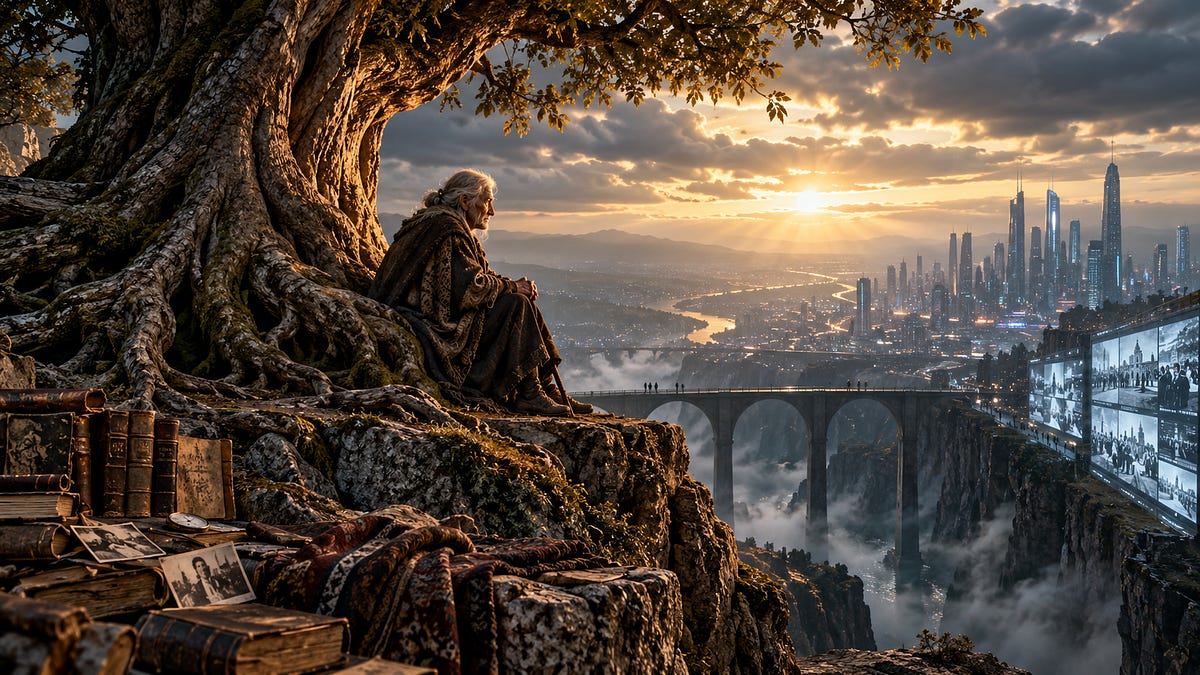
I've been thinking about how strange it is that we now live in a culture with more stored information than any civilization before us, while becoming increasingly disconnected from the people who actually remember what came before.
We have archives. Search engines. Cloud storage. Endless footage. Entire histories available in seconds.
And yet there's a kind of memory those things don't hold.
An elder doesn't just carry information.
An elder carries sequence.
What came before what.
What people believed before the story changed.
Which promises were made.
Which warnings were ignored.
Which things that look new now aren't new at all.
That matters more than we seem to understand.
Because once a culture loses sequence, the present begins to look inevitable.
Whatever exists now starts to feel as though it has always existed.
Whatever people believe now begins to feel obvious.
And whatever came before becomes easier to dismiss, distort, or simply forget.
I'm old enough now to remember several different worlds.
I remember life before cell phones. Before the internet. Before every moment could be photographed, searched, tracked, stored, monetized, and immediately commented on by people you'd never met.
I remember when you could disappear for an afternoon and nobody panicked because they couldn't reach you.
I remember photographs being physical things.
Directions written on paper.
Phone numbers carried in your head.
Children being around people of different ages because life wasn't divided into such narrow demographic lanes.
And I'm increasingly aware that those memories aren't just nostalgia.
They're evidence.
They remind me that much of what we call normal is extremely recent.
That alone gives memory power.
If you remember that something wasn't always this way, you're less likely to believe it has to remain this way.
Older people used to serve that function almost automatically.
They were living evidence that the present was temporary.
Now we've built a culture that often treats age as irrelevance.
Youth is marketed as authority. Newness gets confused with improvement. Speed gets mistaken for intelligence. Technological fluency can look like wisdom even when it has nothing to do with wisdom at all.
And elders have been moved away from the center of life.
Sometimes literally.
Families scatter. Generations live separately. Older people retire out of workplaces where their knowledge once moved naturally into younger hands. Nursing homes replace multigenerational households. Online culture changes so quickly that something from six months ago can already feel ancient.
Younger people may have access to more information than their grandparents ever dreamed possible.
But access and inheritance aren't the same thing.
You can look up what happened.
That doesn't mean you understand what it felt like while it was happening.
Memory carries atmosphere.
Someone who lived through war doesn't understand war the same way someone reading about it does.
Someone who remembers a financial collapse hears promises of endless prosperity differently.
Someone who watched a political movement rise, fracture, disappear, and return under a different name may hear familiar language long before anyone else notices the resemblance.
Someone who lived before a technology existed can see what entered the world with it because they can remember the before.
That kind of knowledge is hard to digitize.
Part of it lives in the body.
In hesitation.
In recognition.
In the moment an older person hears something and says, 'I've seen this before.'
Civilizations have always needed people who could say that.
They were grandparents. Storytellers. Tribal elders. Craftsmen. Midwives. Farmers. Veterans. Priests. Mothers. Neighbors. Old men sitting outside stores who somehow knew who owned every building in town and why nobody trusted the man who bought the one on the corner.
Not all elders were wise.
Age doesn't magically confer wisdom.
Some people spend eighty years learning almost nothing.
But that doesn't erase the function of eldership.
We've confused imperfect elders with unnecessary elders.
And something has moved into the space they once occupied.
Institutions carry more of our memory now.
Media carries it.
Technology carries it.
Increasingly, algorithms decide which fragments of the past we encounter at all.
Search results determine what appears first.
Platforms determine what circulates.
Old footage resurfaces without the events surrounding it.
A statement made twenty years ago can be severed from the world in which it was spoken and judged entirely through the language of today.
Entire generations can begin interpreting history without anyone nearby who lived through it.
That changes more than what we know.
It changes who gets to tell us what happened.
Because a population without elders becomes increasingly dependent on whoever controls the archive.
And the archive is never neutral.
Someone decides what gets preserved.
Someone decides how it is labeled.
Someone decides what is searchable.
Someone decides what appears first and what is buried beneath twenty pages of results.
Even without conspiracy, power enters here.
It always does.
Memory shapes identity, and whoever mediates memory has influence over identity.
That applies to a person.
It applies to a family.
It certainly applies to a civilization.
When human memory weakens, institutional memory becomes more important.
When lived transmission breaks, centralized transmission takes over more of the work.
And once memory is centralized, it becomes easier to organize, rank, curate, and quietly forget.
We've already accepted this in smaller ways.
We stopped remembering phone numbers because phones could do it.
We stopped navigating because GPS could do it.
We stopped keeping certain kinds of family knowledge because the internet seemed able to answer anything.
Maybe we also stopped listening to elders because modern life convinced us that everything worth knowing was already stored somewhere.
I'm not sure it is.
There are things no database can tell you.
What fear felt like during a particular year.
How a neighborhood changed after the factory closed.
Which promise sounded convincing before everyone realized what it would cost.
How quickly ordinary life can become something else.
How people behave when institutions fail.
What freedom felt like before people had a reason to name it.
That knowledge disappears one person at a time.
And there's another loss buried underneath it.
An elder isn't only someone who remembers the past.
An elder can also tell you where you are in the story.
That's different.
Without that long view, each generation can begin to experience itself as the beginning of history. Its crises are unprecedented. Its discoveries are unprecedented. Its moral insights are unprecedented. Its fears are unprecedented.
It becomes harder to recognize recurrence because recurrence requires memory longer than a news cycle.
And a culture that can't recognize recurrence is easier to surprise.
Easier to frighten.
Easier to persuade that the newest emergency has no precedent and therefore requires entirely new rules.
That may be one of the least discussed forms of power an elder once carried.
Perspective.
Not authority because they were old.
Authority because they had watched enough time pass to know that the present lies about its permanence.
There's a point when the last person who remembers something dies.
After that, history changes categories.
It becomes record.
Before that, it is still witness.
I keep coming back to that distinction.
We may be becoming the first civilization capable of storing nearly everything while carrying less and less of our continuity through living human beings.
Maybe that's why this feels larger than respect for older people.
It's about whether a civilization can remain connected to itself when its memory no longer has a human voice.
Maybe the loss isn't simply that we have fewer elders.
Maybe we've forgotten what elders are for.
Subscribe now
Share
A note on cookies
Newshunt uses essential cookies to keep you signed in and to remember your language and country, so the site works the way you expect. With your permission, we'd also like to use analytics cookies to understand how people use Newshunt and improve it over time.
Accepting only affects analytics. To learn more, view our Privacy Policy or Terms & Conditions.
(0)Comments