


Why LOTR's Weathertop Scene Is GENIUS
Category: Entertainment
Share
Archive
Like
What if I told you the Weathertop scene from Lord of the Rings is genius, not just because of how tense it is, but for how its cinematography subtly conveys a sense of dread?
For instance, this shot of the Hobbits that features an intense 'camera roll' movement, which is designed to subtly communicate a sense of disorientation and instability.
This is just one of many genius framings in this sequence, and in the next few minutes, I'll go shot-by-shot, analyzing the entire scene, showing you subtle details you might not have noticed.
Let's get started!
Subscribe now
We'll start with this extreme long shot of the base of Weathertop. This is actually also called a Subjective Shot, since it's framed from the Hobbits perspective. Peter Jackson uses Subjective Shots a few times at the beginning of this sequence, and for good reason.
In The Filmmaker's Eye, Gustavo Mercado writes that'A subjective shot lets viewers feel as if they are active participants in the story they are watching.'
So Peter Jackson is making us feel the terror of the Nazgul closing in on us by putting US in the middle of the action. A few moments later, we get another Subjective Shot at the summit of Weathertop—this time featuring camera movement. The camera darts around quickly, giving a sense of anxiety and dread, as we search for any sign of the Black Riders. I think Peter involving the audience like this dramatically elevates the tension of the scene.
These two examples of Subjective Shots show just a few ways they can be used. In fact, Jackson uses Subjective Shots quite a lot in Fellowship of the Ring. Like this one from Gandalf's perspective as he comes into Bilbo's home. This shot, instead of making us feel dread or anxiety, helps us feel like we're discovering this amazing world. It's pure immersion.
Another example is this Subjective Shot from Gandalf's perspective of an irate Bilbo, which makes us feel as if Bilbo is angry at US, since Ian Holm is looking right at the camera. The effect is that we're startled by the sinister nature of the ring, as a livid Bilbo screams at us directly.
One final example of a great Subjective Shot is this one of Frodo offering Gandalf the ring in Bilbo's home. Frodo is out of focus in the background, while the ring is in focus, replicating how our eye actually works. The effect here is that we sense Gandalf's temptation to take the ring.
In all these instances, Peter Jackson is including us, the audience, in the story, helping us feel a variety of emotions as we watch—like wonder, or shock, or dread.
In this initial Subjective Shot at Weathertop, pay attention to the smoke formation in frame. The smoke matches the triangular arrow-like formation of the approaching Nazgul, communicating that this ominous fog is something they bring with them everywhere they go.
There's one last thing about this composition that reinforce how terrifying the Nazgul are. Do you know what it is?
It's something I'll call NPC energy. NPC meaning non-player characters in video games who act like soulless robots. Some of my favorite shots in the film come when Aragorn speaks of the Nazgul at the inn in Bree. Overtop of his dialogue, we get a bunch of shots of the Nazgul just kind of existing amidst Middle-Earthien landscapes.
The way they silently sit there, and the way they're silhouetted against the sky, reduced to nothing but black shapes, communicates their alien, lifeless quality.
The way they approach Weathertop here, in perfect arrow formation, is something that could only be shown from above, with this particular extreme long shot framing. I believe Peter Jackson was trying to emphasize their cold, robotic nature by showing them in this perfect formation. We, the audience, are facing ruthless, unfeeling killing machines. All of this is being communicated with one 3-second shot.
Absolutely brilliant.
The next shot I want to discuss is this extreme long shot of Weathertop's top featuring a slow, ominous zoom-in. One thing that stands out to me is how the characters are located in the dead center of the frame.
In classical cinematography, the rule of thirds is typically used to create balanced compositions.For those who don't know, the rule of thirds is justa visual guideline that divides an image into nine equal parts using a 3x3 grid of two horizontal and two vertical lines. If you wanted a balanced, pleasing composition, you could place characters on the left or right vertical line in frame, for instance. In this shot, though, the hobbits are placed dead center, which is unusual.
Why would the filmmakers do this?
It actually fits perfectly, because dead center framing, especially in an extreme long-shot like this, makes characters look tiny against massive environments. In this instance, it communicates a sense of isolation and powerlessness for the Hobbits, who are completely enveloped by these dark, ominous ruins that seems to reach out at them from the periphery.
Further highlighting this danger is the slow zoom-in accompanying the shot. In The Filmmaker's Eye, Gustavo Mercado writes,'A very slow and gradual zoom in, on the other hand, can communicate a sense of increasing tension.'
This mounting tension continues in these sweeping medium shots of the hobbits, some of which feature the camera diving in at them rapidly before pulling out again. I feel this rapid camera movement visualizes little bouts of intense terror the Hobbits are feeling as they scan their environment. Like how you might flinch at a shadow in the dark, and feel your heart drop suddenly.
Subscribe To My Youtube Channel
While this diving camera movement feels antagonizing, the camera also rapidly sweeps around the Hobbits in a circular motion, reflecting their panicked scanning of the environment. Something this subjective shot we already talked about helps to reinforce.
As Frodo finally spots the Nazgul. We start in a medium close-up on his face featuring plenty of headroom for him at the top of the frame, but the camera slowly moves in until all that headroom eventually disappears. Lack of headroom in a medium-close up like this typically signifies a sense of claustrophobia and entrapment.
As the Black Rider draws his sword, we get a close-up on his feature-less face, but it's canted. Canted shots just mean that the camera is not perfectly level with the horizon. These shots typically communicate a sense of unease and psychological strain, both of which Frodo's feeling in spades right now.
We actually get another canted group shot of the Hobbits seconds later, which is even more intense, because Peter Jackson opts to add a twisting camera movement to the shot. I looked this motion up to see if it had a name, and it does! It's called a camera roll, and they're used to communicate disorientation and instability. Makes sense!
This canted shot also qualifies as a 'group shot,' which include three or more characters in frame. In The Filmmaker's Eye, Gustavo Mercado writes,'Character connections in these shots are often communicated through blocking and body language.'
So what can we divine about character connections with this shot? Well, for one, that Sam is the most courageous out of all of them, and takes on the role of protector in the group. He's the one out in front here. It makes me think of the time Sam barges into Aragorn's room and tries to pick a fight with him for taking Frodo. Sam's got a ton of guts, which Peter Jackson loves to communicate by making Sam take on characters 4 times his size.
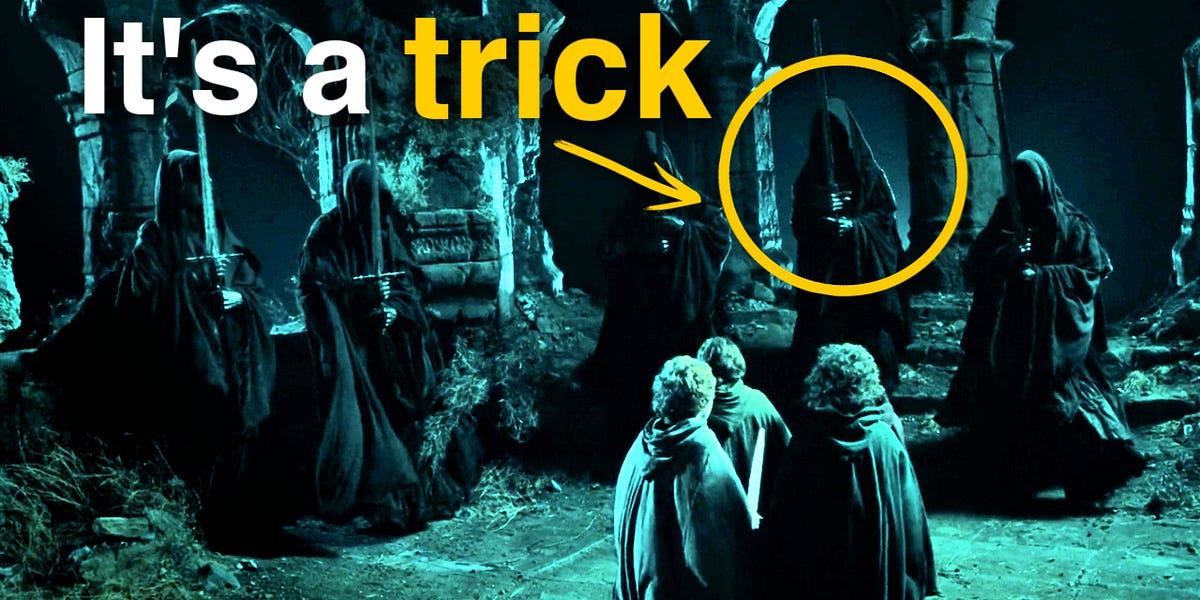
Before this canted group composition, we got a pair of shots that really emphasize the size discrepancy between the Hobbits and the Nazgul. The first is this long shot of the Nazgul towering over the Hobbits. The Hobbits are stuffed into the bottom right of the frame here, where the right vertical and bottom horizontal line of the rule of thirds grid lines connect. And the long shot, which is just a shot that shows characters from head to toe in frame, helps communicate the size discrepancy between the Nazgul and Hobbits.
Look at this harsh white spotlight behind the Nazgul here. This scene was obviously shot on a set, and this light is what you'd call unmotivated, IE, there is no visible, logical source for it.
Why did they do this? Well, the Black Riders are so dark that the filmmakers had to make them stand out somehow. One way to do this is to have a strong light source behind them to silhouette them against. We saw an example of this when the Hobbits were running away from the Nazgul earlier in the film.
We saw another example of this when Frodo puts on the ring for the first time. These strong, white beams of light are a staple of Nazgul design for practical purposes, but what about symbolic purposes?
When Frodo puts on the ring in this scene, we see the Nazgul for what they truly are. Fallen Kings with crowns upon their heads, completely white. Maybe the filmmakers used this unmotivated white light to connect the Nazgul to their true, ghost-like form. Perhaps it's used to connect them to the cold, white, lifeless void, bringing a little bit of their world into ours visually. I also think that, perhaps, these strong beams of light connect to their 'sight' somehow. This shot of them galloping down the road after Frodo's put the ring on is my biggest evidence for that. This unnatural white light pierces the trees, and they follow in the direction that it shines towards Frodo.
Speaking of light, let's jump to this crane shot of the Nazgul drawing their swords at the Hobbits. The filmmakers had to make these blades stand out, and they did it by bouncing light off of them. The Nazgul performers had to angle their swords just right to catch that reflected light. Take a look at the ground, too. I learned in film school that crews like to wet the pavement before shooting so that light can bounce off of it. You can see that's exactly what they did here, and it really helps the Hobbits stand out, too.
One last thing about the lighting. I love how 'backlit' the Hobbits are here, which completely shrouds the front of their bodies, and faces, in shadow. It gives the sense that these massive black figures in front of them have sucked all the life out of their souls.
The high framing here, again, helps emphasize the Hobbits small stature, and the evil literally bearing down on them.
Let's skip ahead to Frodo falling down here. This looks like it was taken with a wide-angle lens, which captured a large amount of the environment to the left and right of Frodo, creating a sense of isolation and vulnerability.
Take a look at this stone statue of an ancient King that's fallen behind Frodo. It feels like this not only connects with Frodo's current situation, but kind of connects back to the Nazgul, who are fallen Kings themselves. Weathertop was once part of the great Kingdom of Arnor, which was ruled by men. And funny enough it was the Witch King of Angmar who actually destroyed this great tower. Perhaps this fallen statue in the background connects to all of these things at once.
Speaking of wide-angle lenses, let's talk about the close-up shots of these Nazgul faces in the void. These shots also look like they utilized wide-angle lenses, which is perfect because these types of lenses can distort facial features, especially when used up-close like this. Here's a quick example of how different lenses can change how a face looks. This lens choice helps make these Nazgul faces look even more monstrous and deformed. By the way, these faces were all made practically by Weta Workshop.
I hate to skip over the Void section to Aragorn, but I genuinely don't have much to say about it.
Let's talk about Aragorn's inclusion on a general level for a second. At first Jackson uses lots of tight framings to emphasize the chaos of the action, intercut with lots of close-ups on Aragorn's face.
I know they're just simple close-ups on his face, but there's a reason they intercut the action with so many of them. We've already met Aragorn, but this is his true coming out party. As he fights these terrifying beings, we don't see him display an ounce of fear. I feel it was important to the filmmakers to show us his courage with these close ups.
As Aragorn starts setting fire to the Nazgul, we get wider framings with a longer depth of field that help emphasize this burst of color on screen, and the beautiful chaos that he's created. I feel that as we transition from tight framings to wider ones, it's subtly communicating that the danger is passing, and Aragorn's getting control of the situation.
Now let's talk about the torch throw.
First, Aragorn looks over his shoulder, directly at the camera. Why? This doesn't seem like a true subjective shot from the Nazgul's perspective, because the framing is tight on Aragorn's face, taken from a a few feet away, perhaps.
This, on the other hand, IS a Subjective shot from the Nazgul's perspective. The distance between the camera and Aragorn does match where the Nazgul is, and the torch is thrown directly at the camera.
I'd love your opinion in the comments, but my best guess has two points. One, it sets up this beautiful subjective shot of Aragorn throwing the torch directly at the camera in a few seconds. And two, that Jackson knew this was a badass, important moment for Aragorn's character introduction, and that making him look directly at the camera kind of clues us in that something important's about to happen, since characters don't look directly into the camera that often.
The following torch throw shot, I feel, really emphasizes the extraordinary nature of Aragorn's throw. The camera is a bit far from Aragorn here, and Viggo Mortensen had to hit the camera with the torch. Technically, this is a Subjective Shot. Maybe the filmmakers wanted us to feel Aragorn's lethality first hand to establish him as one of the biggest badasses in the movie. What do you think?
Lastly, we get a crane shot that rises upwards as the final Nazgul flees Weathertop. In The Filmmaker's Eye, Gustavo Mercado writes,'Another typical use of the crane shot is to insert it at the conclusion of a key event.' 'In these cases, the crane shot adds a dramatic emphasis that communicates a sense of finality and narrative closure.'
I don't want to read too far into it. That's what I think Peter Jackson was trying to do here.
That's all I got to say about the Weathertop scene. What did you think of this iconic moment? Let me know in the comments below. And if you liked this film analysis, subscribe to my channel, I publish new videos every week. Thanks so much for watching, I'll see you next time.
Filmalysis is reader-supported. To receive new posts and support my work, consider becoming a free or paid subscriber.
A note on cookies
Newshunt uses essential cookies to keep you signed in and to remember your language and country, so the site works the way you expect. With your permission, we'd also like to use analytics cookies to understand how people use Newshunt and improve it over time.
Accepting only affects analytics. To learn more, view our Privacy Policy or Terms & Conditions.
(0)Comments