


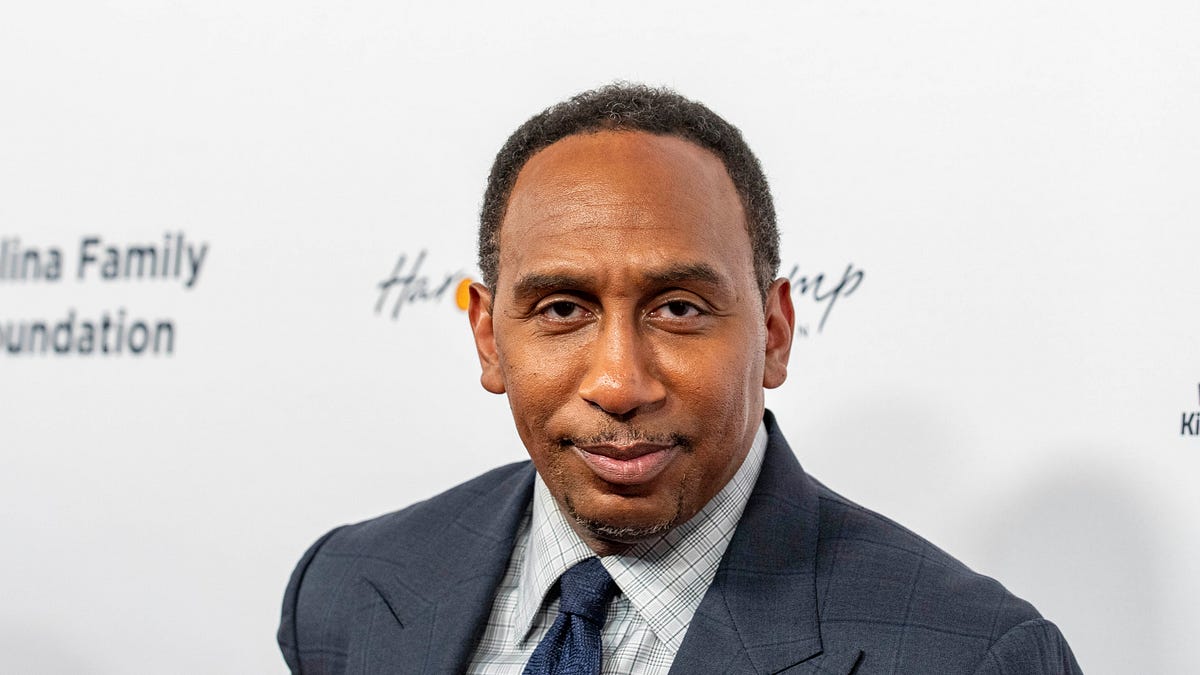
On Stephen A. Smith's NABJ Thumbs ‘Down Award,'' This Black Journalist Calls BS
Category: Politics
Share
Archive
Like
'Congress shall make no law respecting an establishment of religion, or prohibiting the free exercise thereof; or abridging the freedom of speech, or of the press…' First Amendment, U.S. Constitution
By John W. Fountain
SO THE NATIONAL ASSOCIATION of Black Journalists during its annual summer convention last month gave Stephen A. Smith the 'Thumbs Down Award' for a so-called 'recurring public pattern of disparaging commentary directed at prominent Black women across politics, sports, and media.'
Huh? Wait a minute… Isn't this the same organization that invited Donald J. Trump to its conference in Chicago in 2024 only to have him essentially defecate on the NABJ's sacred annual gathering during his now infamous interview with ABC journalist Rachel Scott where the insulter-in-chief disparaged a Black woman running for president, saying then Democratic candidate Kamala Harris 'happened to turn Black'? Not to mention Trump's glaring rudeness to Scott, a Black woman.
Isn't this the same organization that for its panel of Black journalists selected to interview Trump during its conference that summer did not include a single Black male journalist?
If memory serves me right, didn't Stephen A. bring his national critically-acclaimed ESPN sports talk show First Take to the conference that year then again the following year, giving young emerging Black journalists access, opportunity and exposure as he broadcast live from NABJ convention central?
They say no good deed goes unpunished. But I digress. So let me try and get to the sugar in the bottom of the Kool-Aid…
'For the record, one thing should be made perfectly clear or corrected: The nation's Black journalists didn't vote to give Stephen A. that award. Neither did NABJ's Sports Task Force. The board did. Period.'
50 Cent A Word is a reader-supported publication. To receive new posts and support my work, consider becoming a free or paid subscriber.
While 'NABJ' asserted that Stephen A. was guilty of a 'recurring public pattern of disparaging commentary directed at prominent Black women,' it offered up no receipts, no cold hard facts to support its claim. Hmmm… Odd for a 'journalism' organization.
Weeks later, in a Chicago radio discussion I participated in regarding the NABJ/Stephen A. controversy, a local Black female journalist, in defending NABJ's decision, characterized the sports commentator's critical exchanges about Black women as having an 'odd and offensive tone.'
My issue in both cases is that on their surface —particularly without the facts to substantiate the accusations— are general, if not nebulous. And they amount to opinion and interpretation. What did Stephen A. actually say? Just the facts ma'am.
In the case of Michelle Obama —one of those prominent Black women supposedly assailed by Stephen A.— was his challenging of the former First Lady during the 2024 presidential election after she seemed to scold young Black men for considering to vote for Trump an example of his 'disparaging' of Black women? Really?
Smith was quoted as respondingto Michelle Obama: 'You said a vote for Trump was a vote against you and a vote against y'all as women. I want to say for the record, I took major offense to that. Black men don't just love our black women, we revere y'all.'
Disparaging? Who? What? When? Where? Why? And how?
Then, earlier this summer, during that UFC on the White House Lawn disgrace where a fighter during a post-match interview made a clearly hideous and disparaging comment about Michelle Obama, there was Stephen A. once again piling on with further humiliation aimed at the former First Lady, right? Wrong. He took to his platform on his SiriusXM show 'Straight Shooter with Stephen A.':
'That was an incredibly disparaging remark about one of the greatest first ladies, if not the greatest first lady we have seen. It was a disgusting thing to say. It was inexcusable.'
And what about U.S. Congresswoman Jasmine Crockett?
Why not try Googling and reading and listening for yourself to thebrother's own wordsfor clarity, even his admission of mistakes and misspoken words rather than hopping on the bandwagon of his haters and detractors. And they are plenteous, judging from the piling on and harsh criticisms even the swell of mocking and delight that trended on social media after the NABJ 'Thumbs Down' Award.
FOR THE RECORD, I don't agree with everything Stephen A. says, or necessarily how he says it. But asEvelyn Beatrice Hallwrote in her 1906 book 'The Friends of Voltaire': 'I disapprove of what you say, but I will defend to the death your right to say it.'
As a Black male columnist, I know well the experience of encountering the ire of those who take issue with what you say or how you say it. Even Black women, including a former Black female newspaper colleague whom I encountered beyond the newsroom once and who shot me a huff and a stiff cold shoulder after I greeted her kindly and gentlemanly like my mama always taught me.
'Did I do something to you, Mary?' I asked, puzzled at her response.
'Yeah,' she huffed, her words dripping with disdain and sass. 'What qualifies YOU to write about Black women's hair?' she continued, referring to a short series of columns I had written about the natural beauty of Black women versus the trend of wearing hair weaves and the obsession with buying straight and flowing foreign hair. A series in which I extolled Black women like my mama and grandmother, and the glamor of matriarchs likeHarriet Tubman.
I could have responded to my acrimonious colleague: '…Because I have at least half a brain and Blacks sisters and daughters, cousins, aunts and a mother and grandmother whom I've seen burn their hair into painful submission in trying to adhere to a Eurocentric standard of beauty. And that their hair is beautiful the way it grows at its root.'
Instead I said nothing, shook my head and walked away, though this was not the last time my written commentary and its intent were misconstrued by a few Black female journalists and a few of their friends who took issue.
Once another Black female colleague who took issue with a satirical column I wrote about Black male and female relationships took her complaint to our white male editor. He asked her plainly: Have you talked to John? She had not. And why not? Smh.
These experiences admittedly made me wary of writing about subjects concerning Black women, knowing that I might encounter the sisters-with-weave assassination squad or the wrath of some Black women who rally and unite to squash, demean, castrate and silence any Black man who dare to publicly disagree with or question a Black woman privately or publicly.
The truth is some sisters want to sensor what we Black male commentators say or think out loud, particularly regarding Black women, no matter the absence of any intended malice or harm. Some of these sisters recoil at accountability but have no hesitance calling a brother out —or out of his name— whenever feeling self-righteously aggrieved. But to challenge these sisters, to show them to be wrong, or simply to criticize or disagree with them in even the most respectful way is to summon an attack by the Black sisterhood posse who stand in allegiance with each other —whether right or wrong— for better or worse. They tend to get stuck in their feelings and eschew the facts.
For the record, I am not insensitive to how my words, even the slightest critique of Black women —or men— might be used by those outside our race as fuel for their jaded, hateful and harmful racist narratives about us. So I am thoughtful and deliberate in seeking to use my pen from a place of love and to uplift even when I suspect I will encounter my sisters' wrath. Should I speak my truth? Or should I be mum?
Thanks for reading 50 Cent A Word! This post is public so feel free to share it.
Share
AS A SOCIAL COMMENTATOR, like Stephen A., my job is not to say what's popular. It is to survey the social landscape and to not be nebulous or milquetoast in our critique or analysis. It includes being fair and contemplative while always aiming to make clear where we stand even when it offends. I would assert that such is essential to journalism.
To take a Black woman —or man— particularly a political candidate, elected official or public figure to task on issues, to ask the uncomfortable questions, and even as a commentator to disagree does not necessarily amount to hate speech or disrespect. Nor does it amount to disparaging someone. Diversity of opinion, of ideas and voice, is the crux of journalism and at the heart of democracy. And the act of practicing our vocation is Constitutionally protected under the First Amendment, which guarantees free speech and a free press.
Aren't commentators, like Stephen A. supposed to challenge, to analyze, to be critical, even when they know they will inevitably encounter the venom of dissenters or critics, rightly or wrongly? Can't we agree to disagree without resorting to name calling or seeking to punish those whose words or tone we disagree with? In the words of Rodney King, 'Can we all get along?'
As journalists, we have the right and also the responsibility to think independently. To write and speak from our own personal conscience, heart and soul. And our journalism —written or broadcast— need not reflect some purported monolithic thought of our race, in order for us to not be considered a sellout, a betrayer of the race.
If a commentator dares to veer from the prevailing opinion of even the majority of Black folk, why in the hell is that automatically regarded as so-called 'cooning'?
From all I can see, Stephen A. has uplifted the race, provided immense opportunities to many young aspiring Black journalists, raised his Black daughters, generously made himself and his resources available toNABJand its programs, and has repeatedly stated and demonstrated his adoration, respect and love for Black women.
And just for the record, one thing should be made perfectly clear or corrected: The nation's Black journalists didn't vote to give Stephen A. that award. Neither NABJ's Sports Task Force. The board did. Period.
That board, according to published reports, did not reach out to Stephen A. beforehand or provide an opportunity to respond, which would have been more than a journalistic courtesy. As a longtime member and one of the nation's most preeminent Black journalists with a proven track record of not only to uplifting young Black journalists, the Black community and also NABJ, didn't he deserve a heads-up or at least a collegial straightforward conversation?
Accountability is not just applicable to Stephen A., but also to NABJ, to Black men —and Black women.
IN THE AFTERMATH, STEPHEN A. has drawn criticism for appearing on FOX with conservative talk show host and political commentatorSean Hannityto discuss his criticism over his induction into what amounts to the NABJ Hall of Shame. Question? So it's not okay for Stephen A. to appear on FOX to discuss the scarlet letter NABJ gave him for the entire journalism world to see? But it is okay for NABJ to receive corporate sponsorships from FOX or for Black journalists —men and women— to be employed by FOX?
Make it make sense. At least keep it a buck.
In my view, Stephen A. was low-hanging fruit. And that dubious award was a hit job that smelled suspiciously like someone may have had an axe to grind. I call BS.
Honestly, I have to ask myself why, as a Black male journalist —a 40-year veteran, author and tenured full professor of journalism who has spent much of my career battling inside newsrooms to tell our stories fairly— why should I expect anything less than the same kind of disparaging treatment NABJ has shown Stephen A.?
Furthermore, if NABJ was looking for a 'Thumbs Down Award' candidate who has repeatedly and consistently disparaged Black women —and women in general— it needed to look no further than the Oval Office. Or how about Yung Miami for her denigrating sensation, 'Spend Dat'? Or an almost endless list of misogynistic male —and female— rappers who incessantly degrade and disparage Black women with music that many Black woman dance to?
The Thumbs Down Award ought to go to... Drum roll, please: NABJ for its devolution from the organization it once was to what has seemed in recent years at times to have become an almost impotent conglomeration of elitist cliques and celebrity journalists that from my observation rarely supports or defends less prominent or popular Black journalists and instead cherry picks which issues and journalists it rallies for.
NABJ praised —and rightly so— the news, days after it derided Stephen A., that theWashington Postwas ordered by an arbitrator to rehire columnist Karen Attiah fired over asocial media postsabout violent white men after Charlie Kirk's murder last year.
Responding to news of the arbitrator's decision, Attiah was quoted as saying, 'I hope that this win sends a message to journalists and media institutions everywhere that freedom of expression is always worth fighting for.'
So is the act of speaking truth to power in a democracy in which there are no sacred cows— conservative or liberal, white or Black, male or female. It is a noble undertaking, worth pursuing, necessary for social discourse and no less protected whether it is Karen Attiah, John W. Fountain or Stephen A. Smith.
I proudly possess a big stack of NABJ Awards that I'd be happy to wager on that, though none of them a Thumbs Down Award. At least not yet.
Email:Author@johnwfountain.com
50 Cent A Word is a reader-supported publication. To receive new posts and support my work, consider becoming a free or paid subscriber.
A note on cookies
Newshunt uses essential cookies to keep you signed in and to remember your language and country, so the site works the way you expect. With your permission, we'd also like to use analytics cookies to understand how people use Newshunt and improve it over time.
Accepting only affects analytics. To learn more, view our Privacy Policy or Terms & Conditions.
(0)Comments