


Labor Day, Unions and the Effects on Families
Category: Blend
Share
Archive
Like
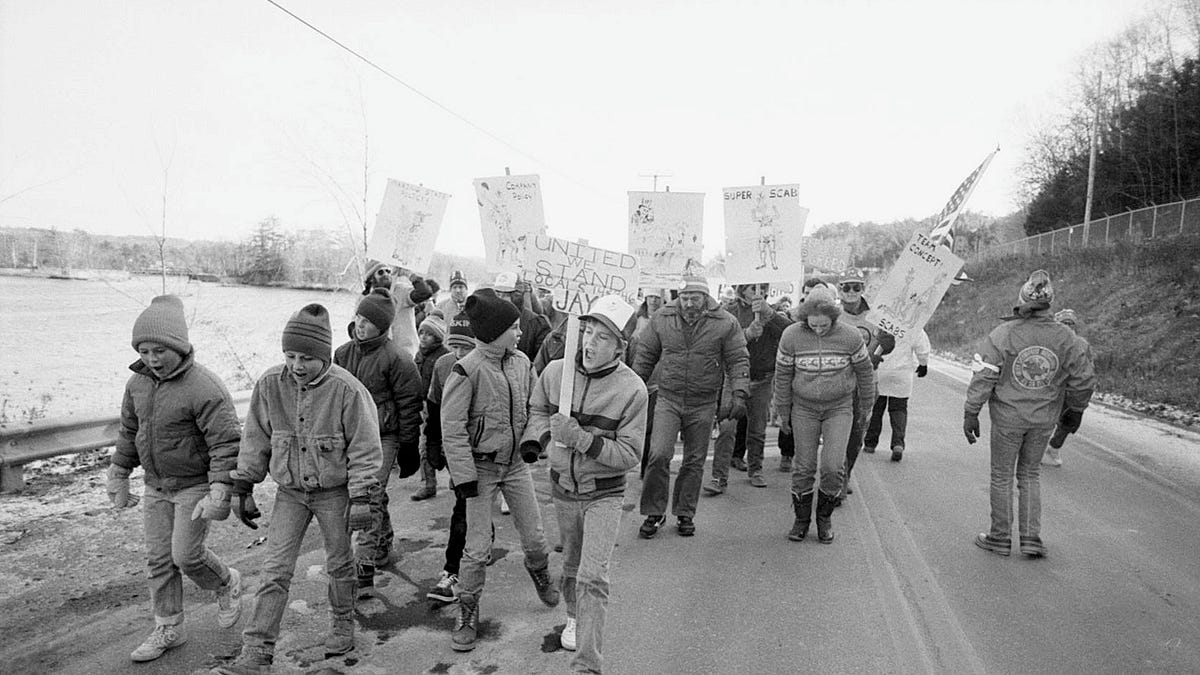
In 1987 the local paper mill, International Paper in Jay, Maine, where my dad and most of the adults I knew worked, went on strike. The union demanded better working conditions, better pay, better whatever. The strike lasted 16 months. Our small community, nestled in the Lakes and Mountains Region of Western Maine was not a wealthy community. Most of mine and my brother's friends, and my parent's friends were employed in some context by International Paper company. The mill affected much of our community's life. Everything from schedules, to lines at the bank on payday, to when food could be purchased by families already living on tight budgets to hunks of discolored foam floating down the river, it revolved around the mill. Waking up to air heavy with the smell of pollution from the mill was a regular daily occurrence. Every once in a while, even in my 50's I catch a scent of something that transports me back to the sour stench of discolored smoke billowing out of the mill's smokestacks. Laborer parents would come home heavy with the smell of having worked long shifts deep inside the various areas of the mill. Log trucks traversing the roads, causing frequent backups filled the rural routes leading up to the mill's log yard. When the union decided to strike in 1987 it went hard. The combined population of Jay and Livermore Falls at that time was hovering around eight thousand people. More than twelve hundred of them went on strike, about fifteen percent of the total population between two towns highly dependent on the mills production. The strike brought enough national news that Jesse Jackson even made an appearance at one point to join the picketers. It would end up being a difficult, strenuous existence for our small rural Maine communities for 16 months. I'm 100% in favor of workers receiving fair wages in good working conditions. But I want to share the realities of what that looked from the perspective of a working class, blue collar eleven year old kid whose dad crossed the picket line.
The local credit union became the food bank, where strikers would wait in huge lines in order to receive a loaf of bread and some government cheese and powdered milk. I'm sure there was other stuff but my memory doesn't bring them to mind. The lines would be hundreds of folks deep and hours long. I remember waiting in one line. Perhaps my parents waited in more but one was enough to etch itself into my brain. It felt very much like what I imagine communism feels like. But it served a purpose right? Somehow pressuring hundreds of workers to go on strike while providing them with minimal amounts of groceries was supposed to ease the effects. A bag of groceries does not a family feed. In those days it was typical mothers would stay home to raise their families. Unless the other parent, not on strike, worked hard thousands of people in our community would be hungry and go without. Bills wouldn't get paid, Christmases might not look too heavy around the tree. School clothes and pictures surely would be an option rather than an expectation. one of my daughters recently found an old school picture of me from this time period. I looked rough, even for a poor 80's vibe.
Somewhere in the middle of that sixteen months, my dad decided that feeding his family was more important than fighting and he crossed the picket line and went back to work. The social toll it would take on our family was significant and in many ways burnt itself into my still moldable mind. In some ways it still lingers. The one and only time I ever heard my father swear was when someone threw a 'damn' rock through our window. My brother got the shit beat out of him regularly at school and called names by people who not long before had been lifelong friends. Our car tires were slashed more than once. Our house was spray painted. My parents had friends who no longer believed them to be worth staying friends with. My father was screamed at, insulted and mocked. 'Scab' seemed to be the word of choice since he had erred on the side of working rather than screaming at people. We only had one car at the time and some days I'd have to go with my mom to pick my dad up at work. It was safer than staying home alone in the strike climate. I would have to duck down onto the floor of the front passenger seat and hide my face while we drove through the entry gates. My mom didn't want the strikers to see my face or for them to know I was with her. I have vivid memories of grown adults, some of them people we knew, holding signs and screaming 'SCAB! SCAB!' and a multitude of derogatory names and words while they stood along the banks of the river where the mill dumped its polluted water, while they fought for their version of justice. The union hall, which was often packed with people making choices they believed in, eventually put up a guillotine in their parking area with an effigy of my father. We had to leave the house we were renting because the owners, you guessed it, went on strike. The local newspaper would run small ads calling out the names and addresses of those who went back to work, along with a few namecalling opportunities. I remember vividly a best friend in fifth grade whose father went on strike. She had asked me to play at her house. Thankfully, the attitude of adults hadn't reached the kids quite yet. When her mother got to school, I asked her if I could go over. Mrs. D. looked me up and down and simply said, 'You? No.' It happened in the girls bathroom at Livermore Falls Elementary. I remember it like it happened yesterday. Moving into sixth grade and moving to the Junior High School, with more mature people and teachers didn't change anything. One particular teacher made life more difficult for me than a healthy adult should have done to a child, making fun of me whenever he got the chance. I lost what I felt like was a lot of friends that year between fifth and sixth grade, often being the brunt of who had to sit with me at lunch. Whatever amount of popularity or status I thought I had left the building and never returned. Apparently, the attitudes of the adults had made their way downstream to the next generation. My friend Tracy chose me. I don't remember the strike working, but I don't think it did. I don't remember it ending, but I know it did. I am grateful that years later, my parent's best friends came to them and apologized for having chosen the mill over what had already been a decades long friendship. My parents forgave and moved on. School and social relationships were never the same for me after that sustained unchroom experience.
Admittedly, I have never done a historical fact check on the ins and outs reasoning of the strike from the Union's POV. I've never cared to. I probably never will. Have a union, fight for better pay and work environments, get a day off for the unofficial end of summer and eat a hot dog while you're at it. Where there is a strike, there may very well be actual humans on the other side of the picket line who are keeping the economy going and who had the courage to say no despite the consequences. There are definitely real people navigating the effects of that choice, some intentional, some not yet old enough to understand.
I've never had a moment where I was embarrassed by my parents for choosing to cross that picket line. I've never had a moment of indifference toward the strike. I'm incredibly and eternally proud that my dad chose to feed his family. His demonstration of character and integrity at a time when it would have been easy to cave and give into social pressure is something that has stayed with me since 1987. That model of justice has far exceeded the model I watched along the roadside and in the classrooms.
The picture attached to this article is from: The Struggle Against Enclosures in Jay, Maine - David Riker | libcom.org. I know nothing of the website. I searched for a picture.
A note on cookies
Newshunt uses essential cookies to keep you signed in and to remember your language and country, so the site works the way you expect. With your permission, we'd also like to use analytics cookies to understand how people use Newshunt and improve it over time.
Accepting only affects analytics. To learn more, view our Privacy Policy or Terms & Conditions.
(0)Comments