


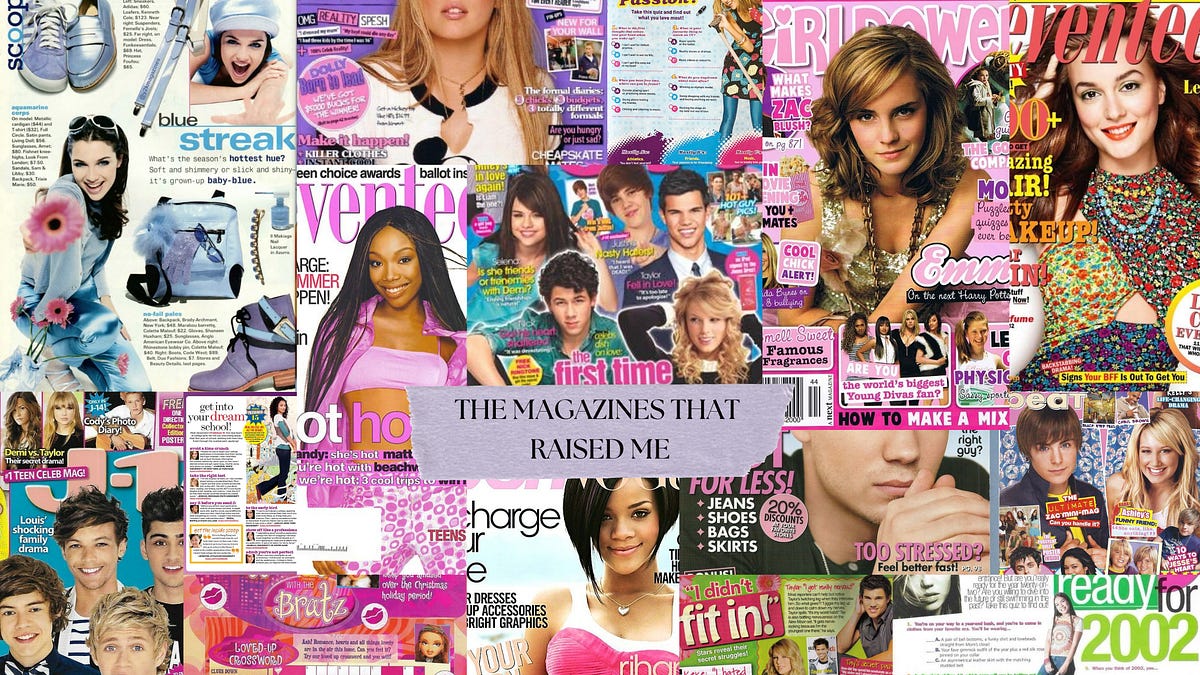
the magazines that raised me: the importance of teen editorial culture
Category: Entertainment
Share
Archive
Like
Girlhood is surprisingly universal. Heartbreak, gossiping, sleepovers with friends—all things that are able to transcend generations. Magazines remain one of the ways that I have stayed connected to those remnants of girlhood, shifting and evolving to suit my needs and interests as I grown. And while the way of consuming them has changed in recent years, I feel like we never have strayed far from the desire for this close, intimate content.
Magazines are also an artifact that remain sacred between me and mom. Even now, she is a magazine girly—we always make sure that it's our first stop whenever we go to Barnes and Noble together (which is quite often). When I was little, I would always reach for the latest edition ofJ-14orTiger Beat(the same magazine that she read as kid!), while she pulledElle, Tatler, or the iconic SeptemberVogue. She taught me to always reach for the third copy in the stand, because the first two usually had bent corners. To this day, you'll never catch me reaching for the first copy on the shelf, comforted by my mom's voice in my head.
Looking back, these magazines were some of my first forays into the world of being a writer. There's a reason that it was the top 2000's rom-com profession, people! For many girly-pops like me, they served as an introduction into journalism itself. (A 1500 word piece guessing what kind of cologne Zac Efron wore to the HSM2 premiere was hard-hitting stuff back in my day).
But these articles could go beyond just the typical Which 1D Boy is Your Soulmate? quizzes, or quick pieces focused on which swimsuits were best to bring on vacation. They taught me what feature writing was, what an editor does (so much so that it was what I listed as my dream profession in a seventh grade project). Not only that, but it was my first exploration into the world of cultural criticism, and witty, intelligent prose. I remember an article that did a deep dive on Proactiv and why the skincare brand was actually not that great for folks with sensitive skin. It was game-changing stuff!
Today, the print media world is dramatically different and, (asDevil Wears Prada 2lectured us on this summer), slowly dying. Readership is down, staff is being cut, and there is a distinctive absence of written media made exclusively for teens that we seemed to have in spades growing up. And while that fact is a bit depressing to come to terms with, I think the shifting landscape is also making room for an exciting rise in independent media (both digital and print), as well as more accessibility to the world of journalism and writing in general.
In this latest edition of myGirlhood Nostalgia series, I want to explore the magazines that helped shape my childhood, the importance of teen editorial culture, and the future of magazines in the Substack and independent media age.
Want to receive more girlhood nostalgia straight to your inbox? Subscribe today for weekly essays and monthly zines.
Before algorithms suggested what we should read, glossy magazine covers were available to us on widely-dispersed racks. If you grew up in the 90's—early 2010's, you probably remember that every popular publication had its own teen counterpart.
Some of them were devoted almost entirely to celebrities, while others attempted to blend fashion, culture, journalism, and advice into more ambitious ventures. Together, there was actually a surprisingly rich editorial landscape that introduced many young women to publishing long before we heard the words 'content' or 'bitly links'.
At the end of the day, it was just cool to know that there was an entire publishing ecosystem devoted to young readers.
Before TikTok, Reddit, or even celebrity's own IG pages, celebrity news arrived once a month in glossy spreads. While my mom would readStarorUs Weekly, I dove in between the pages of the colorful BOP, Popstar, or for a brief period, Teen People. These were magazines filled to the brim with centerfold posters of Zac Efron and Justin Timberlake, quotes from Selena Gomez and the Jonas Brothers, and behind-the-scenes exclusives of whatever movie was about to come out in theaters. Long before TikTok, celebrity news arrived once a month.
Looking back, were they a little frivolous? Perhaps. Although I'm not ashamed to admit that I used flirting skills I picked up years ago in the Lifestyle section of Tiger Beat on my now-husband. So…
But as I perused Pinterest and other nostalgia websites, reminiscing in old covers and articles, I started to yearn for the editorial curation that even 'trashier' magazines displayed. Instead of endless feeds circulating updates and buffering ads, the spreads were carefully assembled artifacts and stills of moments in pop culture. They were brighter, more colorful, and artfully arranged in a way that just felt more meaningful. Not only that, but they represented a time capsule—a window into what we were obsessing over in that very moment.
I can't think about these mags without remembering the baddies of that era—Hilary Duff, Lindsay Lohan, Raven Symone, just to name a few. Entire generations of girlhood memories attached to whatever happened to be featured on the cover that month.
For many readers, these magazines served as our first experience following culture in real time.
While the pop culture spreads in these magazines were fun and all well and good, these publications also occupied an intriguing space between entertainment and education.
Sure, most of them featured beauty trends and celebrity interviews. But they also featured stories, career advice, personal essays, investigative reporting, college-prep guides, and profiles of influential women. It was in one of these magazines that I first learned about Condoleezza Rice—one of the first times that I had seen a women in a position of power in politics as a young girl. Some of the best book guides were splashed across the pages ofSeventeenandElle Girl. I even first understood the topic of consent from an unassuming article inCosmoGirl, when so much of the world tried to convince me that it was full of inane drivel.
Seventeenbecame something closer to a handbook for navigating adolescence. And then there wasTeen Vogue, perhaps the publication that most successfully reinvented what a teen magazine could be. Alongside celebrity profiles and trend reports were conversations about politics, education, activism, body image, global events, and culture. Readers were treated as people capable of engaging with complex ideas—a concept that sometimes my own teachers wouldn't engage in.
They were the precursors for my interest in journalism—the foundational reason why I still use some of my hard-earned paycheck to subscribe to theNew Yorker.Having spaces intentionally designed for young women gives them permission to take their interests seriously. They can discover new books, explore different viewpoints, and encounter possibilities for how their futures can take shape.
Over the last decade,Teen Voguehas become one of the most visibleexamplesof a publication actively treating young readers as participants in civic life. The magazine regularly publishes election explainers, voter-registration guides, coverage of youth activism, climate change reporting, labor issues, reproductive rights stories, and profiles of young organizers. Rather than assuming teenagers are uninterested in politics, it has repeatedly argued the opposite. Young people deserve the tools necessary to understand and shape the world around them.
Likewise,Seventeenhas increasingly used its platform to address issues extending far beyond fashion and beauty (although I love me a GRWM spread). One of the most notable examples came in 2012 when I was in high school, when the magazine adopted a widely publicized'Body Peace Treaty'after teen readers pushed for more authentic representations of beauty. The initiative reflected a broader commitment to conversations surrounding self-esteem, body image, and media literacy.
At their best, magazines remind readers that the world is bigger than their immediate experience and worth paying attention to.
Leave a comment
There is a tendency to dismiss anything created for young women as frivolous. Teen magazines, in particular, have often been remembered as collections of fashion advice, celebrity gossip, and questionable relationship tips (although I took theWhat Kind of Flirt Are You?quiz results as seriously as my medical chart).
Certainly, some of that existed. But that sole interpretation feels distinctly lazy and a typical way to dismiss media aimed at young women.
Media created with young readers in mind can play a profound role in shaping reading habits, encouraging civic participation, and helping teenagers see themselves as contributors to larger cultural conversations.
It can teach us how to evaluate information,articulateideas,andengagethoughtfullywithperspectivesdifferentfromourown.Itinvitesusintolargerconversationsaboutliterature,politics,culture,andart—theverysubjectsthatencourageustobecomemoreobservant,reflective,andinformedpeople. Hence why so many oppressive regimes try to remove accessibility to them.
Even magazines themselves can feel like an invitation into a larger conversation that many of us might not feel that we can participate in.
In hindsight, I think teen magazines functioned as one of the earliest and most accessible gateways into intellectual life for young women.
Perhaps that's why I feel so defensive of these publications. Sure, I loved reading about Hilary and Lindsay's feud (I mean, I'm only human). But I also loved that they made me feel smart, engaged, and fostering a love of writing that I still practice to this day.
What made these magazines special wasn't simply the content itself. It was the assumption that readers contained multitudes. A single issue could include celebrity gossip, fashion trends, mental health advice, political reporting, and book recommendations because editors understood that people are curious about more than one thing. Teen girls especially were never just consumers of pop culture. We were readers, students, aspiring writers, future voters, and people trying to understand the world around us all at once.
In one of my summer editions for my own 'zine',The Study Hall Press, I wrote ashort articleabout what happened to the women's magazine, inspired by recent trends I had been seeing.
Many publications that once played a role in our critical thinking and curiosity fillers are disappearing.
Recently,The New York Timesreported on the transformation ofGlamour, a magazine that for decades was one of the most recognizable names in women's publishing. After significant staffing reductions, the publication shifted heavily toward shopping-focused content designed to generate affiliate revenue rather than traditional editorial journalism. The article presented the change as part of a broader decline across women's magazines and a changing media landscape increasingly driven by commerce, the very future that Meryl Streep's Miranda Priestly tearfully admitted in the summer blockbuster,Devil Wears Prada 2.
To be clear, I am not arguing that commerce has no place in publishing. Writers deserve to be paid, and publications, after a certain period, need revenue in order to continue to put forth quality writing and content.
But something important is lost when storytelling becomes secondary to selling. When every article exists primarily to move products and shill the latest from what's in a celebrity's bag, the publication slowly stops functioning as a cultural space and more like an Amazon storefront.
The magazine rack functioned as a marketplace of ideas. Maybe you picked up an issue for a Zac Efron cover story, but somewhere between the quizzes and posters you found a book recommendation, a profile of a young activist, a political explainer, or an essay about body image. Discovery was built into the experience.
Today's internet, while full of information, often operates differently. Algorithms excel at giving us more of what we've already shown interest in. If you click on celebrity news, you receive more celebrity news. If you watch fashion content, you're served even more fashion content. The result is a media environment that feels highly personalized, but sometimes less surprising or built for critical engagement. When we lose that friction, I argue that we are eroding our ability to cross outside of our comfort zone and exercise our brains in a way that is good for it.
We aren't wandering through ideas anymore. We're being guided toward increasingly narrower versions of ourselves. It's cold, impersonal while trying to convince that it is. There is an art to editorial curation that is noticeably absent from mindless scrolling. In short, the internet is excellent at helping us find what we're looking for. But magazines were excellent at helping us discover what we weren't.
What disappears when editorial spaces fold is the opportunity for accidental discovery. The best magazine articles were often the ones you never intended to read. You opened an issue to find out whether Hilary Duff was really feuding with Lindsay Lohan and left knowing something about college applications, current events, skincare ingredients, or a book you'd never heard of before.Seventeenmagazine was where I first learned about writing tips for my college personal statement—long before my guidance counselor came along.
That kind of intellectual wandering is harder to replicate in digital spaces built around optimization. Algorithms are designed to predict what we already like. Editorial curation introduces us to things we never thought to search for in the first place.
have a favorite magazine or article from your youth? Share this post and your thoughts!
Share
It's not all depressing news, I promise! Because at times, with the collapse of old iterations of industries, we see the rise of something new and surprisingly innovative to take its place.
Just because traditional editorial spaces have shrunk doesn't mean that readers have stopped searching for them. The very platform you are reading this on is direct proof of that.
The rise of independent media has come as a widespread need to create spaces that can build and spread information that is not as necessarily widespread in traditional media outlets anymore.
You can see it everywhere—places such as newsletters, independent magazines or 'zines', literary journals, and community publications.
There is something wonderfully rebellious about a zine. It doesn't need a massive audience, ad revenue, or the dreaded corporate approval. It can exist solely because someone cared enough about an idea to put it to paper or in a digital document.
These publications were originally borne from as far back as the Revolutionary War Era when women used them to promote early arguments for voting rights, to writers like Zora Neale Hurston and Langston Hughes during the Harlem Renaissance, who distributed their work independently in what they called, at the time, 'little magazines.'1
The spirit feels remarkably similar to the magazines many of us loved growing up—special interests and creative risks now available at the tip of our fingertips. Whether as a patron or a creator. If there is one good thing that the Digital Age has brought, you don't need a publishing house to create something meaningful. Right now, you can create a magazine of your own in Canva or draw it by hand and scan copies at a local print shop.
One of the most hopeful bright spots to come out of this dizzying age of publishing is the knowledge that if what you want does not exist in the traditional sense, there is a good chance an independent creator is out there making something very similar—and that creator might also be you.
I don't believe magazines are dead—I just think they're evolving. The format might look a little different now, but as I choose to be optimistic, I think that we are poised to be at an exciting intersection of old and new media. Especially in an age where trust in government administrations and executive leadership is fraying, speaking truth to power and transferring editorial vision back to the people is a tantalizing prospect.
Sometimes I think about the fact that I became exactly the kind of person those magazines hoped I would become. I still spend money on magazines and subscribe to publications. I still read essays for fun and feel that awesome morally superior feeling on the train during my commute . I still highlight passages and recommend articles to my friends. Somewhere between the pages of J-14 and Teen Vogue, I learned that ideas could be exciting. Twenty years later, I'm still chasing that feeling.
Nowadays, we have the opportunity to have our information come to us in a variety of ways and opt out of the algorithmic slog. We can curate art and knowledge in the form of a newsletter, a PDF, or even a handmade zine assembled with a glue stick and a dream.
People still want thoughtful stories from voices they trust. They still want recommendations from people rather than machines. They still want someone to place an unexpected article in front of them and say, 'I know you didn't come here for this, but I think you'll like it anyway.'
That impulse is what made magazines magical. And it's what many independent creators, newsletters, podcasts, and small publications are trying to recreate today.
Perhaps what we're witnessing isn't the end of magazine culture, but instead a return to its intentional and independent roots.
And having a space to read my horoscope is still pretty fun, too.
If this essay has made you nostalgic for magazine culture, the good news is that thoughtful editorial spaces still exist. And being the resourceful girlies that we are, we can train our brains to find them.
A few ways to support independent media:
It doesn't have to be expensive.
One paid newsletter. One magazine. One local newspaper.
That's often enough to help support the writers and editors whose work you value.
Instead of relying entirely on social media feeds, follow individual writers whose perspectives you trust. Substack is great for this. Even though it does rely on an algorithm, I do think the Discover pages and subscribing to individual authors are great ways to be able to stumble across stories that you otherwise might not have read. Bookmark these publications and, if you're feeling supersonic hypnotic funky fresh, use'sSubstack printing press toolto print your favorite articles to look like a newspaper.
Build your media diet intentionally rather than allowing an algorithm to build it for you.
Remember that curiosity is a muscle that needs to be regularly exercised. Reading is one of the perfect outlets to do it! Allow yourself to wander in the bookstore or library. Challenge yourself to read one new genre or randomly pick an article in a publication you wouldn't typically read, but sounds interesting all the same.
I call this serendipity reading. For an official checklist and guidelines, you can read more about this frameworkhere.
Local newspapers, literary journals, zines, and independent magazines often operate on incredibly small budgets.
Many of the most thoughtful voices today aren't backed by massive corporations. They're people making meaningful work because they believe it matters.
It could be anything! A blog that you send to your friends. A podcast that you start in your studio apartment (don't let the haters fool you! Podcasts are still fun). Create your own zine out of paper or on Canva and leave a few copies at your favorite coffee shop to entertain strangers!
Join a book club or a community reading list and let new friends give you book rec. Research your local library or favorite indie bookstores event pages and attend one of their literary nights. I have learned so much from these events over the years and have even picked up some writing tips along the way.
You don't need permission to participate in culture.
Magazines
Vanity Fair
New York Magazine
The New Yorker
Bust
Atmos
Black Fox Literary Magazine
News & Commentary
The Philadelphia Inquirer
404 Media
The Atlantic
Vox
The 19th
Capital B
What a Day
The Contrarian
Newsletters
Culture Study (Anne Helen Petersen)
Emily Sundberg's Feed Me
After School (Casey Lewis)
You're Wrong About's companion writing projects
Independent Media & Zines
Rookie archives
Polyester Zine
Dreamworld Girl
The Rumpus
local zine fests and literary journals
Use this siteto find upcoming events near you
Is Art Under Capitalism Futile? (In Short, No, but Here is a Socio-Economic Explanation of Why it Feels That Way.)
10 Best Horror Movies Directed by Women
Scissors
Y2K Quarterly
If you made it this far, I'm really glad you're here.
Her Thoughts Exactly is a space for lingering a little longer—with ideas, with culture, with the things that shape how we think and live.
Subscribe for free or joinThe Study Groupfor extra credit, bonus writing, and creative extras🦋✨
Want more Girlhood Nostalgia? Explorethe seriesor the rest of myarchivehere.
A note on cookies
Newshunt uses essential cookies to keep you signed in and to remember your language and country, so the site works the way you expect. With your permission, we'd also like to use analytics cookies to understand how people use Newshunt and improve it over time.
Accepting only affects analytics. To learn more, view our Privacy Policy or Terms & Conditions.
(0)Comments