


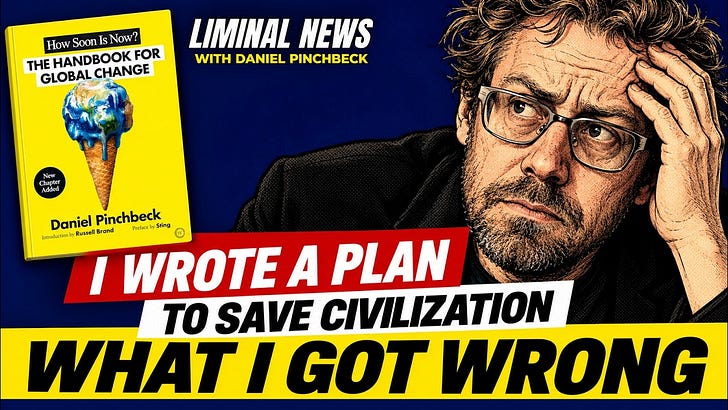
I Wrote a Plan to Save Civilization
Category: SciTech
Share
Archive
Like
Ten years ago, I published an almost ridiculously ambitious book where I tried to put together a complete model of how we could 'save the world' or save our global civilization from ecological and geopolitical meltdown. The book was titledHow Soon Is Now. I started working on it in 2006 and it took me ten years to finish it. Unfortunately, it came out during the 2016 Presidential election when people lacked the bandwidth to focus on it. Ten years later, the world has changed in many ways. The crisis has deepened.
In this video, I want to go back toHow Soon Is Now, present my original plan as well as my theory of change, and then offer some updates and criticisms of my ideas from a decade ago. I still feel, considering where we are now, we need some macro-level, visionary ideas or models for how we could redesign our civilization — I see it as kind of like installing a new system software on a computer and then relaunching it.
Unfortunately, when those relaunches happen in human societies, it often requires revolutions, mass breakdowns, wars, and so on before we figure it out. The Revolutions of the late 18th Century, the American Civil War, and the Communist Revolutions in Russia and China were examples of this. But before we can do anything useful, we need an idea or a vision of what the end goal is and how we might get there.
We have to start by understanding our situation not just as a political or industrial crisis, but as an evolutionary bifurcation. The ecological breakdown operates not as a sudden technical glitch, but as an evolutionary trigger. InHow Soon Is Now, I argue that we find ourselves in something like a planetary birth canal. This is a violent, pressurized threshold forcing either a massive contraction or even humanity's extinction or a massive leap in our collective consciousness.
To survive this passage, we must view civilization itself as a kind of biological process. Humanity functions, collectively, as a super-organism. We are not separate from the biosphere. We are the earth reflecting on itself and evolving itself. We literally transform the planet through our actions — that is why some people call this geological epoch, the Anthropocene. Unfortunately, it is also the Entropocene, where our industries accelerate entropy, both physically and psychically.
Think about what's happened on the planet and how it is kind of similar to what happens in the womb during fetal development. Over the last two thousand years, we covered the world with bridges, shipping lanes, Internet cables, and sattelite transmissions. We went from being widely separated tribes to being one interconnected planetary system — much as the brain of a baby becomes self-aware and discovers its body.
Look closely at our technology.
A note on cookies
Newshunt uses essential cookies to keep you signed in and to remember your language and country, so the site works the way you expect. With your permission, we'd also like to use analytics cookies to understand how people use Newshunt and improve it over time.
Accepting only affects analytics. To learn more, view our Privacy Policy or Terms & Conditions.
(0)Comments