


Class 8 preliminary orders up 31% y/y
Category: Business
Share
Archive
Like
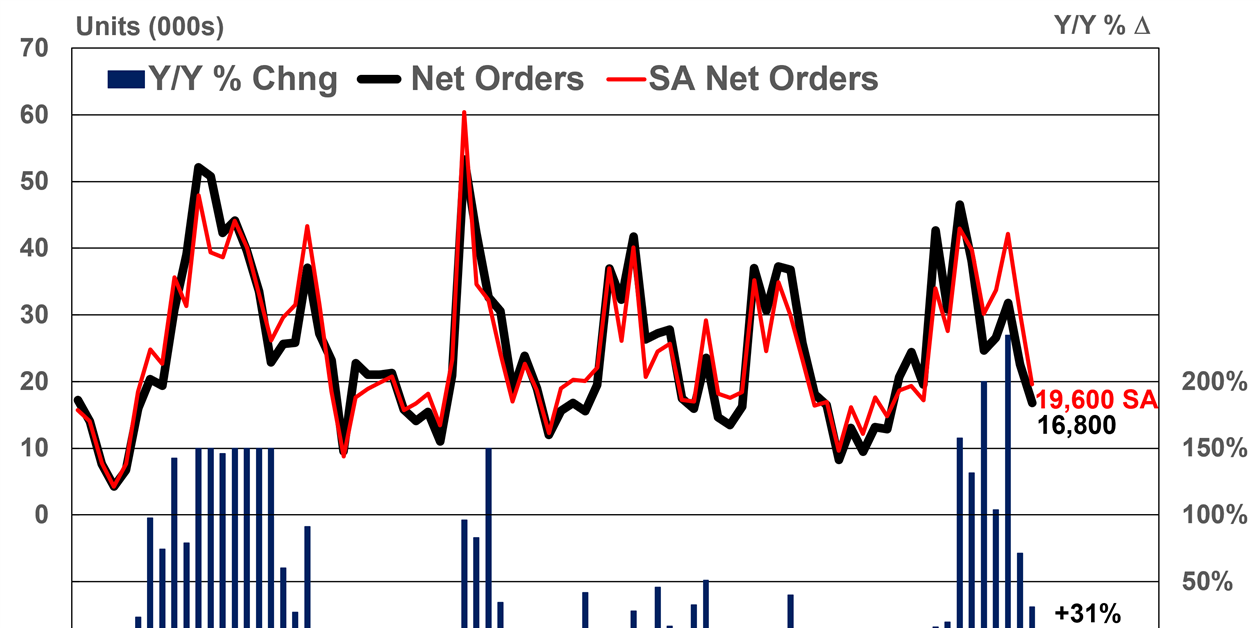
Class 8 orders continued their upward trajectory in August, with preliminary orders totaling 16,800 units (19.6k SA), up 31% year over year (y/y) 'on easy, tariff and carrier profitability impacted comps at this time last year,' according to ACT Research's State of the Industry: Classes 5-8 Vehicles report.
On a seasonally adjusted basis, preliminary net orders fell 35% from the previous month, which the report again attributed to oversubscribed 2026 backlogs and constrained 2026 build slot availability. July ending data showed 2H'26 backlogs oversubscribed by roughly 35,000 units. Adding to the month-over-month weakness is the seasonality factor, the report noted, as orders are typically slow in August prior to OEMs opening next year's order boards in September.
'Demand for new equipment remains strong, supported by meaningfully improved freight rates,' stated Carter Vieth, research analyst at ACT Research. 'While largely driven by severe contractions in the driver supply earlier this year, the Montgomery SCOTUS decision, stricter ELD/HOS rule enforcement and new carrier registration rules have also added to supply constraints and rate improvement through 2026.'
Weakness in housing and 'K-shaped consumer spending' have had some negative impacts on freight rates, but the recovery in U.S. manufacturing and continued buildout of data centers/utilities continue to marginally aid profitability and demand, he continued, adding, 'Q2 earnings from the publicly traded group of TL carriers highlight the fleets' profitability recovery, with aggregate net profit margins hitting a nearly three-year high in Q2.'
Preliminary Classes 5-7 orders rose 37% y/y, to 20,00 units (20.5k SA) in August. On a seasonally adjusted basis, medium-duty orders have remained above 20,000 units for the past four months, up from the 16,000-unit order trend at the start of 2026. The timing of these gains suggests customers and dealers are working to get ahead of 2027 regulations, the report indicated, adding the country's ongoing economic resilience despite inflationary headwinds is likely another factor supporting higher order levels.
A note on cookies
Newshunt uses essential cookies to keep you signed in and to remember your language and country, so the site works the way you expect. With your permission, we'd also like to use analytics cookies to understand how people use Newshunt and improve it over time.
Accepting only affects analytics. To learn more, view our Privacy Policy or Terms & Conditions.
(0)Comments