


Addo Elephant National Park, where land and ocean safaris meet
Category: Tourism
Share
Archive
Like
Addo Elephant National Park in the Eastern Cape brings together dense thicket, mountain ravines and a protected slice of Indian Ocean coastline in a single conservation area. Established as a national park in 1931 to safeguard the last surviving elephants of the Sundays River valley, it has since expanded into a multi-part reserve that reaches from inland dams and Karoo landscapes down to coastal dune fields and offshore islands.
From 11 elephants to a sprawling conservation landscape
The story of Addo Elephant National Park begins with a remnant herd of only eleven elephants in the Sundays River valley at the start of the 1930s, following decades of hunting and conflict with farmers.The park was proclaimed in 1931 to protect those remaining animals and initially covered just over 2,000 hectares of dense evergreen scrub known as Addo bush.An elephant-proof fence was completed in 1954, enclosing a slightly larger area and making it possible to manage elephants within fixed boundaries.
Since that modest beginning, the protected area has grown into what is now referred to as the Greater Addo Elephant National Park, with terrestrial sections covering around 1,640 km² (630 sq mi) and a linked marine protected area in Algoa Bay.The park's terrestrial area is about 1,640 km², and when the marine section is included, the overall conservation footprint extends over roughly 180,000 hectares of land and a 120,000-hectare stretch of ocean and estuary.The Greater Addo figures illustrate the expansion from a small valley reserve to a much larger network of landscapes and seascapes.
Land, thicket, dunes and sea: the geography of Addo
Addo Elephant National Park lies north-east of Gqeberha (formerly Port Elizabeth) in South Africa's Eastern Cape province, with its main game-viewing area in the Sundays River valley and further sections reaching into the Zuurberg and Winterhoek mountain ranges.The southern portion in the valley preserves thick evergreen scrub, while a northern section of rounded hills and ravines in the Winterhoek Mountains was amalgamated with Addo in 1995 after having been protected separately as Zuurberg National Park.This linkage increased the space available for large mammals such as elephants and black rhinoceroses.
Towards the coast, the park's boundaries reach the Alexandria dune fields and coastal forest near Woody Cape, before stepping offshore into Algoa Bay.The marine protected area associated with Addo includes the Bird Island and St Croix island groups, a band of ocean eastward from the industrial harbour at Coega and the mouth of the Sundays River.Together, these pieces form a route from inland Karoo landscapes to the Indian Ocean, giving Addo an unusual blend of bushveld, fynbos, dune and marine environments within one national park.
Wildlife at Addo: elephants, Big Five and the so?called Big Seven
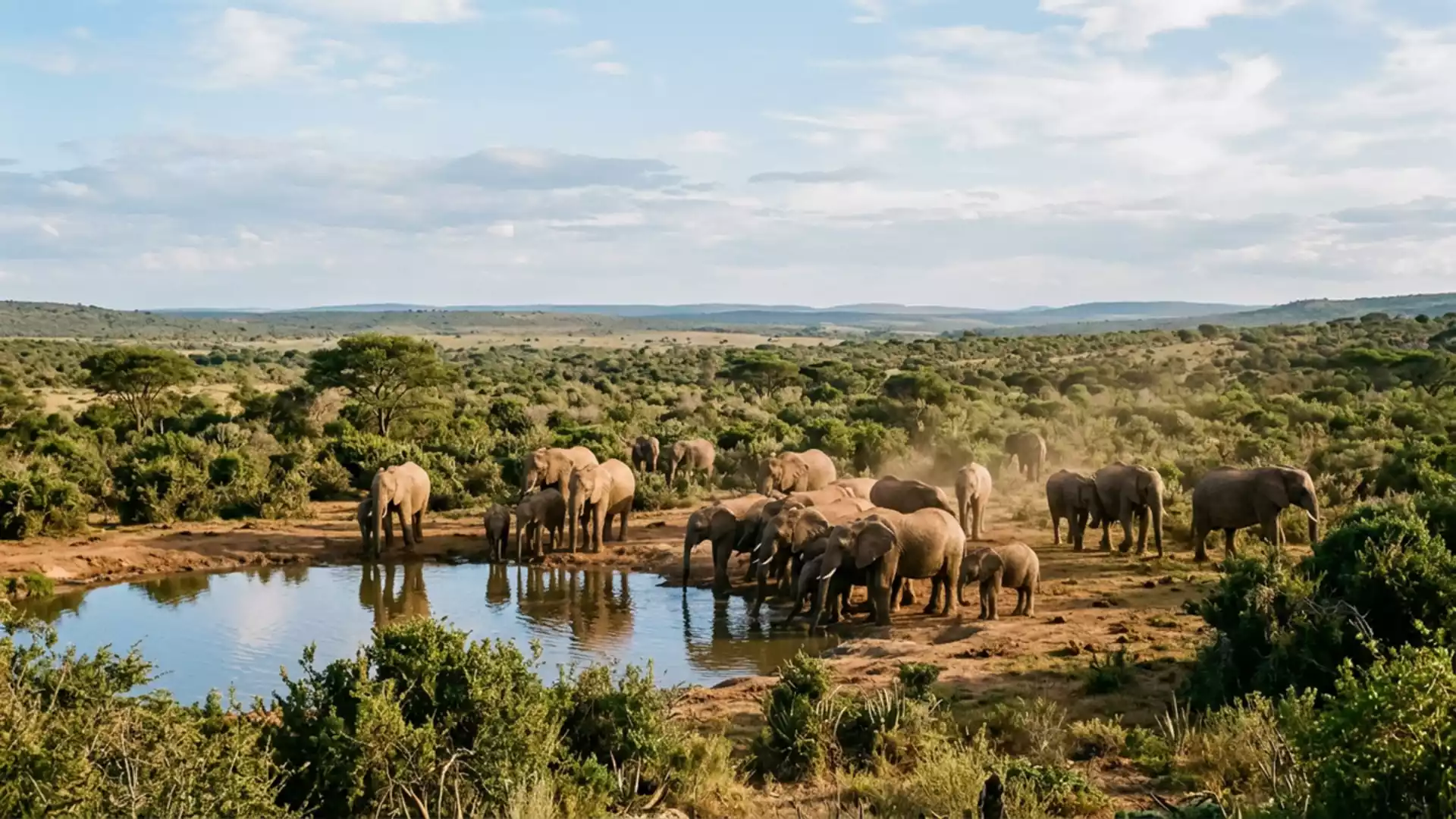
As its name suggests, elephants are central to Addo's identity. The thick, low scrub of the Sundays River valley shelters one of the densest elephant populations on Earth, with several hundred animals in the main terrestrial section.The park holds more than 600 elephants, alongside herds of Cape buffalo, a population of black rhinoceroses and predators such as lion and leopard in selected zones.These species together make Addo a Big Five destination, with plains game and abundant birdlife filling out the terrestrial ecosystem.
Through its marine protected area, Addo adds great white sharks and southern right whales to that list, giving rise to the description of the park as a Big Seven destination that combines land and ocean predators and large mammals.The inclusion of Algoa Bay's marine species reflects a broader conservation approach that treats sea and shore as parts of the same environment rather than separate realms.Smaller creatures such as the Addo flightless dung beetle underline that the park's remit goes beyond charismatic megafauna and extends to endemic invertebrates linked closely to the elephant herds.
Visiting Addo Elephant National Park: what travellers from Western Europe should know
Addo Elephant National Park lies in South Africa's Eastern Cape province north-east of Gqeberha (Port Elizabeth), reached by road from the city along routes such as the N10 and R336.
The main game area includes low, dense thicket and undulating terrain; some viewpoints and lookouts are accessed via short footpaths, while certain routes involve gravel surfaces.
The coastward sections near the Alexandria dune fields and Woody Cape involve sandy tracks and dune slopes, and the marine protected area is viewed from shore or by boat with authorised operators.
The official language is Afrikaans and the currency is the South African rand.
Entry requirements depend on your nationality; UK travellers can check the FCDO travel advice at gov.uk/foreign-travel-advice, Irish travellers the Department of Foreign Affairs at ireland.ie.
Searching for Addo Elephant National Park on social platforms
These links open searches for Addo Elephant National Park on each platform.
Frequently asked questions about Addo Elephant National Park
Where is Addo Elephant National Park located?
Addo Elephant National Park is in South Africa's Eastern Cape, north-east of Gqeberha (Port Elizabeth), with sections stretching from inland Karoo landscapes to the Indian Ocean coast.
What can visitors expect on a visit to Addo?
Visitors encounter dense thicket with elephant herds, open plains with other large mammals, mountain and dune scenery, and coastal viewpoints over the marine protected area.
What makes Addo Elephant National Park distinctive among South African parks?
Its combination of a historically important elephant population, a large terrestrial reserve and a formally protected marine area giving access to the so?called Big Seven sets Addo apart.
A note on cookies
Newshunt uses essential cookies to keep you signed in and to remember your language and country, so the site works the way you expect. With your permission, we'd also like to use analytics cookies to understand how people use Newshunt and improve it over time.
Accepting only affects analytics. To learn more, view our Privacy Policy or Terms & Conditions.
(0)Comments