


Saudi photographer Mohammed Al-Atiq: ‘Academic certificates do not give you an artistic eye'
Category: Tourism
Share
Archive
Like
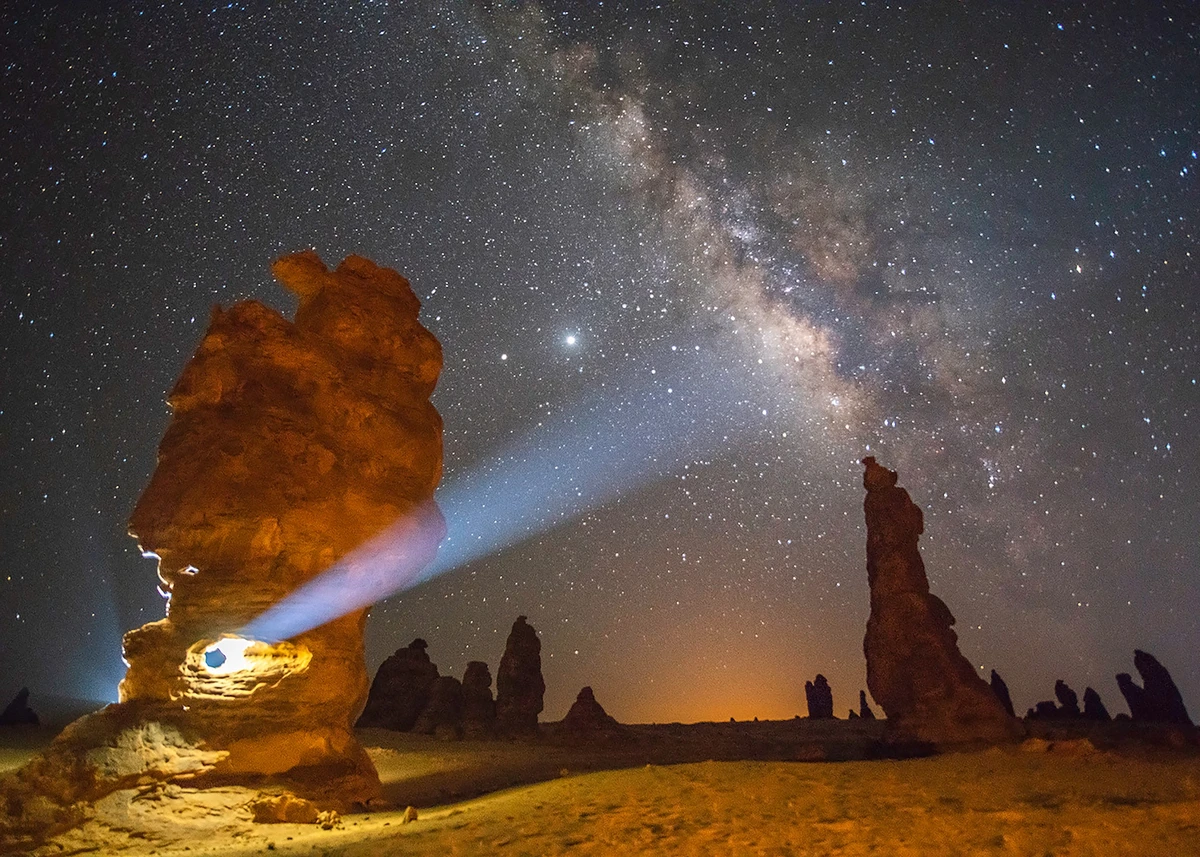
DUBAI: Saudi photographer Mohammed Al-Atiq is from AlUla governorate, which he describes as 'one of the most prominent tourist and historic destinations in the world, for the natural and cultural heritage it holds, going back thousands of years.' He never studied photography. 'Academic certificates do not give you an artistic eye, and they are no substitute for understanding light and developing your visual diet,' he tells Arab News. 'Practice, direct contact with the field, and trying different lighting conditions teach you what books and courses do not explain.' Asked how he would describe his work to someone who had never seen it, he said it came down to building a visual archive. 'Each picture tells its story, and makes whoever sees it feel the same energy and the same emotion of the moment.' He tends to shoot the same places during the day and at night. 'Each time of day shows a different essence, a different feeling and a different angle of the place,' he says. '(In the daytime) you see the true colors, the angles and the fine details. But darkness has something a mystery to it; it needs the right lighting to arrive at a creative image, and it is usually exhausting, but shooting in it is a pleasure. Night photography is my first love.' His hardest shoot was a landscape in the Al-Hamna area of the Madinah region, in a valley with clay ground. 'I fell. My camera was destroyed, and I almost lost my life,' he says. AlUla oasis I took this in 2015 in AlUla. This place is part of my life and my childhood memories. Our family's farms are there, and it's close to where I live. I'd imagined this scene for a long time and wanted to make a visual reading of it from above, one that brings out the unique harmony between the spread of the palms and the height of the mountains around them. I climbed the mountain on foot on a Friday morning in the winter — it's a dangerous path — to come out with an exceptional angle. It took three-and-a-half hours of watching and waiting for the right cloud formations and for the light and shadow to fall correctly. The warm color of the sand makes a striking contrast with the green of the palms. Wadi Disah, Tabuk This was taken in the winter of 2014. The picture was an idea drawn in my imagination before I reached the place, because my memory of earlier visits had left a deep impression of the valley and of its water, which runs for most of the year. But I was looking for an exceptional moment, so I waited for the rainy season and came back. I was with my friend, the photographer Nader Al-Balawi, and we stayed five hours through the evening before sunset. This particular frame took a full hour. The real challenge was finding the angle that shows the mountains in sequence, then waiting patiently for the surface of the water to settle — for the breezes to drop and the cars and visitors to stop moving — until it reflected the scene like a clear mirror. Elephant Rock, AlUla I took this around 2013. Elephant Rock is one of the important and well-known tourist sites in AlUla, and the Royal Commission for AlUla has rehabilitated it as a global destination. I had visited before and photographed it from several angles, but this time I wanted a distinctive frame, so I planned to shoot from this angle specifically, in the first moments of sunrise, after the dawn prayer. Usually when you want to photograph a site you know well, the picture forms in your imagination in advance. I reached it by car — access is easy because it is close to the town — and prayed there while it was still dark, in a very quiet place and in the biting cold, so that I would be completely ready for the moment the sun came up. I wanted the sunstar effect as it touched the mountains. The challenge was catching that effect quickly, because the sun rises fast. Al-Gharameel Nature Reserve I took these two pictures in 2022 in Al-Gharameel, an area distinguished by unique vertical rock formations carved by the wind in the middle of the desert. It's one of the best places in the world for photographing the Milky Way and the stars, and for contemplating the sky. This idea was not drawn in advance; only when I was standing at the site did I start looking for the angle that would bring the Milky Way out in harmony with the rock formation. Night photography needs somewhere very dark, far from city lights. I used a torch to throw light from inside a small opening, directing the beam toward the Milky Way as a guiding line toward the dominant element, with the help of Nader Al-Balawi. Each picture took an hour of continuous work, and the whole trip about 10 hours. The hardest part was balancing the artificial light against the natural light of the sky. Štrbački Buk, Bosnia I photographed Štrbački Buk, on the Una river near the city of Bihać in Bosnia, in August 2024. It was my first time exploring and documenting sites in Bosnia and Herzegovina, and I had never seen this one before. I was on a tour with my wife, and as we were passing through the area our guide pointed the waterfall out to us and told us how important and beautiful it was. That recommendation, and my own eagerness to find natural angles, made me ask to go straight there. After trying several angles, I chose this one. I used an ND8 filter to slow the shutter and give the water a soft, silky texture. Qasr Al-Bint, Hegra I took this in December 2013. It's one of the well-known facades of Qasr Al-Bint at the archaeological site of Hegra. The visit was not scheduled. I was on a family outing with my children near the area when the cloud formations in the sky stopped me, and I immediately imagined the magic they would bring to the colors of sunset, so I decided to head to the site to chase that moment. Entering requires a security permit, and because the site is protected and has fixed closing times I had to finish quickly. The whole thing was made in 30 minutes. The greatest challenge was the short life of sunset — either you seize it in its golden minutes or you lose those colors. An ordinary viewer may not notice the precision of the carving and the rock reliefs on the facade at first glance, but a photographer is passionate about detail. Jabal Mahja, Hail In June 2014 I had an exceptional shoot at Mahja, west of the city of Hail, a site with strange and astonishing rock formations shaped by erosion. I had never been there before, so before setting out I had no complete picture of the place, but studying photographs of the mountain from several angles gave me the idea of shooting it as star trails. A number of fellow photographers came with me, along an exhausting track that required four-wheel drives, and each of us chose his own angle. The shoot took about eight hours without a break, using shutter speeds of 25-to-30 seconds-per-frame at low ISO. I took 370 consecutive frames and merged them in Photoshop. What the viewer does not notice at first is the center of rotation.
A note on cookies
Newshunt uses essential cookies to keep you signed in and to remember your language and country, so the site works the way you expect. With your permission, we'd also like to use analytics cookies to understand how people use Newshunt and improve it over time.
Accepting only affects analytics. To learn more, view our Privacy Policy or Terms & Conditions.
(0)Comments