


Is this the most expensive subject your child could pick?
Category: Entertainment
Share
Archive
Like
Advertisement
NationalQueenslandSchools Is this the most expensive subject your child could pick? Catherine Strohfeldt
September 8, 2026 — 5:00am
Save
You have reached your maximum number of saved items.
Remove items from your saved list to add more.
Share
A A A
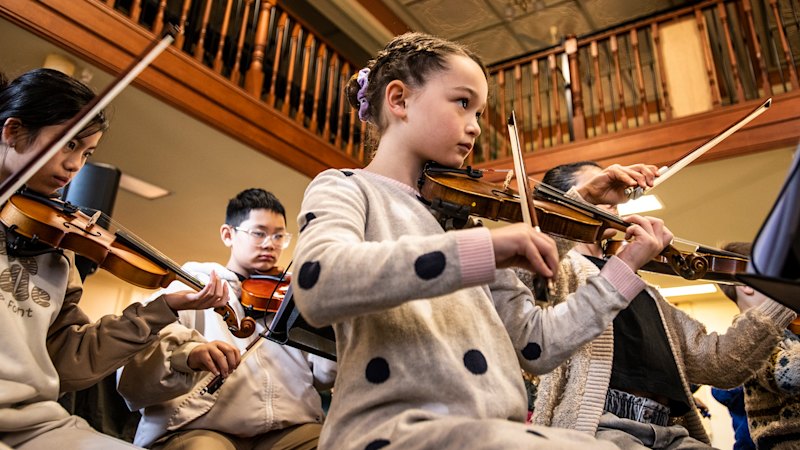
Experts fear changes to the Queensland curriculum are turning families away from music studies, as the number of teachers falls, schools reduce the courses on offer, and those that remain have high out-of-pocket costs.
Metropolitan schools retain music students through to high school more successfully than other creative arts subjects, partly because of extracurricular offerings such as school bands.
However, not all families are prepared to pay.
Kelvin Grove State College's instrumental music program requires families to pay $175 each year to cover uniform costs, with additional instrument hire fees.
Kelvin Grove State College / Instagram
Instrumental music programs at some of Brisbane's largest state high schools can cost families $175 each year, and more than $130 in instrument hiring costs, without factoring in private tuition.
For instrumental music, Jenkins said, the state ran a program for selected students from year 3 onwards.
'Selection for the music program is up to each school's individual policy, with consideration given to the ensemble's make-up, time available and whether the program is a good fit for the student.'
The updated Queensland primary curriculum includes one semester of assessable learning every two years as the minimum requirement for creative arts subjects from years 1 to 6.
Kathleen Jenkins on a music and education panel at Bigsound in Brisbane.
Simon Gorman Clark
The curriculum required students to have participated in all five arts subjects – dance, drama, media, music and visual arts – at least once by the end of year 6.
Advertisement
If schools could employ a classroom music teacher, that teacher would teach each year level for between 30 and 40 minutes each week.
Queensland Teachers' Union vice-president Leah Olsson.
Catherine Strohfeldt
Queensland Teachers' Union vice-president Leah Olsson said there were about 500 full-time equivalent classroom music teachers across more than 900 primary schools in the state.
'Schools are now employing people as art specialists, where they deliver the whole spectrum of the arts,' Olsson said.
'Previously, music was its own specialty area, and the classroom teacher would actually take on the responsibility to teaching [other creative arts].'
Advertisement
The union formed a focus group for primary music education 11 years ago, after teachers noticed fewer students choosing music, particularly in the regions where music teachers often covered multiple schools. Related Article University 'ATARmaxxing': The school trend experts say is quashing the creative sector
Jenkins said industry and external providers could fill the gaps in the public system, but funding was an issue.
'We've got all sorts of sports grants – we've got the Play On vouchers that parents can apply for,' she said.
'It's awesome ... my kids are playing sport because of them, and I bet my kids would probably be learning more about music if we had them [for the creative arts].'
Advertisement
When asked whether it had considered cost-of-living help for arts courses, an Education Department spokesperson said parents could speak to principals about fee waivers.
The department's Back to School Boost program – which will jump to $150 for each primary school child next year – can be applied to music-related costs if they are invoiced directly by the school.
A department spokesperson said remote and regional schools could access travel grants and funding for creative arts incursions.
Start the day with a summary of the day's most important and interesting stories, analysis and insights. Sign up for our Morning Edition newsletter.
From our partners
A note on cookies
Newshunt uses essential cookies to keep you signed in and to remember your language and country, so the site works the way you expect. With your permission, we'd also like to use analytics cookies to understand how people use Newshunt and improve it over time.
Accepting only affects analytics. To learn more, view our Privacy Policy or Terms & Conditions.
(0)Comments