


163 years later, Sabine Pass remembered as a Confederate stand against long odds
Category: Blend
Share
Archive
Like
SABINE PASS, Texas — Today marks the anniversary of the Battle of Sabine Pass, one of the most lopsided Confederate victories of the Civil War, fought on Sept. 8, 1863, at Fort Griffin near the mouth of the Sabine River.
It remains one of the most one-sided victories of the Civil War: a garrison of just 46 Confederate soldiers repelled a Union invasion force of nearly 5,000 men without losing a single soldier.
The battle unfolded at Fort Griffin, an earthwork near the mouth of the Sabine River outside Sabine City, where the Confederacy had recently positioned six cannon, two 24-pounders and four 32-pounders, to guard the pass.
The Union assault was part of a larger push into Texas. Gen. Nathaniel P. Banks sent about 4,000 troops under Gen. William B. Franklin by transport from New Orleans, with plans to land at Sabine Pass and follow a nearby railroad inland toward Houston. Four Navy gunboats carrying 18 guns were sent ahead to clear the way.
Defending the fort were the Davis Guards, Company F of the First Texas Heavy Artillery Regiment, commanded by Capt. Frederick Odlum. In the days before the attack, they'd marked distances along both channels through the pass and drilled to sharpen their aim.
A missed rendezvous between Union ships on the night of Sept. 6 cost the invasion force any element of surprise. Two days later, the gunboat Clifton opened fire on the fort from long range for about an hour that morning, but stayed beyond the reach of the Confederate guns, and the defenders held their fire and waited.
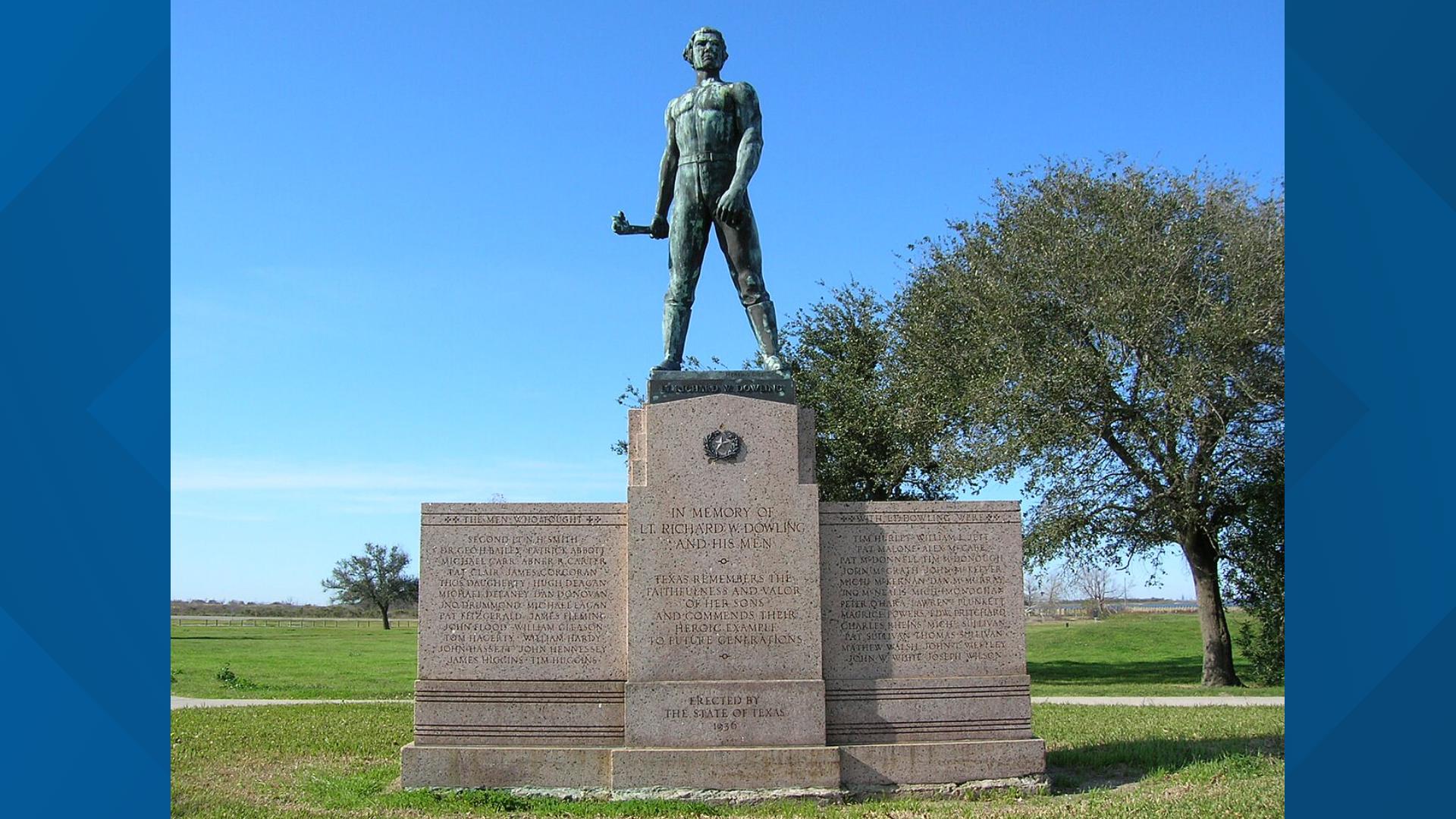
The real fight came at 3:40 p.m., when the Union gunboats pushed into the pass and began firing as they advanced. Lt. Richard W. Dowling led the Confederate gunners out to their cannon as the ships closed to within 1,200 yards. One cannon slid off its platform early on, but the remaining five found their range.
A shot in the third or fourth round tore into the boiler of the gunboat Sachem, which exploded and left the ship dead in the water, its crew killed or wounded. The Arizona, blocked from passing the crippled Sachem, backed off and pulled out. The Clifton pressed forward along the Texas shore until Confederate fire severed its tiller rope, leaving it unable to steer; it ran aground, and a second hit to its boiler filled the vessel with steam and smoke, forcing the crew to abandon it. A fourth ship, the Granite City, turned back rather than run the gauntlet, and the assault collapsed.
In 35 minutes, the Davis Guards fired 107 rounds, a pace far above the standard for heavy artillery at the time. They captured two Union gunboats and roughly 300 prisoners. Franklin's expedition returned to New Orleans, though Union forces went on to occupy the Texas coast from Brownsville to Matagorda Bay later that year.
The Confederate Congress formally thanked the Davis Guards for the victory. The battlefield is preserved today at the Sabine Pass Battleground State Historic Site, 6100 Dowling Rd. in Port Arthur.
A note on cookies
Newshunt uses essential cookies to keep you signed in and to remember your language and country, so the site works the way you expect. With your permission, we'd also like to use analytics cookies to understand how people use Newshunt and improve it over time.
Accepting only affects analytics. To learn more, view our Privacy Policy or Terms & Conditions.
(0)Comments