


Satellite Connectivity Becomes a Battlefield Weapon as Europe Seeks an Answer to Starlink
Category: SciTech
Share
Archive
Like
Satellite communications are becoming an increasingly important element of military capability, from secure command links to the control of unmanned systems. Global satellite capacity has expanded rapidly since the outbreak of the war in Ukraine, while Europe is under growing pressure to build sovereign alternatives to US-led systems. Poland is set to participate in the EU's IRIS² constellation and plans to finance the construction of more than a dozen satellites.
According to data from consultancy Novaspace, global satellite capacity reached 15 Tb/s in 2022, an increase of 62% year on year. Between 2023 and 2025 it rose roughly three-and-a-half times to 105 Tb/s. Extending that trend would put capacity at around 120–130 Tb/s in 2026.
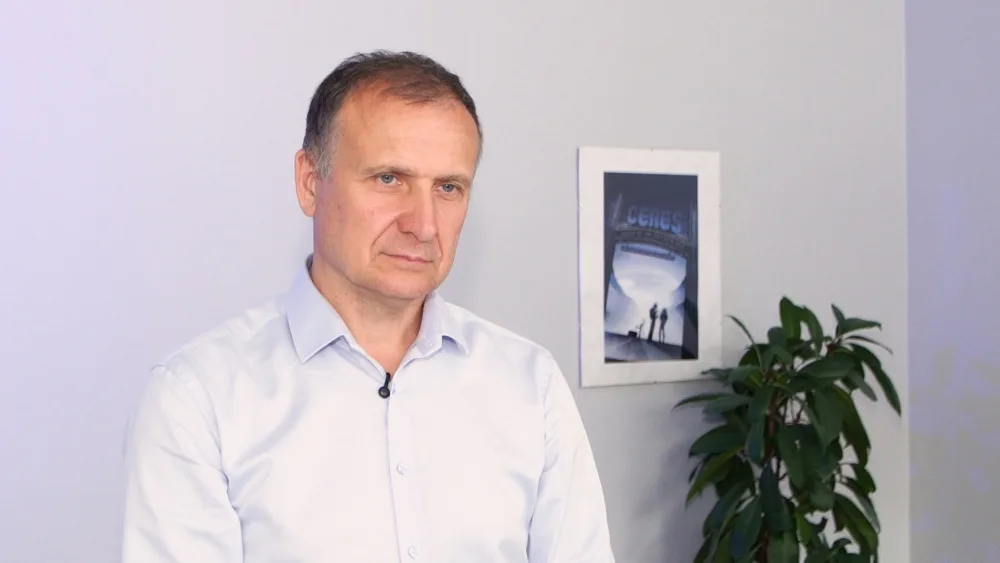
Piotr Mierzejewski, CEO of Polish space company Thorium Space, says the acceleration reflects rapidly growing demand for satellite connectivity in both civilian and military applications.
'Satellite communications have a very broad range of uses in warfare and in the armed forces — not only for communication, but also for controlling unmanned systems and drones. Fast, reliable and secure connectivity is increasingly one of the factors that determines battlefield advantage,' Mierzejewski told Newseria.
According to the figures cited by Thorium Space, around 93% of global satellite throughput currently comes from Starlink. That scale gives the US system a dominant position and allows it to shape market prices, technical expectations and the direction in which competitors have to develop.
The European Commission has also pointed to a broader transformation of the satellite market. Falling launch costs, cheaper satellite production and growing demand for connectivity in poorly served areas are changing the economics of space infrastructure.
Mierzejewski argues that Europe faces a structural cost disadvantage. US launch solutions are already several times cheaper than many European alternatives, and the next generation of launch technologies could widen that gap further. China and India also benefit from larger scale and lower unit costs.
'Europe, in its current configuration, is largely able to meet its own needs, but it operates at a much smaller scale. That means higher costs. In the consumer market it will be extremely difficult to compete with the American and Chinese models. The strongest argument for Europe is therefore technological sovereignty — particularly secure communications for governments and armed forces,' he said. IRIS² is Europe's strategic response
The European Union's answer is IRIS² — Infrastructure for Resilience, Interconnectivity and Security by Satellite. The programme is intended to provide secure communications for governments, defence users and commercial customers while reducing dependence on non-European infrastructure.
The planned constellation will use 348 satellites in low and medium Earth orbit. Unlike the highly integrated US model, the European programme relies on cooperation among multiple companies and countries. Mierzejewski expects this structure to make coordination more complex and says delays are possible, even if the programme ultimately delivers the intended capabilities.
Poland will be one of the countries contributing directly to the project. The country plans to finance the construction of more than a dozen satellites with PLN 2.8 billion, or about EUR 656 million, using funds reallocated under the National Recovery Plan. Poland's space sector is gaining military experience
Poland's space industry is still relatively young, but it is moving from research programmes toward operational systems. A milestone came on 28 November 2025, when Poland's first military radar satellite supplied by ICEYE was launched aboard a SpaceX Falcon 9 rocket. The system gives the Polish Armed Forces an independent Earth-observation capability regardless of weather conditions or time of day.
A recent Polish Space Agency report describes the domestic sector as a combination of commercial, public and research activity. European funding continues to support technologies with a relatively clear path toward implementation in civil, public-sector and commercial applications.
Mierzejewski says the next challenge is to give Polish companies enough contracts to build flight heritage and prove their technologies in operational conditions.
'The Polish space sector is developing very dynamically, but it is young. Some companies already have experience with putting their solutions into space, while others are only building that experience. To use their products in the future, they need orders and opportunities to demonstrate them,' he said.
Thorium Space is working on projects including the European Space Agency's HummingSat programme, the SUBCOM remote-sensing and communications system for suborbital rockets, and the T-XPDR tactical adaptive satellite transponder.
The company says resilience to interference and secure transmission are becoming central design requirements. Its strategy is not to compete with mass-market systems on price, but to develop communications technology aimed at state, defence and other special-purpose users where reliability, sovereignty and security matter more than consumer economics.
Source: Newseria; data cited from Novaspace, the European Commission and the Polish Space Agency.
A note on cookies
Newshunt uses essential cookies to keep you signed in and to remember your language and country, so the site works the way you expect. With your permission, we'd also like to use analytics cookies to understand how people use Newshunt and improve it over time.
Accepting only affects analytics. To learn more, view our Privacy Policy or Terms & Conditions.
(0)Comments