


What Lies Beneath the Tryst: Land, the Legacy, and the Unfinished Future of Fire Island Pines Harbor
Category: Entertainment
Share
Archive
Like
For more than two summers, residents and visitors in Fire Island Pines have looked across the harbor and wondered the same thing: What is happening with the old Botel?
The answer may be more complicated than a delayed hotel renovation.
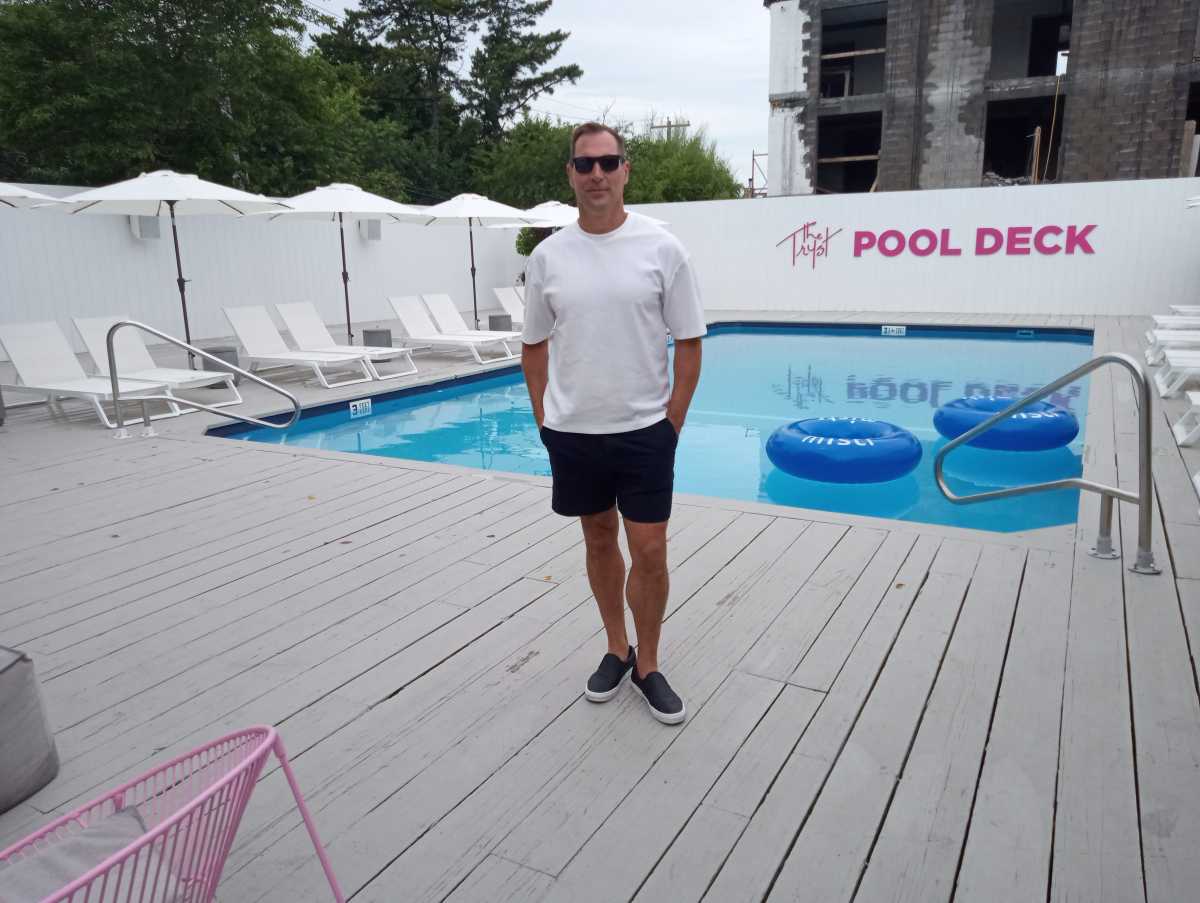
In 2024, hospitality entrepreneur Tristan Schukraft acquired roughly 75% of the community's commercial district, including the Blue Whale, Pavilion, Canteen, pool deck, gym, retail spaces, employee housing, and the former Botel, which he announced would become The Tryst Fire Island, a 30-room hotel overlooking the harbor.
The acquisition was significant not only for its scale but also for Schukraft's stated intentions. In a July 2026 op-ed, he framed the investment as more than a business purchase, in one of the most important places in LGBTQ+ history, and drew a parallel to another part of his life: before Tryst Hospitality, he founded MISTR, a telehealth platform that expands access to PrEP.
'At first glance, beach restoration and HIV prevention may seem unrelated. I don't think they are,' Schukraft wrote in his statement. 'Both are investments in the future. One protects a place that has shaped generations of LGBTQ+ people. The other protects the health of the people who gather there. Strong communities need both.'
Schukraft arrives at an interesting moment, one that raises a broader question: How does a historic gay community remain alive rather than simply become historic?
Part of his answer appears to be reinvestment. But to understand what he intends to build, you first have to understand what he bought.
Before the Clubs, There Was the Land
Much of what became Fire Island Pines was once a tract known as Lone Hill, acquired in 1925 by the Home Guardian Company, controlled by developers Warren and Arthur Smadbeck. After delays during the Depression and World War II, the company laid out a summer community in 1952 and, the next year, bulkheaded a harbor dredged from a mosquito ditch, part of the original plan rather than a natural bay, around which the Pines grew.
Broadway producer Peggy Fears developed the Pines Yacht Club and Botel in the late 1950s. After a 1959 fire, she rebuilt the property and sold it in 1962 to John Whyte, the namesake of Whyte Hall. Whyte became the sole owner and built the institutions that would define gay life here, including the Blue Whale, where the Tea Dance launched in 1966. The Pavilion, on a separate parcel, opened in 1980; Whyte acquired it in 1989.
The businesses increasingly seemed to form a single center, but the land beneath them told a different story: owning the business didn't always mean owning the land.
A Suffolk County tax map still shows the individual lots beneath the harbor's familiar businesses. For roughly 60 years, Becksmad Associates, a Smadbeck family entity, owned the Canteen, pool, and retail parcel, while the businesses above it operated under a separate ground lease. That split resurfaced at a 2015 auction, when the Botel, the Blue Whale property, and the Pavilion sold as fee-simple real estate, while the Canteen parcel sold only as a leasehold.
Becksmad sold the land in 2022, its first sale in 60 years, to Ruff Picketty LLC. Schukraft reassembled many of the pieces two years later. Even today, the harbor remains a collection of separate properties.
FIPPOA President Henry Robbins confirmed to Fire Island News that harbor ownership remains divided.
'The Blue Whale, the Canteen, and the Botel are owned by Tryst Hospitality,' Robbins explained. 'Their area of ownership is the area in front of their properties. The second owner is the Schraders, who own The Pantry grocery store. Everything else in the harbor is owned by FIPPOA—what we call the West Hook, where people go to watch the sunset during the season… That's the simple way to measure.'
The Old Botel Meets Modern Regulation
The former Botel adds another layer. It dates to around 1960, long before the current Brookhaven zoning, which now lists hotels as prohibited uses in the Fire Island Commercial District. That rule postdates the hotel's use, raising questions about how it's treated under nonconforming-use rules, especially given the scale of the reconstruction.
There's another complication: Brookhaven condemned the former Botel in May 2023, before Schukraft bought it, citing unsafe conditions and requiring an engineering review and permits before the condemnation could be lifted. He therefore didn't acquire an operating hotel needing renovation, but a condemned, decades-old structure whose use as a hotel dates back over 60 years.
In May 2026, Tryst Hospitality said development was proceeding as it worked through Brookhaven's permitting process. Fire Island News submitted questions about the hotel, permitting, zoning, wastewater, and the historic tax parcels but received no response before publication.
The central question—what's holding up The Tryst—remains unanswered, and the public record still offers no answer. What it does show is an unfinished hotel at the intersection of several layers of Pines history: a harbor planned from the start, divided waterfront parcels, businesses rebuilt by successive generations, changing ownership, aging infrastructure, contemporary regulation, and a hotel use dating back more than six decades.
That history sharpens Schukraft's argument. Preserving the Pines doesn't mean freezing it in time, nor does investing in its future erase the responsibility to understand what came before. The challenge is to find continuity between them.
The unfinished building overlooking the harbor sits on something more complex than sand. Beneath The Tryst lies nearly a century of Pines history, and understanding what happens next requires first understanding it.
A note on cookies
Newshunt uses essential cookies to keep you signed in and to remember your language and country, so the site works the way you expect. With your permission, we'd also like to use analytics cookies to understand how people use Newshunt and improve it over time.
Accepting only affects analytics. To learn more, view our Privacy Policy or Terms & Conditions.
(0)Comments