


Current sensing, then and now
Category: SciTech
Share
Archive
Like
The originalSPIDriver(2018) has current sensing. In the corner of the screen it shows how much current is being drawn on the power rails. This can be useful while driving a device. (This is particularly true in the early stages when you're just wondering if it's even running.)
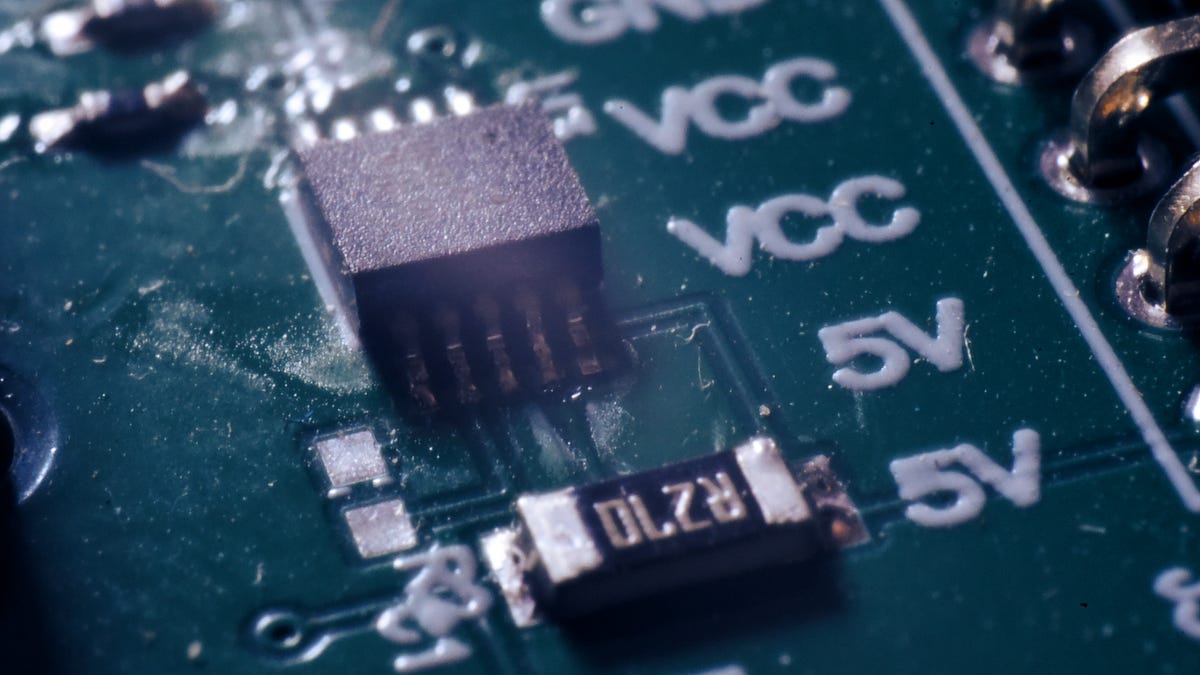
SPIDriver measures current using aZXCT1110 from Diodes Inc. It's an entirely analog part. It senses the tiny voltage across a shunt resistor, and turns that into an output current. An external resistor turns that current into a voltage, and the onboard microcontroller senses that voltage through an ADC.
With resistors selected for the 0-300 mA range of the SPIDriver, and the ADCs carefully configured for maximum resolution, it measured the current to within 5 mA. To do this it needed per-unit calibration. The manufacturing test stand runs it with no load and with a 300mA load, figures out the 2-point calibration, and writes that into microcontroller flash.
Thanks for reading Excamera Labs Substack! Subscribe for free to receive new posts and support my work.
Quite a lot of fuss, and the cost was about 40 cents per unit for the ZXCT1110. And in the end 5mA accuracy isn't really enough to detect subtle state changes in lots of devices.
But eight years have passed, and there has been great progress.
Better sensors are available now. And I've come to understand that microcontroller ADCs are not very accurate (part 1,part 2). Dedicated sensing devices have vastly better accuracy. So now we have the surprisingly comprehensiveINA226current sensor from TI, for about the same price.
First off, this is an I²C device. The ADC is included, so the MCU only has to query some registers to find out the reading. So using it in a design is much less of an electrical person task, more of a software person task.
And the accuracy is much, much better. Setting aside all claims made in datasheets, I can see on the bench that it's accurate down to about 9 µA. That's about 500 times more accuracy than the original setup.
As a bonus feature it also measures absolute voltage to within 10 mV, which is the other analog sensing task in the original SPIDriver.
Overall, it's looking like a great part, and I plan to use it in future products.
A note on cookies
Newshunt uses essential cookies to keep you signed in and to remember your language and country, so the site works the way you expect. With your permission, we'd also like to use analytics cookies to understand how people use Newshunt and improve it over time.
Accepting only affects analytics. To learn more, view our Privacy Policy or Terms & Conditions.
(0)Comments