


Iran to Declare New ‘Restricted Area' in Persian Gulf
Category: Politics
Share
Archive
Like
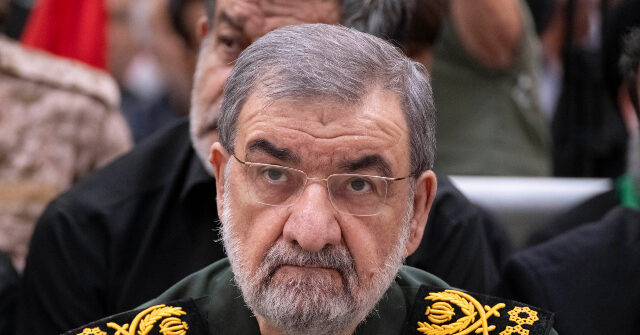
Senior Iranian security official Mohsen Rezaei claimed on Sunday that Iran still controls the Strait of Hormuz, and will soon announce a new 'restricted area' in the Persian Gulf that ships will only be allowed to pass through with permission from Tehran.
The U.S. military made surprising announcements in August that most of Iran's sea mines in the Strait of Hormuz had been removed, and millions of barrels of oil were now moving through the strait under U.S. Navy protection. Some estimates showed traffic levels returning to half, or even two-thirds, of their prewar level.
Iran has been desperately trying to threaten ships in the strait to reassert control and dispute the growing narrative that American forces now control the vital waterway more than Tehran does. Rezaei's boast of creating a new 'restricted zone' was part of that effort.
'This zone will start from the U.S. Navy's blockade line and include areas of the Persian Gulf. Any ship entering this new zone will be placed on the sanctions list,' he said.
'We will only commit to the Strait of Hormuz being open when they stop the sabotage, threats, and attacks on Iran,' he said.
Rezaei also insisted that Iran is still working on an agreement with Oman to control the Strait of Hormuz and extract fees for safe passage from civilian ships. Oman seems considerably less enthusiastic about this idea than Iran, although the Omanis have acknowledged meetings with Iranian officials to determine the future of the strait.
'The maps of a new international corridor which lies in Iranian and Omani waters and in which Iran will have management have been agreed and should be signed in the coming days,' he said.
The belligerent speaker of the Iranian parliament, Mohammad Baqer Qalibaf, sought to back up Rezaei's claims by insisting that international oil shipping remains highly vulnerable to Iranian terrorism.
'It's simple: the oil and gas production chain here is sprawling, accessible, and exposed. American oil and gas companies across these waters and facilities share that exposure,' Qalibaf said.
It was actually three of Iran's tankers that were disabled or destroyed by U.S. strikes on Saturday, after Iran attempted to attack American warships with ballistic missiles. The exchange of fire made shipping companies nervous, reducing ship transits of the strait to about ten per day.
Qalibaf nevertheless claimed on Sunday that the United States must realize 'the rules of the game have changed before it is too late.'
'From now on, any attack against Iran's interests and security will receive a faster, heavier and more painful response,' he said.
Qalibaf also claimed that Iran was managing the 'hardship' of the U.S. blockade and enhanced economic sanctions. Iranian Economy Minister Ali Madanizadeh on Sunday rejected reports that the regime is beginning to buckle under the pressure.
'They speak of economic pressure and isolation, of breaking off financial ties and they think that by pressuring the economy of a country they can change the decisions of its people,' he said.
'I have to clarify one point: The responsibility of reforming Iran's economy is with its government and people, not with the U.S. Treasury,' he added.
Iranian Oil Minister Mohsen Paknejad said in a state television interview on Sunday that Iran's primary oil terminal on Kharg Island has been 'hit around 550 times' since the beginning of hostilities with the United States, but is still functioning.
Middle Eastern Studies chair Stephen Zunes of the University of San Francisco told Al Jazeera News on Monday that Iran can still sporadically threaten ships passing through the Strait of Hormuz, but would have a very difficult time enforcing an expanded 'restricted zone' in the Persian Gulf.
'It's hard to see how they will really be able to enforce it. Iranian ships and planes trying to enforce that would be very vulnerable to U.S. attack,' he said.
'But perhaps they are giving a warning, given there still would be some risk for shipping companies to not count on being able to get through the strait without suffering consequences,' he added.
Zunes speculated that Iranian boasts of an expanded zone of control in the Persian Gulf might be a ploy to provoke the U.S. into launching more strikes, potentially prompting the Iranian people to 'rally around the flag' instead of rising up against the weakened regime. The Iranians might also be trying to intimidate Oman into signing up for Tehran's scheme to control the Strait of Hormuz, or create more leverage for resumed negotiations with the United States.
A note on cookies
Newshunt uses essential cookies to keep you signed in and to remember your language and country, so the site works the way you expect. With your permission, we'd also like to use analytics cookies to understand how people use Newshunt and improve it over time.
Accepting only affects analytics. To learn more, view our Privacy Policy or Terms & Conditions.
(0)Comments