


How the International Plant Production Society Aims to Seek and Share Research
Category: SciTech
Share
Archive
Like
'Blooms and Beyond' is a podcast produced by the University of Georgia Center for Urban Agriculture, whose support makes the series and the outreach that grows out of it possible. The podcast is hosted by Dr. Ping Yu in the UGA Department of Horticulture.
Earlier this summer, Dr. Yu sat down with Brie Arthur, 'Brie the Plant Lady,' International Delegate and Communications Director for the International Plant Production Society Southern Region, to explain how a 75-year-old organization keeps drawing in the next generation.
Here's a brief breakdown of some of the key takeaways from the discussion. You can find the full conversation at bandbpod.com and on Apple Podcasts.
What makes a multifaceted industry thrive? Bringing all the good people together. IPPS is the one that makes it happen.
Public gardeners have the American Public Gardens Association (APGA). The research and academic community has the American Society for Horticultural Science (ASHS). The nursery industry has AmericanHort and statewide associations. But our industry has so many wonderful facets that gardeners, landscapers, nursery and greenhouse professionals, Extension agents and specialists, and students can all build a career in one of them. There aren't a lot of organizations that bring together academics, nursery and greenhouse industry professionals, and public garden professionals, and that is what makes IPPS so unique.
IPPS originally started off as the International Plant Propagators' Society in 1951 and is now the International Plant Production Society. Different name, same acronym, and same mission: to seek and share plant knowledge globally. Changing that word from 'propagators' to 'production' was valuable because it reflects the changes in modern nurseries and creates an opportunity to bring more people in.
IPPS has seven regions around the world, including three in North America (Eastern, Southern, and Western) with additional regions in Australia, Europe, New Zealand, and Southern Africa. Among them, the IPPS-Southern Region is the largest in membership.
IPPS Is Where You Find Your People
Brie Arthur attended her first IPPS Eastern Region meeting in the late1990s as an undergraduate at Purdue University, where she was introduced to the organization then known as the International Plant Propagators' Society. For a young college student who was still finding her direction, the experience became a pivotal moment. She remembers seeing so many people who shared her interests and passion for plants and thinking, 'There were all these other people that were just like me, and I didn't feel like a weirdo for being excited about plants. I knew I had found my group in that moment.'
That first IPPS meeting helped solidify Brie's decision to pursue horticulture and build a career in plant production. Although it took more than a decade before she became deeply involved in the organization, IPPS eventually became an important part of her professional life. She has served on the Southern Region board since 2014 and has devoted considerable time and energy to supporting the organization. Today, Brie serves as the IPPS International Delegate and Communications Director for the Southern Region, continuing the same tradition of sharing knowledge and building connections that first inspired her as a student.
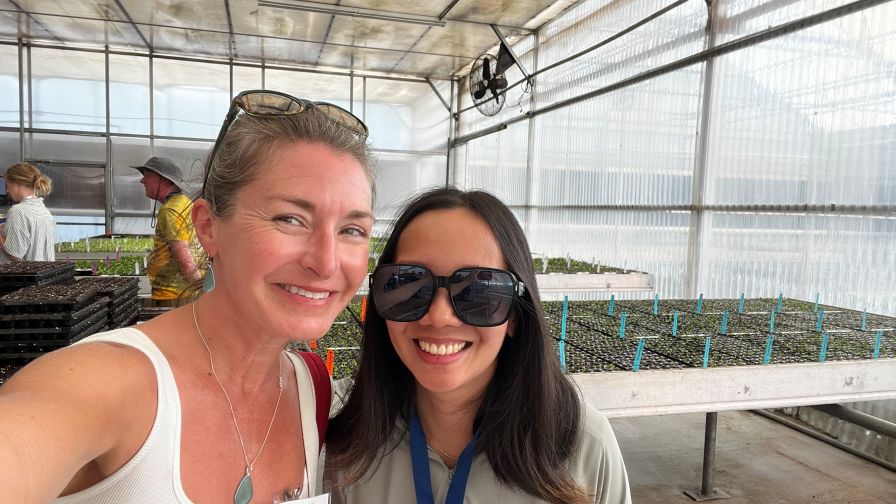
My first meeting was in IPPS-SR in 2019 in Baton Rouge as a graduate student from Texas A&M University. The IPPS was introduced to me by Dr. Sandy Wilson from the University of Florida and my PhD advisor Dr. Mengmeng Gu. I went to the meeting, talked to people, and had the same feeling as Brie, 'Oh, gosh, I found my people.' It was at the meeting when I met Dr. Tom Yeager, a retired professor from the University of Florida. Back then, I cited many of his papers, so I was familiar with the last name. I was standing in the crowd when Dr. Mengmeng Gu randomly asked, 'Oh, do you see Tom Yeager?' I looked at her with a little confusion, 'Oh, this name sounds familiar.' After one second of silence, I responded with an excited voice, 'The Yeager? The one that I always cite?' She nodded. I went there and started talking to Tom Yeager, the Yeager, and he was surprisingly nice, kind and easy to talk to. As nerdy about plants as we are, meeting him felt like meeting a celebrity. So, I took a picture with him and still have it.
When you first started your career, you were trying to figure out who you are and what you do, with different organizations, different groups. Finding your people is critical, and it makes the whole journey an entirely different experience. IPPS is the one that carries the magic power because of all the wonderful people. I have talked to many IPPS members over the years and always hear people saying: 'If I have to choose only one meeting to attend every year, it's IPPS.' This shows how welcoming IPPS is to many people.
IPPS Turns Research Into Practice
Another thing that makes IPPS unique is that people value research and evolve with it, and that is what makes us thrive, not just survive. When researchers and industry people meet at IPPS, we share research ideas. Some are immediately adoptable and some are not, and for the ones that are not there is almost always a way to adapt them. That is the value IPPS delivers to all its members.
When plastic pots emerged in the 1960s, nurserymen began growing plants in containers, transforming the pot from an afterthought into an important production decision. That simple change opened the door to many of the questions we still explore at IPPS meetings today, from pot color and root zone temperature to substrate composition and particle size. Whether rooting liners or finishing plants, these decisions continue to shape production at every stage of the cycle.
The modern nursery industry is only about 75 to 80 years into transformation, with much of its technical advancement occurring within the past 30 years. Throughout that evolution, IPPS has grown alongside the industry, providing a place for professionals to share knowledge, explore new ideas, and learn from one another for more than 75 years.
Dr. Jeremy Pickens from Auburn University presented temperature management in plastic container production at the IPPS-SR annual conference with immediately adoptable research results. As Brie described it, 'hot pots are a big issue as our summers aren't getting cooler.' The message from his talk on 'the advantage of white containers and a cooler root zone' was taken home and adapted by many attendees.
Similarly, Dr. Jeb Fields, now at the University of Florida after LSU, has done a great deal of research on stratified substrates. However, the adoption is not there yet, and Brie is clear-eyed about why: 'the industry is reluctant because it requires multiple potting machines, and it's complicated.' Fortunately, the industry is willing to work with researchers to find a solution if the research is economically worth the investment. For commercial nursery production, the economic and technical barriers may prevent it from being adopted immediately, but the research can be adapted in other places where the barrier does not exist. Brie, as a horticultural communicator, suggested that this information can be used by people who have container gardens at home.
What We Learned
Stratified substrates deliver, but the adoption barrier is equipment, not evidence. If you are evaluating them, cost the second potting line first and the substrate second.
Particle size governs how long your substrate holds fertilizer. Dr. Brian Jackson at North Carolina State University is the other name worth following.
The 2026 meeting is Houston, TX, October 18 through 22 . Members-only early-bird pricing closes September 18 , and the hotel block closes September 26.
. Members-only early-bird pricing closes , and the hotel block closes September 26. The IPPS-SR has many scholarship opportunities for young professionals and students. Every scholarship deadline is June 1 , with applications opening in January . Mark this on your calendar.
, with applications opening in . Mark this on your calendar. The 2027 meeting is in Charlottesville, VA, October 24-28.
1
1
5
How the International Plant Production Society Aims to Seek and Share Research
A note on cookies
Newshunt uses essential cookies to keep you signed in and to remember your language and country, so the site works the way you expect. With your permission, we'd also like to use analytics cookies to understand how people use Newshunt and improve it over time.
Accepting only affects analytics. To learn more, view our Privacy Policy or Terms & Conditions.
(0)Comments