


What Becoming Is For
Category: Entertainment
Share
Archive
Like
I've been alive more than six decades now. I've married, worked, left things, stayed in things, traveled, owned things, lost things, made communities, watched communities fracture, cared for people, watched women age, watched institutions fail and watched people build alternatives in their place. At some point, all of that has to count for something beyond experience.
Today I am asking myself a question that sounds deceptively simple:What do I actually believe now?
I keep this space free because honest conversation is vital right now, especially when so many voices are being pushed to the margins. To support this work, consider subscribing, purchasing a copy ofOn Becoming, or sending a smallVenmo 'thank you,' or simply sharing and restacking—every gesture matters.
It is a somewhat strange question for me to be asking because I wrote an entire book calledOn Becoming. I wrote most of it before I turned sixty, edited it during the year I turned sixty and published it not terribly long afterward. Everything I wrote in that book was true when I wrote it. I don't look back at that woman and think she was naive or wrong. I recognize her completely. But here I am at sixty-three, only a few years removed from her, and I can already see things differently.
I am learning that Becoming doesn't slow down just because you get older. If anything, it appears to accelerate, at least for me. Culturally we still seem committed to the idea that all the interesting human development happens before forty and the rest of life is primarily about maintaining bone density and trying not to look our age.
We have more information than any civilization has ever known what to do with, but I am noticing something happening in my own life as the years accumulate.Repeating patterns.A political movement starts using language you have heard before. Someone tells you that this time everything is completely different and some little voice in the back of your head says,Maybe. But I've seen something that looks remarkably like this before.
Which made me stop when an Instagram post about the Grandmother Hypothesis popped up. The scientific version is fairly specific. It is a proposed theory to explain why human women commonly live for decades beyond their reproductive years. The argument, broadly speaking, is that older women may have contributed to the survival of children and grandchildren through food, caregiving, knowledge and experience. Their reproductive usefulness may have ended, but their usefulness to the group had not.
You mean that some time ago accumulated knowledge of an older woman was once considered an asset?
Imagine that.
Today we live in a culture that spends an immense amount of energy teaching women to fear aging. We are supposed to fight wrinkles, gray hair, menopause, softness, invisibility and anything else suggesting that we are no longer thirty-five. We are encouraged to age gracefully, which apparently means aging without displaying any visible evidence that we have actually done it. We talk about staying young as though youth were the highest possible human achievement rather than one fairly brief developmental stage that, if we are lucky, we survive.
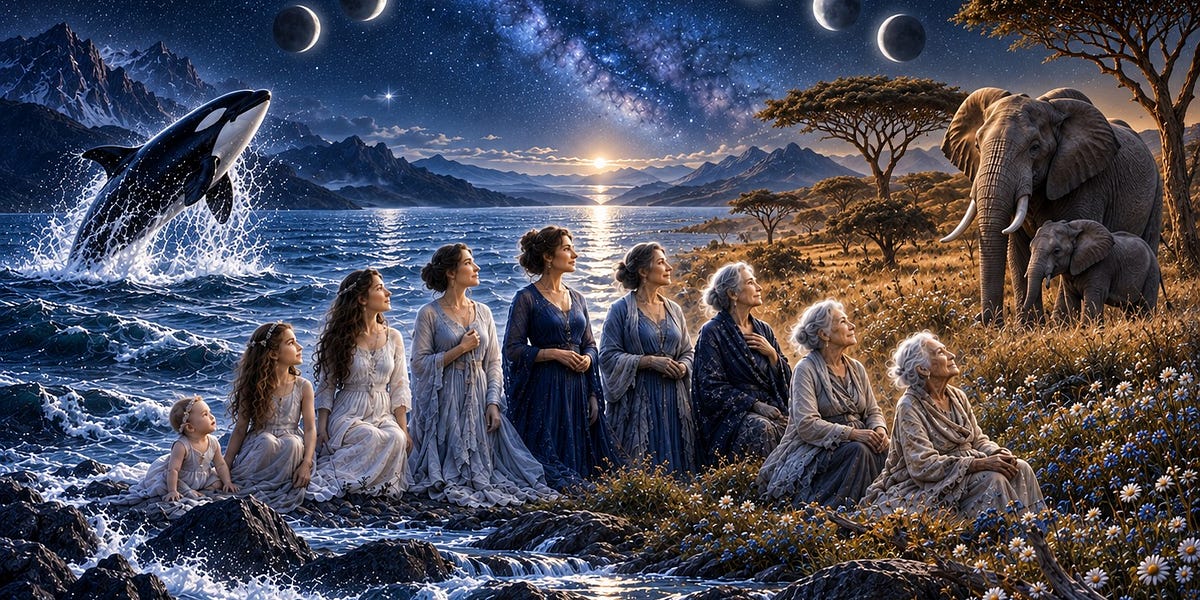
Meanwhile, some of the most successful social animals on this planet seem considerably less confused about the usefulness of older females. Orcas are one of the rare mammals in which females can live for years beyond reproduction. Older females have been observed leading groups, particularly during periods when food is difficult to find. Elephant societies are different biologically, but their family structures are famously matrilineal, with older matriarchs carrying memory about water, danger, movement and survival.
The old female remembers. She remembers where the water was during the last drought. She recognizes the sound that means real danger. She knows where food might still be found when the usual place has failed. Her value is not that she is stronger than everyone else or that she possesses mystical wisdom simply because she managed to stay alive. Age does not automatically make anyone wise.I have met people who appear to have spent seventy years practicing the same mistake, apparently determined to achieve mastery.
But experience creates the raw material from which wisdom can be made. Maybe we were never meant to spend the second half of life desperately proving that we are still young. Maybe we were supposed to become the ones who remember where the water is.
That idea keeps showing up in essays I have been reading over the last few months about ritual, community and the peculiar loneliness of modern Western life. I recently read an essay arguing that our abundance of choice has not necessarily made us happier, and I found myself thinking that choice was only part of it. Somewhere along the way, especially in American culture, we did more than increase individual freedom. We dismantled many of the structures through which people had once belonged to one another.
Some of those structures deserved dismantling. I have no desire to romanticize a past in which women had fewer legal rights, racism was embedded in institutions, queer people were forced into hiding and an individual's family, religion, class or geography could dictate the entire course of a life. Breaking those walls mattered. I am not proposing that we all return to 1952, put on aprons and pretend everything was wonderful because the family ate dinner at the same table….although honestly we are fast headed back into these times with the current regime in charge….but I digress.
With the recent passing of Wendell Berry, his work is resurfacing, and the truth is that he had been arguing some version of this for decades. His criticism of industrialization was never as simplistic as technology is evil and everyone should abandon electricity and churn butter.Frankly, I am quite fond of electricity, especially AC in the depths of a Texas August 100+ day.His point was what happens when industrial thinking becomes the organizing principle for everything. Land becomes a commodity. Labor becomes a cost. Efficiency becomes the highest virtue. Communities become markets. Human beings become consumers.
And honestly, I am more interested in what we tore down along with it.
Ritual disappeared because it felt old-fashioned. Multigenerational households became signs that someone had failed to achieve independence. Elders became people we visited rather than people woven into daily life. Caregiving became a private family burden, usually falling disproportionately onto women, until families could no longer manage it and we professionalized much of it. We stopped making many of the things we used and began purchasing them instead. We stopped knowing the people who grew our food, repaired our tools, delivered our babies or buried our dead.
We gained enormous freedom in the process. We also became increasingly unnecessary to one another. Somewhere along the way, needing less from other people became a measure of success.
There is a strange mythology embedded in that. The completely self-sufficient individual standing alone, making her own decisions, owing nobody anything and free to go wherever she wishes has become one of our highest cultural ideals.
Except nobody actually lives that way.
Every supposedly self-made person is standing on roads somebody built, drinking water somebody treated, eating food somebody grew and benefiting from systems and knowledge created by people they may never meet. 'Self-made' is a lovely phrase as long as nobody gets rude enough to ask who paved the road, taught you to read or keeps the sewer functioning.
So how independent are we, really?
We have simply become very good at disguising dependence as commerce. Instead of talking to my neighbor, I look for a service provider. Instead of asking my mother or grandmother, I search Google. Instead of gathering with people who know me, I scroll through hundreds of people who don't.
Perhaps that is why social Sit & Stitch gatherings centered on crochet, knitting and other portable fiber arts are resurging. We seem to be rediscovering that sitting beside other people while our hands are busy fills something that scrolling does not.
And this is where I think we have confused freedom and independence.
Freedom appears in our political speeches, advertisements, car commercials, military rhetoric and arguments about everything from healthcare to guns. We are apparently so extraordinarily free that we have to remind ourselves of it constantly.
But what do we actually mean by it?
Usually we mean freedom from interference. Nobody can tell me what to do. I can choose where to live, what work to perform, what religion to practice, what products to purchase and what ideas to believe. Those freedoms matter enormously. But there is another kind of freedom that receives far less attention: having enough stability beneath you that your choices are real.
You are technically free to quit a terrible job. But if doing so means losing your health insurance, how free is that choice?
You are free to start a business, go back to school, become an artist, care for an aging parent or take time away from work after having a child. Provided, of course, that you can afford to do any of those things.
Nothing screams personal liberty quite like staying in a job you hate because your body has had the poor judgment to require healthcare.
We have created an extraordinary amount of freedom in the abstract while leaving enormous numbers of people with very little freedom in the concrete.
That is where I find myself willing to take a deeper look at what democratic socialism and social democracy actually are, rather than simply reacting to the words the way Americans have been carefully trained to do. I am not suggesting that Denmark has discovered utopia or that Sweden has eliminated human unhappiness. I feel reasonably confident that Scandinavia contains assholes, bad marriages, bureaucrats and people who behave badly at whatever the Danish equivalent of Thanksgiving might be. But there is something worth examining in societies that have decided certain forms of collective stability expand individual freedom rather than diminish it.
Healthcare, childcare, education, reliable public transportation, worker protections and support for people temporarily knocked sideways by life can all do that. Hell, even knowing clean water is available can do that.
Maybe freedom is not simply the government leaving you alone. Maybe freedom also requires knowing that one illness will not destroy everything you spent thirty years building. Maybe paying taxes and expecting functional services in return is not the slippery slope to tyranny we have somehow convinced ourselves it is.
That leads directly into another uncomfortable subject: gender.
Women have spent generations performing an enormous amount of the unpaid labor that held communities and families together. We cared for children, maintained relationships, remembered birthdays, tended aging parents, cooked meals, volunteered, organized gatherings and performed the emotional labor necessary to keep a group of humans functioning. Women's liberation rightly said that none of this should automatically be our destiny simply because we were born female.
But we never fully answered the question that came next.
If women are no longer required to carry the entire burden of care, who carries it?
The answer cannot be to force women back into dependence. Yet we are watching a very real cultural movement that responds to women's increasing autonomy not by rebuilding the structures of care, but by reaching backward toward control. Apparently, if women stop volunteering to function as unpaid social infrastructure, one possible solution is not to redesign the infrastructure but to remove enough of their choices that perhaps they will resume the position.
Put women back in the home.
Make men the unquestioned heads of households.
Restore the old hierarchy.
That will surely fix everything…insert eye roll here.Except perhaps the old hierarchy is not what we are missing. Perhaps what we are missing is the community that existed underneath it.
There is an important difference between matriarchy and simply replacing male domination with female domination. What fascinates me about matrilineal structures, grandmothering and female-centered communities is not the possibility of women finally getting to be the boss. I have worked on enough committees to have no illusions that putting a woman in charge automatically ushers in an age of enlightened governance.
It is that within matriarchal governance, power can serve continuity rather than domination.The matriarch remembers. The elder teaches. The grandmother watches the children while someone else gathers food. Someone knows the ritual. Someone remembers the dead. Someone notices that the river is behaving differently this year.
Knowledge stays inside the community instead of disappearing every time a person dies or moves away. Maybe ritual was one of the ways humans created a container for that transmission. Ritual said: this matters enough that we will stop what we are doing and gather.
Someone was born. Someone died. The harvest came in. Winter is ending. Two people are marrying. A child has become an adult. A family is grieving. The season has changed.
We will witness it together.
That last part may be what matters most. Not post an emoji under it. Not click 'interested.' Not order the seasonally appropriate merchandise. We will stop what we are doing, arrive in the same place and acknowledge that something happened to one of us and therefore, in some small way, happened to all of us.
Technology has complicated this even further. And to be clear, I do not think technology is inherently the problem. I have philosophical conversations with artificial intelligence and here I am writing an essay about the dangers of modern disconnection. The irony is not lost on me.
Technology can do extraordinary things for community. It can allow a woman living alone in an RV to remain connected to people scattered across the country.
The question is what we are asking it to replace?
A tool that strengthens community is very different from one that substitutes for it. There is a difference between technology helping me maintain a friendship and technology becoming the thing I use instead of friendship.
We are drowning in information while becoming increasingly starved for wisdom. Apparently access to virtually the entire accumulated knowledge of humanity has not prevented us from becoming people who will argue for three days with strangers over a meme nobody bothered to verify.
Which brings me back to my book,On Becoming. I thought when I wrote that book that becoming was about understanding myself more completely. I still believe that. But at sixty-three I think the question has widened.
Maybe becoming cannot remain forever centered on the self.
Maybe there comes a time when the accumulation of experience asks something from us. Not unquestioned authority. Certainly not the assumption that because we survived something our way must be the only way. Every generation of older people has contained at least a few who mistook'I have always done it this way'for evidence that it was a good idea.
Something quieter. Remember. Notice. Connect. Tell the story accurately. Admit what you got wrong. Pass along what proved useful. Protect what deserves protecting. And remain willing to change your mind when another few years of living show you something you couldn't see before.
At sixty-three, I find myself less interested in proving that I can live without needing anyone and considerably more interested in asking what human beings actually owe one another.
I believe freedom matters. I believe that freedom without a functioning community beneath it may be little more than the freedom to struggle alone. And perhaps that is one of the stranger things I have come to believe at sixty-three: needing one another may not be evidence that we have failed to become independent enough. It may simply be evidence that we are human.
Maybe the most important question of this part of becoming is no longer simply,Who am I becoming?
Maybe it is:
What is all of this becoming for?
And perhaps one answer is that eventually, we become the people who remember where the water is. The harder question is whether anyone has remembered that they should ask us.
A note on cookies
Newshunt uses essential cookies to keep you signed in and to remember your language and country, so the site works the way you expect. With your permission, we'd also like to use analytics cookies to understand how people use Newshunt and improve it over time.
Accepting only affects analytics. To learn more, view our Privacy Policy or Terms & Conditions.
(0)Comments