


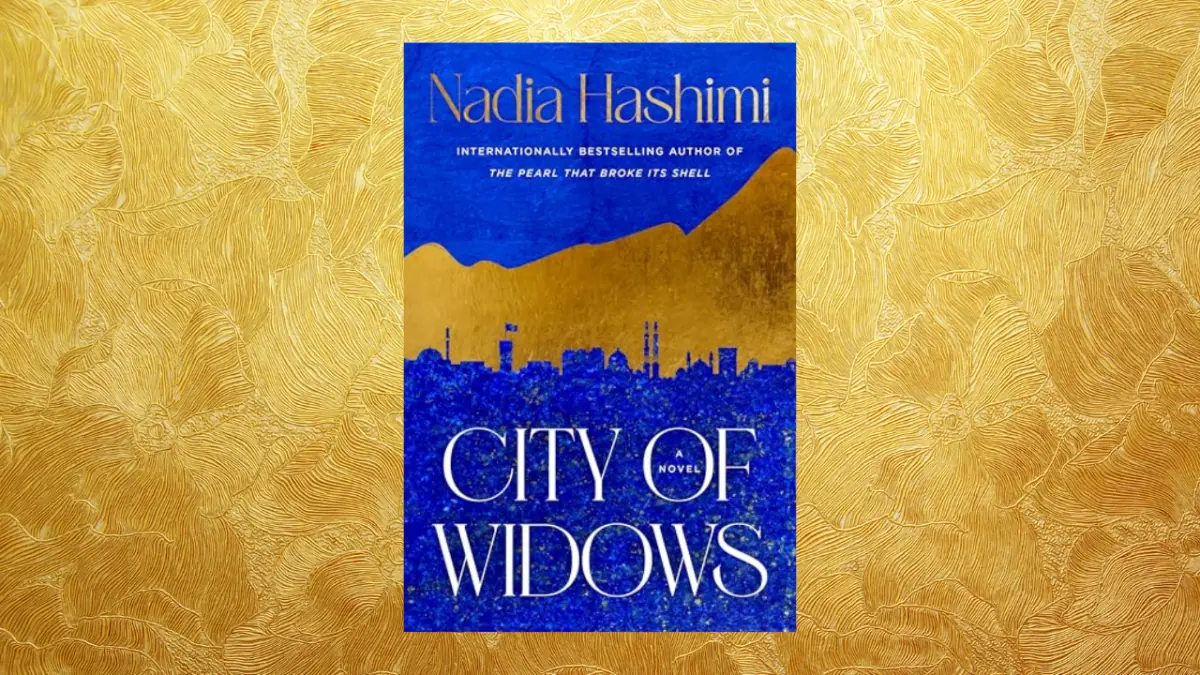
Review: Nadia Hashmi's City of Widows gives you a glimpse into the fall of Kabul through a woman's eyes
Category: Entertainment
Share
Archive
Like
In August 2021, the world watched Kabul fall. As Taliban fighters streamed into the presidential palace and desperate crowds swarmed the airport, the images broadcast across the globe captured chaos, but not its texture — the specific, private terror of women who had spent two decades building careers, raising daughters, and imagining futures that could be erased in an afternoon. Nadia Hashimi's City of Widows steps into that silence.
It's a novel that refuses the long shot of history in favour of the close-up, tracing what it meant to be an Afghan woman when the world decided the war was over.
The prologue opens like a thriller. A dozen women are crammed into a stifling room on a hilltop outside Kabul, the settlement known as Zanabad, the City of Widows. Their leader, Kobra, fixes her gaze on Marjan, a newcomer with a soldier's bearing and a daughter to protect. 'Marjan,' she says, 'You have not been honest with me.' The sentence hangs. An infant swallows a cry. Bodies press against clay walls. Then Marjan's teenage daughter, Hawa, steps forward and speaks: 'My mother has made a lot of enemies in her life. … But I'm the reason we are in danger.' In a few compressed pages, Hashimi establishes the novel's central truth — that survival depends on the stories women tell, and on whether those stories can hold up under pressure.
The narrative moves between two timelines. In the present, August 2021, Marjan is a former operative of the Female Tactical Platoon, an elite unit trained by American Special Forces to conduct night raids. She knows that the Taliban will hunt down soldiers like her. She needs visas, safe passage and a way out for Hawa.
Interwoven with this race against time is the story of her past: a girl named Rahima, who was married at 13 to a warlord and escaped his compound while pregnant and rebuilt herself as Marjan, borrowing the name from a wounded lion at the Kabul Zoo. The dual structure asks a hard question: what safety is possible when the institutions meant to protect women — the shelter, the military, the foreign forces — dissolve overnight?
Hashimi's prose is at its most devastating when it fixes on the body in pain. Early in the novel, teenage Rahima is examined by a doctor who confirms the pregnancy forced upon her. 'Rahima let out a howl that slipped under the closed door, out of the clinic, and into the street, where it caused two women to pause their steps, but only briefly. As if they had heard a car honk or a door slam. The cry of a girl wronged by the universe was hardly remarkable.'
The passage is remarkable precisely because it refuses to amplify the scream. It notes how quickly the world absorbs a girl's grief and moves on. This documentary restraint is sustained through the novel's most harrowing set piece, the Abbey Gate bombing. Hashimi describes a dead child with clinical precision: 'Brown curls cling to her forehead. Her hair is spread on the earth.' She does not tell the reader what to feel. The flatness becomes its own accusation.
In contrast, the 2021 sections sometimes labour under the weight of explanation. When characters debate visa categories or dissect the mechanics of the American withdrawal agreement, the dialogue flattens into information. I found the novel most persuasive when it trusted objects and gestures — a half-dozen bangles, a plastic water bottle twisted in nervous hands, a notebook with a ledger for a rubab — to carry the political argument. These small things speak louder than the speeches.
Music is the novel's most carefully sustained motif. Hawa studies the rubab at a Kabul institute, and her lessons with Ustad Rafiqi are among the book's finest scenes. When Hawa stumbles over a passage, her teacher stops her: 'The only thing worse than a shoddy note is no note at all. … Do not sacrifice an entire song for one wayward note. The music you are playing is older than our years combined. It has survived wars and drought and fickle hearts. It will survive your choppy renditions as well.'
The lines double as an artistic credo for the novel itself, which insists that flawed, persistent creation matters more than the silence the Taliban would impose. When Hawa later plays her flute to catch a marine's attention at the airport, music becomes survival in a literal key.
The mother-daughter relationship is the novel's emotional core. Marjan's love is rendered as a ferocious inventory: new sneakers, a winter coat, a bar of lavender soap left behind. Yet the intimacy sometimes stays at arm's length; we see Marjan's devotion more through her budgeting and her vigilance than through sustained, unguarded exchanges with her daughter. The exception is the prologue, where Hawa's declaration earns its force through everything the novel has withheld.
What Hashimi understands with terrifying clarity is that the end of a war is not the end of danger for women; it is simply its reconfiguration.
This insight pulses beneath every scene. When the Americans withdraw, the threat Marjan faces is not new. It is the same patriarchal violence she fled a decade earlier, now wearing the legitimacy of state power. The Female Tactical Platoon, which offered the brief illusion of institutional protection, evaporates. The shelter that once saved her can no longer guarantee anything. Hashimi refuses the consolations of rescue. The airport sequences are suffused not with the romance of escape but with the grinding logistics of survival, the slow accumulation of small betrayals and sudden losses that define humanitarian catastrophe.
In the context of Hashimi's career, City of Widows marks a maturation. Her earlier novel, The Pearl That Broke Its Shell, explored the tradition of bacha posh with evident research that sometimes sat uneasily on the surface. Here, history is absorbed into character and scene. The closer, more fragmented third-person perspective mirrors the characters' precarious hold on safety and identity. The reader is never entirely comfortable, and that discomfort is the point.
If the novel has a weakness, it is a tendency to name its own themes. Words like resilience and resistance appear with a frequency that risks dulling their edge. Hashimi does not need them. When Soraya, Marjan's fellow soldier, defends her right to wear lipstick on a night mission — 'if I die, I die pretty' — the politics are unmistakable without commentary. I wished the novel had allowed more such moments to speak for themselves, trusting the reader to recognise rebellion in a tube of lipstick, defiance in a rubab string.
The epigraph is drawn from Rumi: 'Ever since I was cut from my bed of reeds / My song can elicit human tears.' Hashimi treats separation as a formal problem. Her characters are severed from names, homes, families, countries, and the novel's fractured timeline enacts that severance at the level of structure. It is an elegant solution, though it occasionally slows the narrative.
City of Widows is a novel for readers who believe fiction can engage with contemporary crisis without abandoning its obligations to art. It will resonate with those who admired the moral sweep of Khaled Hosseini's work but longed for a more granular immersion in female interiority. Hashimi offers no easy redemption. She turns her characters into allegories of nothing. I closed the book not with a tidy political thesis but with a sensory residue: the grain of a rubab's note, the scent of lavender soap, the weight of a water bottle twisted in a soldier's tired hands. These are small things, but in Hashimi's hands, they are enough.
A note on cookies
Newshunt uses essential cookies to keep you signed in and to remember your language and country, so the site works the way you expect. With your permission, we'd also like to use analytics cookies to understand how people use Newshunt and improve it over time.
Accepting only affects analytics. To learn more, view our Privacy Policy or Terms & Conditions.
(0)Comments