


Resistance Archive: Study Communism
Category: Politics
Share
Archive
Like
Today's essay is a guest post fromLife Against Capital. He writes essays from a Marxist perspective exploring how collective power is organised and how we can organise it differently. He is one of the most essential writers in the Substack community. If you aren't subscribed to hisnewsletter, you need to be.
I don't think I've ever stopped being a student.
Ever since I can remember, I've been attending a school of some sort. My mother used to take me to a community school, where she would play the piano and I would sit next to her, too small to be enrolled, feeling grateful for her graceful hands, and watching all the students in one room sitting cross-legged on the floor watching her.
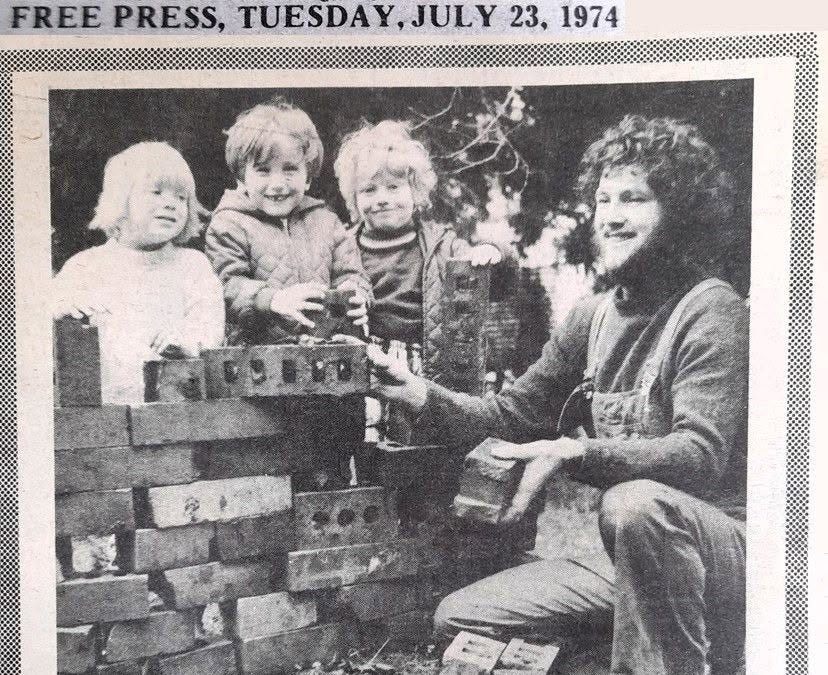
I would be one of those kids in the coming years. Those years have had a lasting effect on who I am, because they built capacities in me that have outlived those days and the later closure of what the Free Press in its early days called Coonara Community House.
Coonara—as we called it then—started as a radical home-school initiative in the Whitlam-era, an experiment in education in the Dandenongs in Victoria, and later became Coonara Community School. [1] Parents ran the school via a collective leadership group and there was at least one teacher whose job was to draw in a community to share with us their care, skills and experience. My memories of Coonara are full of so many adults dedicated to the free development of each and all of us. My mother participated in the school before I was old enough to enroll, as a piano teacher before she later became a secondary school teacher. My uncle taught me art and exhibited our works to parents. There was the conscientious war objector who taught us meditation. The parents of my friends helped me publish my writings. Many years later, I still carry around with me something of this school that imagined education as developing the powers and capacities of a community.
Over the next thirty years, I continued to study. Today, I have completed two Masters. But I never finished my PhD. It was never about the credentials for me. After more than ten years as a student, lecturing and tutoring, the project didn't feel right and life had moved on, so I abandoned it.
I had patiently assembled 30,000 words of a thesis drafted from research around the world. People close to me, who knew, acted as though I had lost something: an act to them of reckless futility. But, again, it wasn't the credentials that I wanted. I could abandon the PhD without abandoning all the skills that studying had taught me, even if no one else could legitimise what those skills were.
Perhaps the capacities we develop through study are mistaken for the forms we develop them through, but I do not think we should make that mistake. Study, beyond its position or function, outlives its forms.
And outliving study is, I believe, what happened to me. Despite losing the social function of a student when I became a professional teacher, I still think of myself as something like a student. After a lifetime studying other things, I've even found myself now caught up in studying study itself. Being a professional teacher has made this unavoidable.
That's because I now know that teaching becomes its best art for me only when I am studying my students: learning what they know, putting what I know into relation to them, and allowing what happens between us to exceed the positions of teacher and student–while maintaining my responsibility as an adult. Whenever I forget this, my teaching becomes worse, hits a wall. Then I find that I need to learn to unbrick that wall, piece by piece and student by student, and build it up again, anew.
In this piece of mine, 'Resistance Archive: Study Communism', I want to share on behalf ofLife Against Capitalwhy I think study belongs in Ryan Ward's groundbreaking initiative,Resistance Archive Project. Ward is kind enough to indulge me, and he is one of those indispensable members of the Substack community. Recently, he invited contributions to his assembly of historical and ongoing resistance strategies. Please contribute! To make these contributions accessible, Ryan has also created a secureCryptPad document—a digital archive that will be studied in the coming years, and that anyone from our community should feel you can share and build up with your own content. Here I will make my contribution by explaining why I want to place study into this new archive, and why I think Study Communism names a specific kind of practice of study that grounds resistance in its most peculiar powers.
Study certainly doesn't feel revolutionary when it is the night before an exam, the books clutter the floor, highlighters run dry, and the process of something that can alter our horizons is squeezed into the time we're forced into. But it belongs to no one. And while it has accompanied all activities, it has also accompanied revolutionary movements and resistance everywhere in one form or another. But, in what respect is study itself a revolutionary practice? I believe study becomes revolutionary not when revolutionaries need to know things, or when it is trained under capital for us to beat the system, as they say, but because studying can—in a specific way of practicing it—change what people become capable of doing together.
To see this, however, I think we need to recognise the social powers that students develop to transform their lives in ways that exceed the forms we give them. I believe that this reality of study is fundamental to Marxism as a revolutionary method and critical to what communism is—especially communism, as formulated by a fellow life-long student, Karl Marx. Marx offers one of the most interesting examples of study as a revolutionary practice: he studied capitalism his whole life to learn how we might exceed it. He pulled it apart and put it back together again, like a brick wall he could take apart piece by piece and learn how to put back anew.
But Marx also understood study as embedded in social relations under capital, and only revolutionary because of a set of highly specific circumstances. Thus, it is not just any type of practice that becomes a revolutionary practice, because it is about the concrete nature of these relations that we live and struggle against. AtLife Against Capital, I recently launched my own series calledStudy Communism,which I understand as a revolutionary possibility within the practice of study.
When I first wrote about Study Communism, I found that some readers felt the name was more literal than I had anticipated. I did not mean to suggest that communists have some privileged claim or that we need only cadres who know the correct things. Instead, I was trying to name the conditions of study itself, something I notice across practices of study in its most revolutionary power, and that Marxists and Communists, among others, help us theorise and understand.
In the first entry in the Study Communism series I referred to two Walters who were writing in radically different situations in histories and struggles. Walter Benjamin, a young Jewish intellectual confronting the bourgeois university and student life in imperial Germany, and Walter Rodney, a Black Caribbean Marxist confronting the colonial university amid decolonisation and Black Power. But both Walters illuminated practices of study that could generate powers exceeding the institutions organised around them: Benjamin through the transformative possibilities of student life, Rodney through grounding. [2]
Study Communism is not a practice of searching history only for practices already recognisable as Communist. That approach reproduces the problem, because if we accept that study continually exceeds the forms organised around it, including revolutionary forms, we cannot reduce our histories of practice. The two Walters, writing in radically different circumstances, help me see practices in very different histories. It's not about seeing only Marxist practices.
Study, I have often observed, tends to disappear from histories of revolutionary practice and become replaced by other forms. The reality of study, its material practice, seems to be very different than that usually appreciated. People studybefore,duringandafterthe interesting things happen. They read, discuss and develop theories they debate and contest or enlarge. Then they find themselves organising, striking, occupying or disobeying. But the practice of studying is never exhausted. And they endure as reproduction and maintenance—practices we tend to leave settled in the background.
But what if that backgrounding of study risks reducing a revolutionary practice that grounds all the others? What changes if we begin to see study as a practice that becomes revolutionary when people become capable of doing things they could not do before?
Marx himself gave us a practical way of beginning to answer these questions in his famousTheses on Feuerbach, a work that was never published in his lifetime. Marx wrote the eleven brief notes now known as theTheses on Feuerbachin spring 1845, while developing the conception of history that he and Engels would work through at much greater length inThe German Ideology(1845-6). [3] This latter work, which Marx worked on with Engels, was also not published in his lifetime. Circumstances prevented Marx and Engels from publishing it. Marx suggested that writing the work had already achieved him 'self-clarification', and the manuscript was now suffering the 'gnawing criticism of the mice'.[4] The manuscript failed to become what manuscripts are supposed to become: a published book. Marx believed, however, that the study itself had already done something to its studiers: 'self-clarification.'
(Coincidentally, that pithy saying about the 'criticism of the mice' seems to me to echo similar imagery of manuscripts and mice used by a once-famous man of letters, Isaac D'Israeli. Marx had read D'Israeli—incidentally the subject of my abandoned PhD that I mentioned before—when he was reporting on Parliament, and he found their Isaac's Anglo-Jewish son Benjamin Disraeli, who had become a strange conservative curiosity in British politics.) [5]
'Philosophers have only interpreted the world; the point is to change it.' [6]
This famous phrase from Thesis XI or Eleven inTheses on Feuerbach(1844) should be familiar to us. This is an eminently quotable saying that seems to have circulated as a quoted phrase far more than anything else that Marx wrote. It certainly does a powerful job of describing the goal and method of his study. But oddly, if it is detached from the other theses or from Marx's methodical concern with the society around him, it can often be mistaken for an injunction to put down the books at some point and get on with the practice of revolution, where the struggle becomes supposedly less bookish, more dirt and blood.
In the much less quoted third thesis, however, Marx established a way of seeing what changing the world involves that demands to be read alongside the eleventh thesis. There, Marx criticises the vulgar materialist idea that people are mere products of 'circumstances and upbringing.' Marx does not deny the role that circumstances and background plays in our lives, but her refers to the key problem of who has the power to change us. Is it the materialist who is somehow able to lead us in changing ourselves? Such a doctrine is hardly materialist, he points out, because 'the educator must himself be educated', and we cannot ignore the way that people—through revolutionary practices among other things—can change the circumstances they find themselves reduced to in their lives. The problem with this approach is that, unless we study the problem better, society gets divided into two parts, 'one of which is superior to society'.
The alternative to counterrevolutionary study is not, then, throwing out the books and starting again. Instead, it is studying to become a person who becomes revolutionary by getting involved in changing our social relations, as they are lived, in a study that refuses to pretend itself 'superior to society'. And lest you do not believe this is what Marx intended he does provide the alternative.
While Marx is not writing here about study specifically, his formulation I believe allows us to recognise a possibility within study that exceeds its institutional forms. He describes 'the coincidence of the changing of circumstances and of human activity or self-change'. Read today, with the eyes of capitalist society that has commodified every activity we want to reclaim today, such as statement might seem like a vaguely self-help statement. But notice that the words 'coincidence' and 'self-change' suggest something much other: a process of life and thinking as a revolutionary practice, a recursion in which those seeking to transform the world are themselves transformed. Marx is pointing out that revolutionary practice isn't simply something that people who already possess revolutionary consciousness do to the world. Changing our circumstances and changing ourselves are moments of the same activity. The revolutionary is inside the world being transformed, and their practices are within the social relations we find ourselves.[7]
The third thesis is also preceded by Marx's insistence in the first thesis that human activity must be understood as practice (orpraxis), and in the second that thinking proves its 'reality and power' in practice. By the third, he identifies revolutionary practice as the transformation of circumstances and the transformation of ourselves—we cannot know the world without changing it.
Study as a revolutionary practice is therefore something so much more demanding than a branding exercise or a self-help activity. A reading group isn't revolutionary because revolutionaries read in it, and a school doesn't become emancipatory because it teaches a radical text, although these are the forms of study that we often find ourselves taking up. What is revolutionary about the practice is not in these forms: it is what happens to the people ('All brickies'), in their social relations, and in the relations of the learning itself.
A revolutionary practice that aims to educate must itself be educated. And it must constantly learn how to resist becoming caught up in forms that would commodify it, or to build social relations out of divisions that would wall up the coincidence of circumstances and self-change.
Marxists should be aware that capitalist production is constantly developing capacities that can exceed what capitalism requires from them. Cooperation is the obvious example, which Marx had studied across the years to bring together a study of it inCapital: capital assembles people together to produce commodities, but as workers multiply and combine, they develop knowledge, relationships and collective powers—and a self-change—that cannot be reduced to their wages or the products they make. Marx calls cooperation the creation of a 'new power', the 'collective power of masses'. Under capitalist relations, this 'social productive power of labour' appears as the productive power of capital. [8]What if we looked at study in a similar way? Capitalism has created multiplying, enormous powers of study. We have vast forms of concentrated study around us, schools, universities, laboratories, libraries, archives and research institutions. They are all designed to employ our potential or to sort and position us in the circumstances of social relations dominated by capital. Both the reproduction and production of the system require a constant churn of people learning, investigating and inventing.
But study can become a troublesome revolutionary practice when it develops the person studying—or when the educator becomes educated. Because studying together can develop capacities between people that no institution completely determines beforehand. That excess of studying, in the form of the University institution and the community school, has become routinely subject to regulations and administrative controls designed to limit the disruption to capital, while maximising capital.[9]
Study, of course, isn't revolutionary in any inherent way, because capital builds our capacities for study very well: we know this from all the institutions, but also the professional development and business credentialism that surrounds us. Schools function to discipline and sort us into economic positions that our circumstances sort us into. Meanwhile, even some of our revolutionary and Communist parties can turn study into a wall-building endeavour, catechism, and recreating the distinctions that Marx warned us against.
Study becomes interesting as revolutionary practice when the development of our capacities begins to transform the relations within which these capacities are being developed. The educator and educated cease to be fixed positions, and knowledge begins to move in directions that cannot be contained by its form.
This is what I mean by Study Communism. Study Communism begins when the people studying their circumstances discover that, in changing their capacity to understand their circumstances, they begin to develop the capacity to change their conditions—and therefore themselves.
Study Communism is not communists studying in communist poses. It is not even studying communism. Instead, it may be arrived at in such study, but it is instead an orientation towards practices of study in which changing our conditions and developing ourselves become part of the same activity. That's what Marx was referring to in his theses and in his larger book that never became published in his life, but that he left to the mice as a lesson in 'self-clarification', and that were as productive as a productive force.
Communists have practiced Study Communism but so have many people who would never call themselves communists—people who have never accessed Marxist theory but have lived the marks of capital, as labour organiser Bill Haywood used to say. We can name some forms of this, but there are countless others—and some we have not discovered.
As to examples, Workers' inquiry were practices that transformed workers from objects of managerial knowledge into investigators of their own labour and workplace. Mississippi Freedom Schools invited Black students denied their history and political agency by segregated schooling to study that history while participating in the struggle transforming it.[10] Anti-colonial struggles involve practices of study to overcome the devasting impacts of colonialism, the destruction of capacities and cultures that liberation movements must confront. Feminist consciousness-raising brought experiences treated as private into collective investigation, where their social patterns could become visible. Rodney's groundings disturbed the distinction between the intellectual who possessed knowledge and the people to whom it was supposedly delivered.[11]
There are countless other examples we have not learned how to recognise. They have different histories, different struggles, and different forms. But there is a movement within them. People study conditions that they struggle within and against. Then they study those conditions and develop new capacities, which in turn transforms the knower. Reflexivity is recursive when it becomes self-emancipation. The educator is educated, the studied become studiers, and circumstances change with them.
Marx and Engels imagined communism inThe Communist Manifestoas an association in which 'the free development of each is the condition for the free development of all.' What if we understood study as an association, and a practice that begins to make that relation? Study Communism asks what it might mean to begin organising study so that what each of us becomes capable of enlarges what others might become capable of too.
I have studied for most of my life. But only in the last few years have I thought to understand study as a practice that is itself worth studying—not because of what we learn, but because of what we become capable of through learning together. Study Communism becomes possible when those capacities begin to exceed the relations that have made us students.
I therefore present Study Communism for inclusion in theResistance Archive Project. But if it is a revolutionary practice, we cannot expect it to sit still in the archive.
The point, as I am learning, is to see what else we might become capable of together.
Thanks for reading Free Market Moralism! Subscribe for free to receive new posts and support my work.
[1] Coonara Community School began in 1973 as a home school collective and gradually moved from parent-led to teacher-led programs with a small enrolment and strong parent involvement, but closed after 34 years.ttps://ferntreegully.mailcommunity.com.au/mail/2008-04-20/school-shutdown/
[2] Walter Rodney, 'Groundings with My Brothers,' inThe Groundings with My Brothers(London: Bogle-L'Ouverture Publications, 1969). Republished by Verso, London, New York: 2019; and Walter Benjamin, 'The Life of Students' (1915), inSelected Writings, vol. 1:1913–1926, ed. Marcus Bullock and Michael W. Jennings (Cambridge, MA: Harvard University Press, 1996).
[3] Engels gave one of Marx's manuscripts the titleTheses on Feuerbachwhen he published his edited version ot it in 1888. Marx's noes were merely headed '1) ad Feuerbach.' Seehttps://www.marxists.org/archive/marx/works/1845/theses/
[4] 'We abandoned the manuscript to the gnawing criticism of the mice all the more willingly since we had achieved our main purpose — self-clarification.' Karl Marx,A Contribution to the Critique of Political Economy, Progress Publishers, Moscow, 1977, with some notes by R. Rojas.https://www.marxists.org/archive/marx/works/1859/critique-pol-economy/preface.htm
[5] For Marx's reporting on Disraeli in the Parliament, see his journalism forThe New York Tribune.https://www.marxists.org/archive/marx/works/subject/newspapers/new-york-tribune.htm. The Talmud manuscripts being gnawed by mice is one imagery from Isaac D'Israeli that seems to reappear in Marx's playful remark. See D'Israeli'sCuriosities of Literature(1791-1848)-https://www.victorianweb.org/previctorian/disraeli/talmud.html
[6] Marx,Theses on Feuerbach, Translated by Cyril Smith and Don Cuckson 2002, Marxists Internet Archive.https://www.marxists.org/archive/marx/works/1845/theses/
[7] Hal Draper read the principle here similarly to me. See 'The Principle of Self-Emancipation in Marx and Engels' (1971),Socialist Register.https://www.marxists.org/archive/draper/1971/xx/emancipation.html
[8] Kar Marx,Capital, Chapter 13, Progress Publishers, Moscow, USSR; Samuel Moore and Edward Aveling, edited by Frederick Engels. Marxists Internet Archive.https://www.marxists.org/archive/marx/works/1867-c1/ch13.htm
[9] Compare Joanna Williams's more conservative critique of the transformation of the University since the 1960s: 'Students have moved from being political change agents to being themselves the object of political change. Rather than imposing their ideas on the world, they are to obey edicts from radical lecturers and diversity officers. To accommodate these developments, objective measures of what students know are replaced by more subjective measures of their own personal and psychological development.'Hungarian Conservative, 30.01.2025.https://www.hungarianconservative.com/articles/opinion/student-identity-scholar-consumer-academia-higher-education/
[10] For Mississippi Freedom Schools, seehttps://mshistorynow.mdah.ms.gov/issue/The-1964-Mississippi-Freedom-Schools
[11] See Kevin Okoth, 'The Revolutionary Legacy of Walter Rodney's 'Groundings': On Walter Rodney's concept and practice of 'Grounding' as Critical Pedagogy', Verso Books, 13 June 2019.https://www.versobooks.com/en-gb/blogs/news/4351-the-revolutionary-legacy-of-walter-rodney-s-groundings
A note on cookies
Newshunt uses essential cookies to keep you signed in and to remember your language and country, so the site works the way you expect. With your permission, we'd also like to use analytics cookies to understand how people use Newshunt and improve it over time.
Accepting only affects analytics. To learn more, view our Privacy Policy or Terms & Conditions.
(0)Comments