


Will Enric Mas hold his nerve? Five questions for the final week of the Vuelta
Category: Sports
Share
Archive
Like
This was supposed to be the Tadej Pogacar Vuelta a España, but the world champion's abandon has led to the most open and unpredictable Grand Tour of the season. Enric Mas is the favourite after his displays since inheriting the red jersey, but there are sure to be twists and turns on the final approach to Granada. Ahead of the Vuelta's third week, we look at the questions still to be answered.
The Vuelta is Enric Mas' race to lose. That's not a sentence any of us expected to write before the peloton left Monaco two weeks ago, but Tadej Pogačar's abandon was a seismic event that altered the topography of the Vuelta.
Thanks for reading! Subscribe for free to receive new posts and support my work.
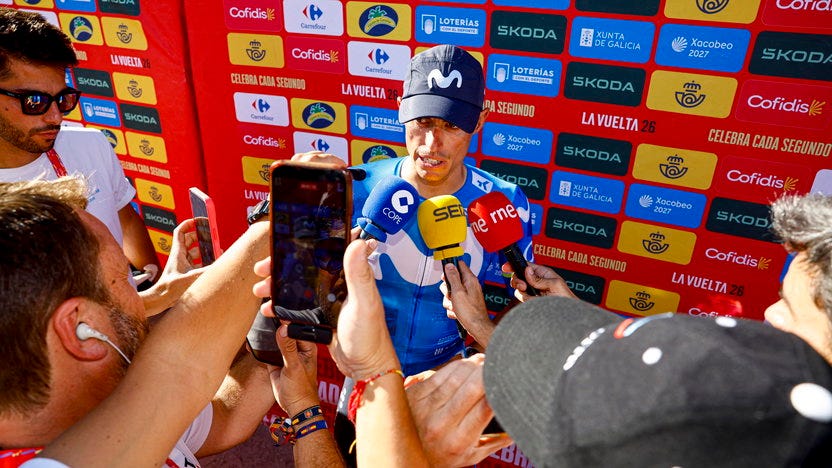
Mas was just about the best of the rest before Pogačar crashed out, but he has surprised everybody – and probably even himself – with how much he has grown into the status of race leader since inheriting the jersey in Xeraco.
The Spaniard cut an uneasy figure when he held the maillot rojo on the podium that evening, refusing to put it on out of deference to Pogačar, but he has looked increasingly comfortable with red ever since, gaining time on the summit finishes at the Alto de Aitana, Calar Alto and La Pandera.
Mas enters the final week with a lead of 2:06 on Felix Gall and 2:10 on Primož Roglič, and even with a 32km time trial in Jerez on stage 18, it looks like a winning lead.
But that brings its own burden. Mas has never been a serial winner and never been in a position like this before, hence the repeated questions in press conferences about his mindset.
The 31-year-old has insisted that he is not afraid of winning the Vuelta, but he will know that plenty of would-be winners of this race have floundered within sight of the shore. Mas has the lead, the form and, perhaps surprisingly, the team to win the Vuelta – now he must prove that he has the mentality too.
The arrival of Remco Evenepoel saw Primož Roglič's status downgraded at Red Bull-Bora-Hansgrohe this season, with the Slovenian left out of the team's Tour de France plans and assigned leadership at the Vuelta.
A heavy training crash in July seemed to end any hopes that Roglič might land a record fifth Vuelta victory, but he surpassed his team's expectations by holding his own alongside the podium contenders trailing in Pogačar's wake in Andorra on stage 4.
When Pogačar crashed out four days later, Roglič's prospects rose exponentially and his canny display on the Aitana suggested that his form was in crescendo at just the right time. Roglič lost just 12 seconds to Mas there and he began the second week just 1:18 off the maillot rojo and with the trump card of that Jerez time trial.
The past week has been less kind to Roglič, who conceded 27 seconds to Mas at Calar Alto and 25 at La Pandera, slipping to third place and more than two minutes off the pace in the process. The Jerez time trial now takes on outsized importance for Roglič, who must claw back serious ground on Mas there to have any hope of snatching red at the last.
Roglič will certainly need to do better than he did in Monaco on stage 1, when he only picked up 1.17 seconds per kilometre on Mas. At Caen on last year's Tour, Roglič was just shy of 3 seconds per kilometre faster than Mas and he was 3.24 seconds per kilometre quicker in the Tour de Suisse time trial in June.
It's not clear, however, if either of those time trials offers much relevant intel for this iteration of Mas. In any case, Roglič won't be able to lean fully on the time trial. If he wants to produce a remontada - or a rogmontada, as Daniel Friebe would have it - to win this Vuelta, he's going to have find a way to attack Mas in the mountains. Easier said than done.
Pogačar's abandon and the absence of Jonas Vingegaard and Remco Evenepoel – not to mention Isaac del Toro and Paul Seixas – makes this an unusually open edition of the Vuelta. 10 of the past 11 Grand Tours have been won by UAE Team Emirates-XRG or Visma | Lease a Bike riders, but both teams are out of the running here.
Normal service will likely resume in 2027, meaning that this Vuelta offers a rare shot at Grand Tour victory for men who had set out from Monaco with second place as the very summit of their ambitions.
A podium finish won't add much to Roglič's legacy and that might inspire him to cut loose in the final days, but he's not the only one. Gall, already second at the Giro in May and destined to sign for Lidl-Trek, might be tempted to take risks to discommode Mas next weekend.
But the most obvious wildcard in the Vuelta's final days is Richard Carapaz, currently fourth at 4:24. The EF Education-EasyPost man already has a Giro on his palmarès, and he has already shown a willingness to go on the offensive at this Vuelta even when his legs haven't matched his ambitions.
This version of Carapaz has a tendency to finish Grand Tours strongly – witness his two wins in the dying days of the Tour in July – and he might well seek to test Mas' nerves and his rivals' legs with attacks from distance on the two mountainous days in Andalusia on stages 19 and 20.
Carapaz's deficit means he almost certainly won't win this Vuelta, but his default setting of all-out attack could be the catalyst for chaos at Peñas Blancas and Collado del Alguacil. Historically, the Vuelta has a penchant for late twists, and Carapaz might be the trigger.
Matthew Brennan's first thoughts after the heat-shortened stage 15 to Córdoba were for the extreme conditions faced by the peloton on Sunday, but he also weighed in on his teammate Wout van Aert's victory. It was Visma's fifth win on this Vuelta, and Brennan felt there was no reason why they couldn't add a couple more between now and Madrid.
'Why not go for more? Why not go for six, seven victories?' Brennan said, before realising he had unwittingly created a headline. 'Some people are going to clip that now, aren't they? But yeah, we'll see what we can do…'
Brennan has every reason to be bullish. He has already become the first Grand Tour debutant to win three stages since Pogačar achieved the same feat on the 2019 Vuelta, and the Briton looked even more impressive in his supporting role on behalf of Van Aert in the break on stage 13. He might now have back-to-back sprint opportunities at La Rábida and Seville.
Van Aert, meanwhile, looks to have reached something of a flow state on this Vuelta, quietly stitching together his most consistent body of work since he crashed out of this race two years ago. The Belgian looks destined to win the green jersey, and he will also be eager to make hay while the sun shines. Above all, he knows the final week of the Vuelta offers a chance to hone his form and underline his leadership credentials ahead of the World Championships in Montreal.
The Brennan-Van Aert tandem has been one of the highlights of the Vuelta to date, and there is ample opportunity for an encore or two between now and Granada.
The climate crisis cannot be ignored by cycling, even if several high-profile teams in the WorldTour peloton are backed by fossil fuel-based sponsors. This year's Tour de France already saw stage 9 cut by 30km due to extreme heat, while the route of the final stage was shortened as various emergency services in Paris had been deployed to south-west France to fight wildfires.
At the beginning of this Vuelta, stage 3 to Font-Romeu was cancelled due to a sudden and extreme hail shower, but soaring temperatures have been the story of the race since it ventured southwards.
The heat and humidity were already making an impression on the peloton along the Valencian coast in week one, but the conditions started to become untenable in Andalusia in week two, when the temperature repeatedly nudged above 40°C.
At the behest of the riders, the Vuelta organisation finally agreed to apply the extreme weather protocol and shorten stage 15 by 79km, and some in the peloton felt that racing at all had been rather extreme.
'When I was on the climb at the start, it was 44°C, and at that point you start thinking, 'What are we doing?'' Brennan said on Sunday. 'I think it wouldn't surprise me if there's a few bodies going home in an ambulance tonight with a heat stroke.'
Vuelta director Javier Guillén was careful to stress that the decision to shorten stage 15 wasn't specifically because of the temperatures on Sunday but because of the accumulation of several days of extreme heat.
High temperatures are forecast again for Tuesday and even though the mercury is expected to drop slightly in the days that follow, there will be plenty of riders struggling to recover as the race draws on towards Granada.
That will have an impact on this Vuelta, but the conditions should be food for thought for cycling's decision-makers with an eye to the years ahead. Start times, feeding rules and the WorldTour calendar itself should all be up for discussion after witnessing the impact of this summer's heatwave on pro cycling. One can only hope the CPA hierarchy - and not just the riders themselves - will finally find its voice on the issue.
'I'm in a perfect scenario' - Roglic eyes Vuelta comeback against Enric Mas
Pogacar withdrawal forces Belgium to rethink Worlds plan
'I don't fear the time trial' - Mas bullish ahead of final Vuelta push
Road to Montréal: How the contenders are building for the World Championships
UAE team boss Matxin challenges cycling's TV schedule after dangerous extreme heat
A note on cookies
Newshunt uses essential cookies to keep you signed in and to remember your language and country, so the site works the way you expect. With your permission, we'd also like to use analytics cookies to understand how people use Newshunt and improve it over time.
Accepting only affects analytics. To learn more, view our Privacy Policy or Terms & Conditions.
(0)Comments