


In 2011, Swedish and Danish researchers fenced muskoxen out of test areas in Greenland. 3 years later, plants there absorbed only half as much carbon in summer
Category: SciTech
Share
Archive
Like
Muskoxen
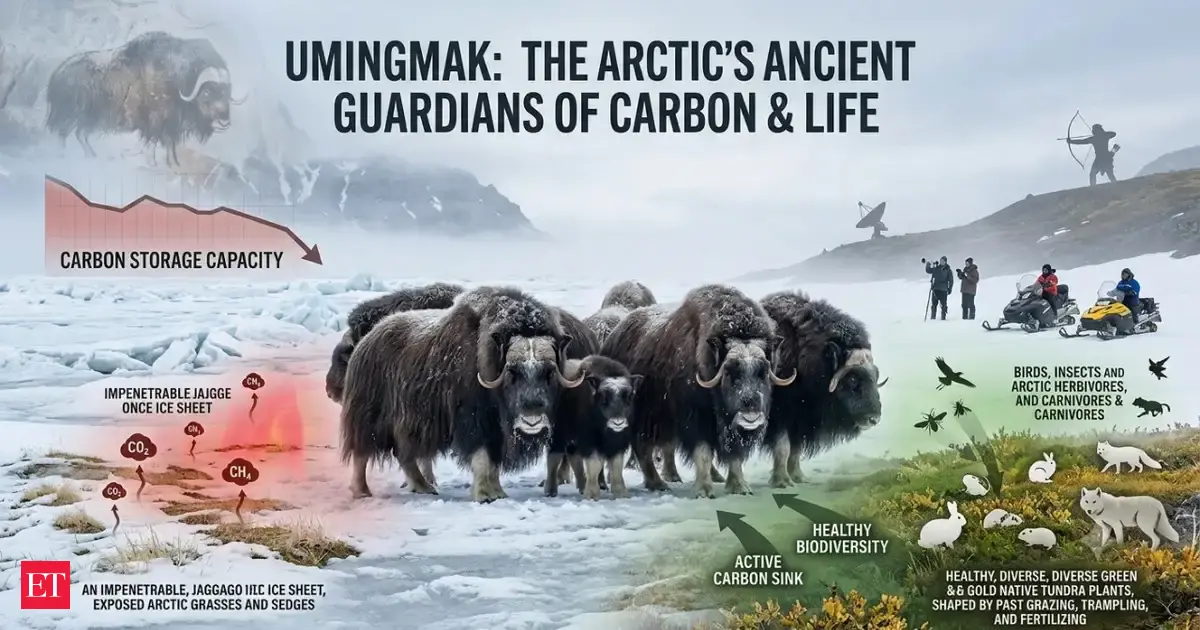
are among the Arctic's ancient survivors, but their importance extends beyond their ability to withstand some of the harshest conditions on Earth. As large herbivores, they help regulate and maintain healthy Arctic grasslands that function as carbon sinks.
Known by their Iñupiaq name Umingmak, meaning 'The bearded one,' muskoxen have no musk and are not oxen. They belong to the goat and antelope family and are among the few survivors of the mass extinction of Earth's megafauna during the Pleistocene, or Ice Age.
The
muskox
is the iconic species of the Greenland bioregion, located in the Subarctic America realm.
Muskoxen play a role in Arctic carbon storage
Early studies indicate that when grazing, trampling and fertilizing are absent, ground cover can change radically, as per a One Earth report. This is associated with an increase in the release of carbon dioxide and methane.
The loss of diverse native tundra plants can also affect the wider ecosystem. These plants provide nutrients, trace minerals and pollen that are important to
Arctic wildlife
.
You Might Also Like:
In the early Holocene, West Siberian peatlands started storing carbon. Today, 11,700 years later, the lowland holds 70 billion tonnes, but thawing puts the store at risk
They also provide habitat and resources for birds, insects and small herbivores such as Arctic hares and lemmings. Those animals, in turn, feed carnivores including Arctic foxes and wolves.
The decline of muskoxen and caribou may therefore amplify the effects of climate change on Arctic biodiversity.
An ancient species adapted to extreme cold
Muskoxen can thrive at temperatures of -20°C. They are heterothermic, meaning they can shut off thermal regulation in parts of the body to reduce heat loss. Their hemoglobin is also less sensitive to cold than that of most mammals.
In winter, their long, dark outer guard hairs cover a layer of underwool called qiviut. It is eight times warmer than sheep's wool and finer and softer than cashmere. Calves are born with the same insulating coat.
You Might Also Like:
In 2015, California's Scott River Watershed Council built 2 artificial beaver dams to restore wetlands. 11 years later, juvenile coho survival rose from 8% to 60% in restored habitat
Muskoxen naturally shed qiviut each spring. The material has been identified as a promising resource for a new Arctic economy, while the feasibility of muskox domestication for this purpose has been established over the past 70 years, as per the One Earth report.
Muskoxen face growing threats
Despite their ability to withstand extreme cold, many muskox populations are in dramatic decline, according to wildlife researchers and Indigenous observers.
Climate change is causing severely fluctuating winter precipitation, including deeper snow, extreme ice tidal surges and rain-on-snow events. These conditions can create impenetrable ice sheets over winter grazing areas.
When muskoxen cannot reach nutritious browse, starvation can follow. Food scarcity can also affect the health of cows during gestation, resulting in low calf survival rates.
You Might Also Like:
In 2001, Kentucky flagged 6.5 miles of Triplett Creek for silt and nutrient pollution. 21 years later, monitoring found it met standards and cleared 2 pollution listings
Increasing predation by grizzly bears has taken a serious toll over the past 30 years. Mass die-offs are also occurring more frequently, while parasites and bacteria moving northward are leaving muskoxen increasingly vulnerable.
Pollution and habitat loss linked to mining and fossil fuel extraction pose additional threats. Muskoxen are highly sensitive to seismic activity, which can fragment their territories and cause them to keep their distance from areas they would normally use for better foraging and snow conditions.
The muskox's long Arctic history
The earliest evidence of muskox ancestry dates back to Central Asia during the Late Miocene-Early Pliocene periods, millions of years ago.
From Asia, muskoxen spread east through northern Europe and west across the Arctic Circle. They crossed the Bering Sea Land Bridge from Siberia into Alaska as early as 200,000 years ago before spreading across the Arctic Archipelago and mainland tundra of Canada and into Greenland.
Despite their wide circumpolar range, muskoxen have very low genetic diversity, ranking second only to the cat-sized foxes of California's Channel Islands in this regard.
For thousands of years, muskoxen have also been important to Indigenous peoples of the Far North. Greenland Inuit traditions connected their people with the 'bearded ones,' while Canada's Naskapi revered them as examples of wise leadership and the Cree used their heads and horns in sacred ceremonies.
Their skins were used for bedding, tents and sled runners, while bones and horns served as materials for tools including ladles, sealing harpoons, bows, arrow points and sled crossbars.
Hunting pushed muskoxen toward extinction
Overhunting caused muskoxen to disappear from many northern regions. In prehistoric times, they were extirpated in Eurasia, leaving their images in Paleolithic cave paintings and sculptures.
Their natural defense is to stand together and form a protective circle around their young, with adults facing predators with their horns. While effective against wolves, the strategy also made entire herds vulnerable to hunters with rifles.
Commercial whalers and sealers, explorers and local hunters killed muskoxen by the thousands for meat and dog food, as well as to support fur farming and remote weather and trading outposts.
In the late 1850s, Native Alaskans reported killing a herd of 13, believed to be the last muskoxen in the state until the animals were reintroduced from Greenland in the 1930s.
After market hunters turned north following the slaughter of tens of millions of buffalo across the American West, the Hudson's Bay Company alone recorded the killing of more than 23,000 muskoxen, as per the One Earth report. With only about 400 remaining, concerns over their possible extinction contributed to the introduction of Canadian regulations in the early 1900s.
A species still in need of study
Muskoxen have recovered in different regions following international efforts to regulate hunting over the last century. However, enforcement has been inadequate, and excessive hunting remains a serious threat.
Their global population status is unknown because no comprehensive count has been completed to guide international management strategies. Satellite data collection, followed by verification and continued work on the ground by Indigenous researchers, offers a promising approach.
Their ecological role extends beyond carbon storage. The plants shaped by grazing, trampling and fertilizing provide nutrients, habitat and other resources for wildlife across the Arctic.
With the Arctic warming at four times the world average, further studies are urgently needed to determine the true demographic and health status of muskoxen and understand how their decline may affect the wider Arctic ecosystem.
A note on cookies
Newshunt uses essential cookies to keep you signed in and to remember your language and country, so the site works the way you expect. With your permission, we'd also like to use analytics cookies to understand how people use Newshunt and improve it over time.
Accepting only affects analytics. To learn more, view our Privacy Policy or Terms & Conditions.
(0)Comments