


Ukraine's prosecutor general resigns as the watchdogs he was appointed to leash close in
Category: Politics
Share
Archive
Like
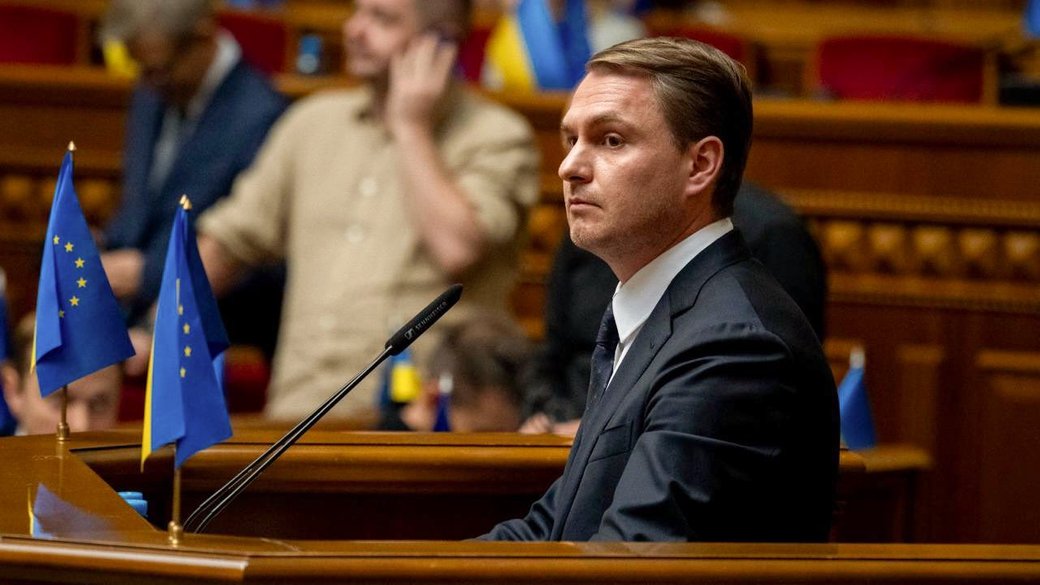
Ukraine's Prosecutor General Ruslan Kravchenko resigned on 7 September, hours after publicly defending himself, as anti-corruption investigators closed in on an alleged criminal organization operating inside his own office.
"I do not want the position of prosecutor general to be used as an instrument of political confrontation," Kravchenko said, announcing his departure on Telegram. "My position regarding the charges remains unchanged"—a denial he has held throughout, including in a 6 September statement rejecting any role in protecting the call centers.
President Volodymyr Zelenskyy confirmed the resignation on the evening of 7 September. "I had a fairly long meeting with the prosecutor general; he submitted the relevant resignation letter, and the submission will be sent to the Verkhovna Rada," Zelenskyy said, adding that he had spent the day on personnel matters and had also met the heads of the National Anti-Corruption Bureau (NABU) and the Specialized Anti-Corruption Prosecutor's Office (SAPO). The resignation is not final until parliament acts on it.
It reads as a scandal. It is closer to the opposite.
Kravchenko was appointed in June 2025, as the anti-corruption agencies were pressing toward figures close to the president—and his appointment came alongside the draft law, No. 12414, that would have put NABU and SAPO under his control. That law triggered the first street protests since Russia's invasion; within ten days, parliament reversed the part stripping the agencies' independence.
The provisions handing Kravchenko a personnel monopoly over the prosecution service were never repealed.
Explore further Ukraine's anti-corruption cops just beat the president—but the fight's not over
Since then, those agencies have forced out Andriy Yermak, the second-most-powerful man in the country. Now they have reached the prosecutor general—whose office kept, even after the capture law was reversed, a personnel monopoly over the prosecution service.
The corruption is not new. What is new is that it is being caught, and that being caught now costs the powerful their offices. The story of the past year is not that Ukraine is coming apart, but that its watchdogs have stopped being toothless.
What Operation Carthage found
On 5 September, NABU and SAPO announced they had uncovered a criminal organization run, investigators say, by a department head inside the Prosecutor General's Office. Its members allegedly took regular bribes from fraudulent call centers—operations that defraud victims in Ukraine and abroad—in exchange for shielding them from prosecution, then laundered the money through property, assets registered to other people, and associates' bank accounts.
The group was formed in mid-2025 and recruited serving prosecutors and associates, NABU and SAPO said. Over 20 million hryvnias (about $449,000) went on property, jewelry, and other high-value assets, according to NABU.
NABU described the organization as run by the head of a department inside the Prosecutor General's Office. Sources told Ukrainska Pravda that the official is Serhii Kropyva, deputy head of the office's International Legal Cooperation Department. He was remanded in custody on 6 September with bail set at 120 million hryvnias (about $2.7 million).
In recordings released by NABU, a figure using the codename "Chancellor," reported to be Kropyva, is described as protected by a "boss." Two details identify that boss: the patronymic "Andriiovych," and a previous job leading the State Tax Service. Ruslan Andriiovych Kravchenko ran the State Tax Service from December 2024 until he became prosecutor general in June 2025. The investigation understands the "boss" to be Kravchenko, the Kyiv Independent reported.
NABU has not publicly named Kravchenko as a suspect. He denies instructing anyone to protect illegal call centers or using his office to shield them. He resigned nonetheless.
Explore further Ukraine's anti-corruption agencies target Prosecutor General's Office official linked to fraudulent call centers
The searches, and the surveillance files
NABU searches also reached the offices of Kravchenko himself, his deputy Mariia Vdovychenko, and the head of the Odesa Regional Military Administration, Oleh Kiper. Kravchenko defended the handling of those searches at a 7 September press conference—the same day he resigned.
The investigation into the Prosecutor General's Office is the latest in a widening confrontation between Ukraine's anti-corruption bodies and the institutions around the presidency. When NABU announced the case, it described a senior official running a criminal ring from inside the office meant to prosecute exactly such crimes.
Why it matters
The Prosecutor General's Office is one of the institutions Kyiv relies on to supervise—and, critics say, to restrain—NABU's investigations into figures close to the president. That an investigation reached the prosecutor general himself is a measure of how far the anti-corruption bodies have pushed against that restraint, not a sign they have failed.
It caps a run of accountability cases since July 2025 that would have been unthinkable earlier in the war.
In June 2025, NABU charged Deputy Prime Minister Oleksiy Chernyshov—the only official at Zelenskyy's private birthday during lockdown—with a $24 million land scheme, the first case to reach the president's "family."
The attempt to capture the agencies came weeks later, and failed: in November, Operation Midas exposed a $100 million scheme that forced out Zelenskyy's chief of staff and two ministers, one of them later detained at the border. Other resonant cases include Operation Forest Gump, targeting officials inside the President's Office. Now Carthage has reached the prosecutor general himself.
The pattern that looks like a government in crisis is also a state where stealing at the top is no longer safe—and where the public has twice in a year come into the streets over how power is used: in July 2025 to defend NABU and SAPO, and in July 2026 for a sacked minister.
Kravchenko took office in June 2025. He is the second prosecutor general to leave under a cloud in three years, after Andriy Kostin.
Explore further First real crash test for Ukraine's anti-corruption institutions
A note on cookies
Newshunt uses essential cookies to keep you signed in and to remember your language and country, so the site works the way you expect. With your permission, we'd also like to use analytics cookies to understand how people use Newshunt and improve it over time.
Accepting only affects analytics. To learn more, view our Privacy Policy or Terms & Conditions.
(0)Comments