


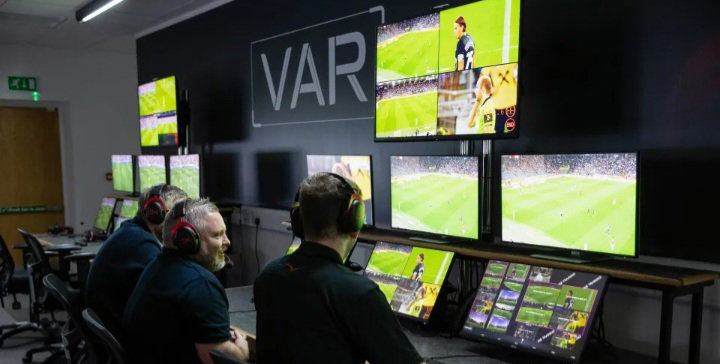
Celtic VAR Hypocrisy Exposed: Two Goals Ruled Out, Technology Failed — So Where Is the Media Outrage?
Category: Sports
Share
Archive
Like
Celtic VAR hypocrisy is not simply about whether an individual decision is right or wrong. It is about the extraordinary difference in reaction depending on which direction that decision travels.
When Celtic benefit, Scottish football appears capable of turning one refereeing call into a national emergency.
When Celtic suffer from controversial decisions but still manage to win, the temperature suddenly drops.
That contrast has rarely looked clearer than after Saturday night's 2-1 victory over St Mirren.
Go back to Motherwell in May.
Celtic received a stoppage-time penalty which was subsequently judged incorrect by the SFA's Key Match Incident panel, by a 2-1 majority. That should be acknowledged.
But consider what happened before that official verdict even existed.
Kris Boyd warned of 'serious questions'. Ryan Stevenson branded the decision a 'disgrace'. Derek McInnes called it 'disgusting'. Sky devoted an entire Q&A to the controversy. The BBC assembled the outrage. National publications asked whether it was the worst VAR decision ever.
The reaction became so ferocious that the Scottish FA itself later condemned what it described as a 'hysterical media narrative' surrounding referees.
Now compare that forensic frenzy with Paisley.
Camilo Durán had an extraordinarily tight goal removed by VAR. Even former referee Bobby Madden's defence of the decision centres on the possibility that television viewers were initially shown the wrong kick point. That hardly screams transparency.
Then Shim Mheuka scored.
The normal virtual offside lines could not be produced.
That matters because SPFL Rule 6.7 states that when those lines cannot be used, VAR should intervene only where the on-field decision represents a clear and obvious error. In all other circumstances, the original decision should be supported.
So what visual evidence made Mheuka's position clearly and obviously offside when the technology designed to establish that factual position could not do so?
That question deserves more than a shrug.
There was also the push on Liam Scales inside the St Mirren penalty area. At the very least, it deserved the same freeze-frame examination routinely applied when Celtic are perceived to have benefited.
It has received nothing remotely comparable.
This does not require a conspiracy theory.
It is better explained by narrative bias and outcome bias.
Celtic are Scotland's dominant club. Therefore, a controversial decision benefiting Celtic easily fits a powerful storyline: the giant receiving another advantage while everybody else suffers.
That storyline generates anger, phone-ins, social-media engagement and headlines.
A controversial decision against Celtic creates a less attractive narrative, particularly when Celtic win anyway. The injustice becomes almost consequence-free: they won, so why complain?
But refereeing standards cannot work like that.
A questionable decision does not become less questionable because Yang Hyun-jun later scores the winner.
There was another revealing example in May's title decider against Hearts. Daizen Maeda was initially flagged offside after scoring the goal which effectively swung the championship Celtic's way. VAR correctly intervened because replays showed Maeda was onside.
One of the most glaring on-field offside errors of the title run-in therefore went against Celtic.
Yet the wider post-match controversy quickly became Celtic supporters, the pitch invasion and Tony Bloom's subsequent allegations concerning Hearts players. The SFA later released audio confirming Hearts had told officials they were happy for the game to end.
That is the real double standard.
Not that nobody reported Paisley. Some did.
It is that when Celtic benefit, controversial refereeing becomes an investigation into Scottish football itself.
When Celtic suffer, it too often becomes a footnote to another Celtic victory.
KEY TAKEAWAYS Celtic had two goals overturned against St Mirren.
SPFL Rule 6.7 places an important threshold on VAR when offside-line technology cannot be used.
Richard Foster publicly questioned the accuracy of extremely tight VAR calls.
Motherwell produced significantly more aggressive and sustained national scrutiny.
Celtic winning in Paisley should not make questionable decisions less important.
The strongest argument is unequal scrutiny, not an unsupported claim of conspiracy.
A note on cookies
Newshunt uses essential cookies to keep you signed in and to remember your language and country, so the site works the way you expect. With your permission, we'd also like to use analytics cookies to understand how people use Newshunt and improve it over time.
Accepting only affects analytics. To learn more, view our Privacy Policy or Terms & Conditions.
(0)Comments