


Governing AI in Physical Spaces - What Happens When Everyone has AI Wearables?
Category: SciTech
Share
Archive
Like
Most corporate AI policies rest on one assumption: someone has to actively give data to the AI. They copy text, upload a file, or paste data into a prompt.
Now EnterWearable Recording Devices. Of which I haven't seen a single corporate AI policy addressing yet.
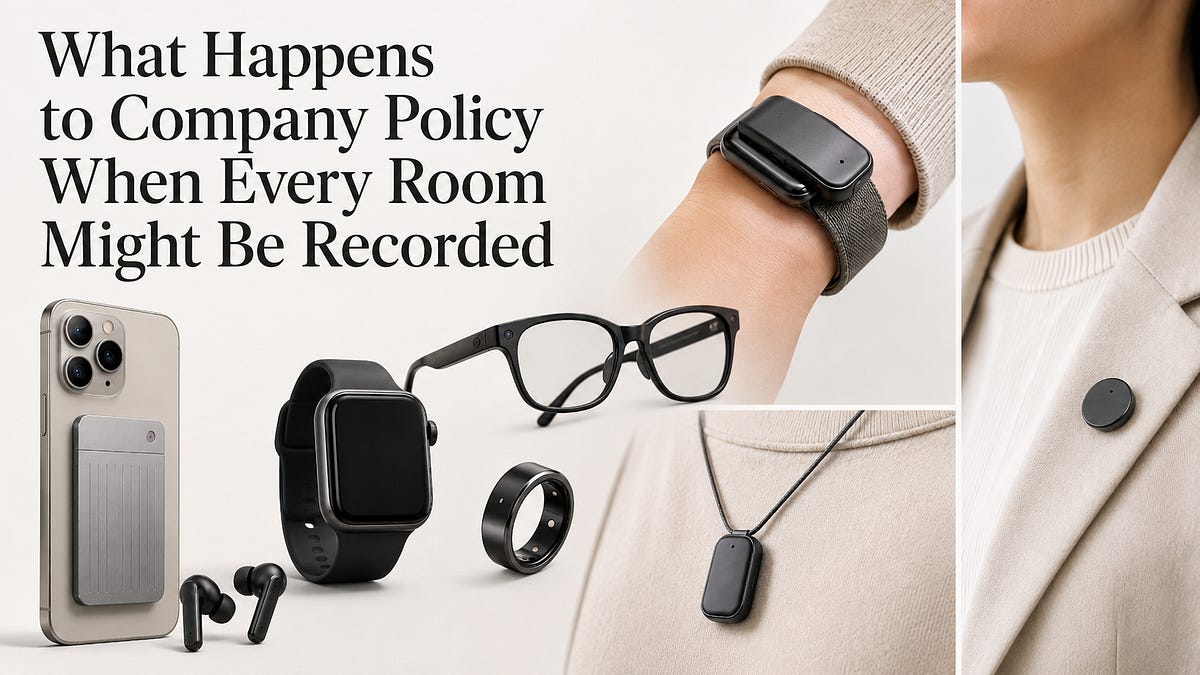
Plaud clips to the back of a phone. Meta's glasses look like glasses (and are easy to alter the light). Recording and transcription devices keep getting smaller, cheaper, and easier to wear without thinking about them.
So what? Well…Recording devices are becoming invisible and causing two big problems:
What changes when you must assume every room might be recorded?
How can you regulate the person wearing a recordable device from uploading sensitive date (like looking at financial spreadsheets on their computer) into someone else's cloud?
Your Data Loss Prevention tool sees nothing. Your network controls see nothing. Your AI policy does not mention it. That is the screen-capture gap, and it widens with every new wearable release.
The natural response is to look for the hardware. That's becoming impossible. Smart glasses look like glasses. Microphones disappear into pins, rings, and earbuds. A policy built on identifying hardware needs a rewrite with every product launch.
Govern the context instead. Determine where continuous-capture devices can be used and where they must be removed.
Most organizations treat recording as a privacy or consent issue. That covers half the problem.
Capturing people:Performance reviews, hiring discussions, customer calls, and HR conversations. This raises questions about privacy, consent, employment law, and trust.
Capturing data:Compensation spreadsheets, source code, financial reports, and login credentials. This happens when an employee is alone at a desk. Nobody else is in the room.
And these are two different problems caused by the same device. A meeting-recording policy protects the people in the room. It does nothing for the spreadsheet on the monitor.
Breaking this down a bit:
Smart glasses in the hallway are fine. The lobby is fine. A conversation about where to order lunch does not need a governance committee.
The exposure becomes a problem when:
The leadership meetings next quarter's revenue gets said out loud.
The employee alone at a desk looks at a compensation spreadsheet open.
The engineer reviewing source code.
The HR conversation about a performance issue.
Decide where wearables do not belong.Identify the environments where recording-capable devices must be removed, powered down, or have capture disabled (e.g., HR conversations, board meetings, secure engineering areas).
Update your personal device policy.Treat camera glasses and ambient recorders as unmanaged personal devices. If an employee cannot bring a personal phone into a secure area, smart glasses do not get a pass.
Require explicit disclosure.A tiny indicator light is a product feature, not disclosure. If someone uses a capture device during an approved meeting, they must state it before recording begins.
Create an accidental-capture process.Build a blame-free incident response process for when an employee accidentally captures confidential data.
Rotate credentials immediately.If an employee reports an accidental screen capture, IT must immediately rotate any passwords or revoke API keys visible on that screen. The consumer AI likely parsed that text instantly.
You can drop this clause directly into your existing Acceptable Use or Personal Device Policy.
Continuous-Capture Wearable and Ambient AI Devices
Definition: This policy applies to all personal wearable technology capable of continuous or ambient audio/video recording, including but not limited to smart glasses, AI pins, audio pendants, and smart rings.
Prohibited Zones: Continuous-capture devices may not be worn, powered on, or actively recording in designated secure areas, including [insert locations: e.g., legal review rooms, HR meeting spaces, server rooms, areas displaying regulated data].
Data Capture Prohibition: Employees must not use continuous-capture devices to record, process, or transcribe proprietary company information, customer data, source code, or financial records.
Explicit Consent Required: If a continuous-capture device is used in an approved collaborative setting, the device owner must provide explicit verbal notice and obtain consent from all participants before recording begins. Relying on the device's visual indicator light does not constitute adequate notice.
Reasonable Accommodation: Exceptions to this policy for disability accommodations must be processed through [insert department, e.g., Human Resources] to identify secure, enterprise-approved alternatives.
This doesn't need to be a difficult fix. Get Security, HR, Legal, and IT in a room and answer two questions:
Which five conversations should never end up on someone else's server?
Which five screens, files, or physical spaces should never be captured by an unmanaged device?
Start there. Map those answers into your AI policy, acceptable-use rules, and incident-response process. Build governance around the information you cannot afford to lose. Here's an easy prompt to get started:
The Risk Identification Prompt
You are an enterprise risk and security advisor.
Our company operates in the [Industry] sector with [Number] employees. We regularly handle [List specific data types, e.g., financial records, PHI, proprietary code, unreleased product designs].
We are updating our acceptable use policy to address ambient AI wearables like camera-enabled smart glasses and always-on audio recorders. We need to define strict 'no-capture' physical zones and restricted data views.
Based on our industry profile, identify the following:
The top five specific types of internal conversations that carry the highest legal, competitive, or compliance risk if recorded and processed by an external consumer AI cloud.
The top five specific screens, software systems, or physical documents that present catastrophic risk if captured continuously by an employee's wearable camera.
Provide a one-sentence explanation of the exact risk exposure for each of the ten items.
Creating the policy is easy. As with most things, the hard part is the people side. That is until the market perfects ultrasonic jamming bracelets and room scramblers, we have to manage the people wearing the devices.
A note on cookies
Newshunt uses essential cookies to keep you signed in and to remember your language and country, so the site works the way you expect. With your permission, we'd also like to use analytics cookies to understand how people use Newshunt and improve it over time.
Accepting only affects analytics. To learn more, view our Privacy Policy or Terms & Conditions.
(0)Comments