


The ultra-right AfD wins where Nazism rehearsed power and shakes the foundations of German democracy
Category: Politics
Share
Archive
Like
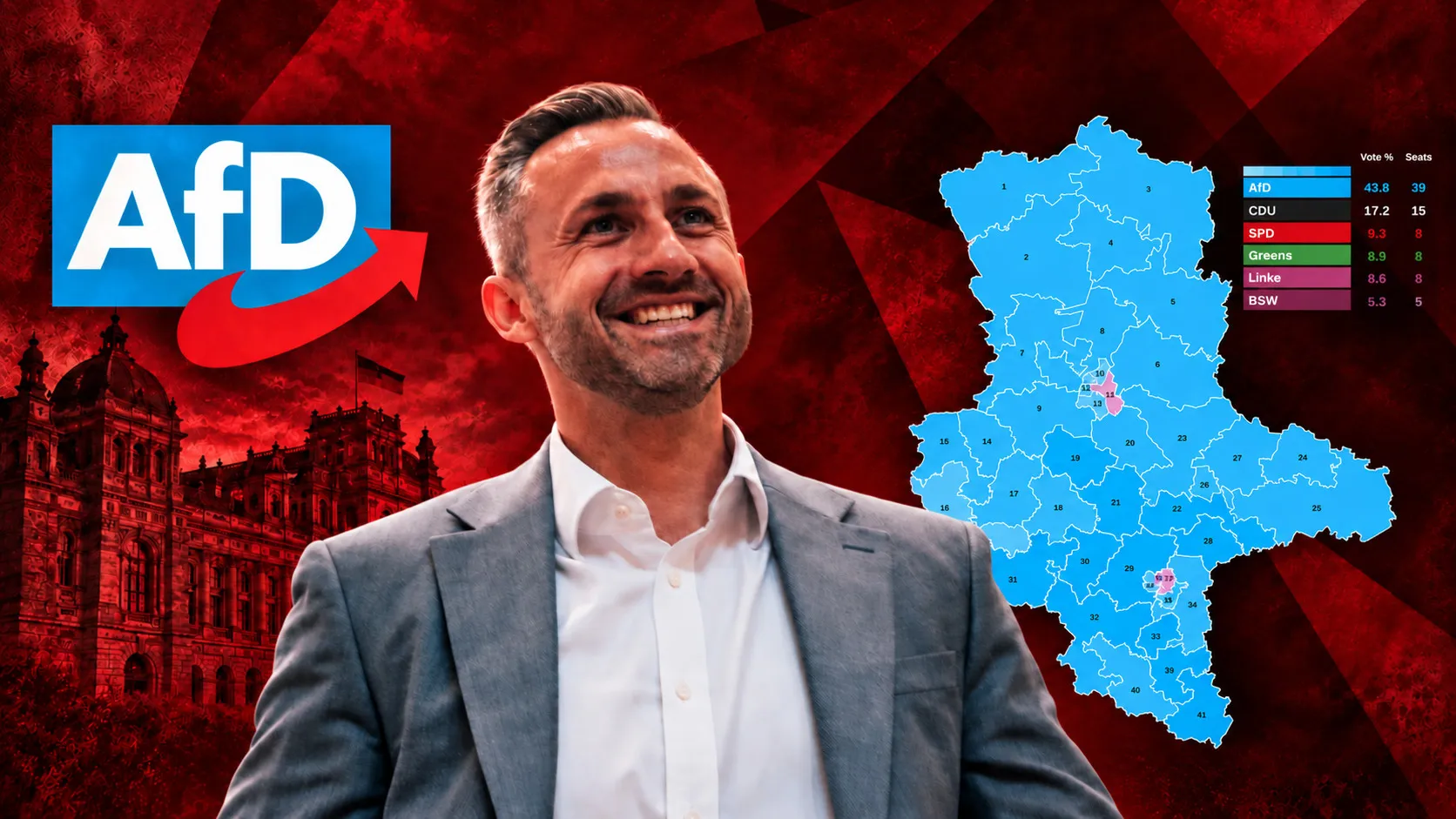
Alternative for Germany had already won regional elections in Thuringia in 2024. What happened this Sunday in Saxony-Anhalt has crossed another frontier. AfD obtained 43.8% of the votes, more than double that of five years ago, and left Chancellor Friedrich Merz's Christian Democratic Union at a distant 17.2%. These are 39 of the 83 seats in the new Parliament, just three less than needed to achieve an absolute majority.
The magnitude of the shift is visible across the entire map. AfD won in all 218 municipalities in the region, from the smallest villages to Magdeburg and Halle. Turnout reached 77.8%, seventeen points higher than in 2021 and the highest level since reunification. The mobilization that was supposed to stop the far-right ended up fueling its growth, according to the results and post-election studies by German public television.
The CDU has lost twenty points and has gone from 40 to 15 deputies. The Social Democratic Party obtained 9.3%, The Greens 8.9%, and Die Linke 8.6%. Each will have eight representatives. The nationalist left of the Sahra Wagenknecht Alliance, known by the acronym BSW, narrowly surpassed the electoral threshold with 5.3% and five seats. The Liberal Party was left out of the Chamber.
The victory is even more serious due to the nature of the party that achieved it. The Office for the Protection of the Constitution of Saxony-Anhalt considers the regional organization of AfD a confirmed far-right structure. The agency maintains that its activity is directed against essential principles of the democratic order, including human dignity and political equality enshrined in the German Constitution. The classification is based on numerous racist, anti-Muslim, and anti-Semitic statements by its leaders, as explained by the regional Ministry of Interior itself.
Reducing the result to a fit of protest would prevent understanding its depth. 55% of AfD voters stated they had chosen the party out of conviction, while 35% spoke of disappointment. Furthermore, 35% of the entire electorate considered it the most prepared force to solve the main regional problems. Five years earlier, only 9% shared that opinion.
AfD has achieved something decisive in any electoral realignment process. It has appropriated the problems that order public conversation. The population attributes more competence to it than to its adversaries in economy, education, security, asylum, and the future of the region. Miguel Otero Iglesias, senior researcher at the Elcano Royal Institute, has precisely summarized it by pointing out that the party "has become the political language through which very broad sectors of society express their discontent".
Immigration has served as ideological glue, although economic and social concerns took center stage during the campaign. The cost of living, pensions, social security, education, and peace in Europe weighed as much or more in the immediate voting decision. Among AfD followers, however, the fear of the arrival of foreigners and a supposed change in the German way of life reaches levels close to 90%.
Therein lies much of the effectiveness of the far-right. It has merged material insecurity with cultural fear. The deterioration of services, low wages, lack of opportunities, and population loss are presented as consequences of immigration, of Brussels, or of elites detached from the common citizen. Complex problems accumulated over decades receive easy-to-identify culprits.
Saxony-Anhalt has lost about a quarter of its population since 1990. The disappearance of much of the industry of the former German Democratic Republic left social wounds that three decades of public investments have alleviated without fully closing them. The region has recovered sectors such as chemistry, logistics, and renewable energies, and its unemployment is around 8%, but it maintains lower wages, a shortage of skilled jobs, and strong youth emigration. The economic distance from the west is also experienced as a loss of recognition.
This discontent has found a very concrete electoral translation. The far-right obtained around 61% among workers, 52% among the self-employed, and 46% among employees. It reached 65% among those who describe their economic situation as bad. It was also first in all age groups and exceeded 50% among voters aged 35 to 59. Among those under 25, it reached approximately 42%, while the CDU was reduced to 5%.
AfD grew at the expense of almost everyone. It attracted more than 80,000 former Christian Democratic voters and gained support from liberals, social democrats, and Die Linke. Its main source of new voters was among those who had stayed home in 2021. The party mobilized hundreds of thousands of additional citizens and turned the increase in participation into its own advantage.
The defeat points directly to Berlin. 87% of regional voters declared themselves dissatisfied with the federal government, and a large majority interpreted the election as a punishment for Merz's executive. The chancellor came to power promising to stop AfD and hardened the Christian Democratic discourse on immigration and security. The result has strengthened those who had been imposing these frameworks for years. The CDU lost centrality and authority while the far-right maintained the credibility of the original. A friendly face for a radical program
Ulrich Siegmund has understood the emotional terrain of this campaign better than his rivals. He is 35 years old, smiles continuously, attends popular festivals, poses for photographs, and masters TikTok and Instagram. He has presented far-right politics as a promise of normality, pride, and community. His slogan, "Everything will be fine," has replaced the angry aesthetic with a familiar and optimistic image.
Political communication expert Johannes Hillje has defined this strategy as "feel-good far-right". The radicalism remains in the content, now wrapped in closeness and entertainment. Siegmund promises to recover a "good, old, and safe" Germany, exploits nostalgia for the former East Germany, and offers an idealized past to a generation that barely knew it.
Thorsten Faas, a political scientist at the Free University of Berlin, believes that AfD has become a much more effective force than its competitors in getting its message across. Christian Stecker, professor of German Politics, points out another advantage. It is the only relevant party that has not yet had the opportunity to disappoint its voters from within the government.
Behind that friendly image appears a project of institutional and cultural transformation. AfD proposes mass deportations, asylum restrictions, separate classrooms for refugee children, and an educational policy oriented towards a homogeneous national identity. It also intends to reduce diversity policies, pressure critical civil associations, and modify the role of public media.
Siegmund participated in the meeting held in Potsdam in November 2023 alongside AfD leaders, businessmen, and far-right activists. There, a 'remigration' plan that even included German citizens of foreign origin was discussed. The investigation by 'Correctiv' also documented the presence of former members of neo-Nazi organizations in his political circle. During that meeting, Siegmund himself explained that his strategy consisted of generating personal sympathy and then introducing radical measures "through the back door."
German regional power offers instruments capable of converting that program into daily decisions. The federal states manage the police, education, culture, and a large part of the administration. An AfD government could intervene in school curricula, integration policies, cultural institutions, and the appointments of high-ranking officials. The dispute goes far beyond the distribution of positions in Magdeburg.
Historical memory adds a particular burden. The current Saxony-Anhalt was born after World War II, but incorporates the territory of the former Free State of Anhalt. There, the NSDAP obtained 41.6% in April 1932, and lawyer Alfred Freyberg assumed leadership of the first regional government headed by a Nazi weeks later. Thuringia had already incorporated Wilhelm Frick as the first Nazi minister in a state cabinet in 1930.
Anhalt had until then been one of the bastions of German social democracy. The economic crisis, unemployment, political fragmentation, a well-organized far-right network, and the underestimation of the danger facilitated the turnaround. A historical investigation by the Otto von Guericke University of Magdeburg describes that territory as an "experimentation field of National Socialism". Among the first decisions of the Freyberg government was the closure of the Bauhaus in Dessau, which became a target due to its modernity and international character.
Mechanically equating AfD with the NSDAP would impoverish history and the analysis of the present. Germany today has a solid Constitution, independent courts, and a mobilized civil society. The experience of Anhalt shows, however, the speed with which an extremist force can use an electoral victory and the cooperation of other parties to occupy institutions that seemed protected. The German firewall and the Spanish mirror
The arithmetic leaves the regional future in the hands of very delicate movements. AfD has 39 deputies and needs 42 to control the Chamber. CDU, SPD, Greens and Die Linke also add up to 39. Any stable alternative requires the five representatives of BSW, Sahra Wagenknecht's nationalist left, which shares with the far-right the rejection of immigration, the end of military aid to Ukraine and rapprochement with Russia.
BSW has shown willingness to negotiate concrete support and even to facilitate an investiture through abstention. AfD is also trying to individually attract Christian Democratic deputies. Siegmund demands a "stable majority" and maintains the repeat election as a threat, convinced that a new call could give him an absolute majority.
Merz has ruled out any cooperation between the CDU and AfD. The so-called 'Brandmauer', the firewall erected by democratic parties, formally remains in place. Its maintenance will force very distant forces to agree or tolerate a common government. The far-right will take advantage of this difficulty to present itself as a victim of a system that blocks the most voted force.
The cordon sanitaire protects institutions against those who aspire to empty them from within, but it needs more than just a parliamentary sum. It requires policies capable of reducing economic insecurity, recovering services, offering a future to abandoned territories and disputing the cultural narrative of the far-right. Institutional exclusion without social response has allowed AfD to monopolize anger.
The shockwave reaches all of Europe. AfD advocates for the end of support for Ukraine, the lifting of sanctions against Moscow and the recovery of Russian gas. The head of European diplomacy, Kaja Kallas, has warned of the growth of parties "blind" to the Kremlin's threat. France and Poland have expressed similar concern, while leaders such as Matteo Salvini, Viktor Orbán and Elon Musk have celebrated the result.
Santiago Abascal also congratulated Alice Weidel and Ulrich Siegmund for a result he described as "a great hope for Germany and for Europe". Aliança Catalana spoke of a "door to hope". The Spanish far-right sees Saxony-Anhalt as proof that a radical discourse can reach popular sectors, young people, and former conservative voters when immigration and fear dominate public debate.
The parallel with Spain requires attention to historical and political differences, although the trend deserves vigilance. The latest 40dB barometer places Vox at 17.8%, six tenths more than in July and 5.4 points above its 2023 result. PP and Vox together reach 50.2% for the first time in this series. After the Ceuta crisis, Abascal's party also appears as the party considered most capable of managing immigration by 27% of respondents, according to data published by 'El País' and Cadena SER.
The new Parliament of Saxony-Anhalt must be constituted before October 6. Until then, Siegmund will seek the three votes that separate him from the Government, and BSW will have to decide what to do with its five seats. In the streets, thousands of Germans have already demonstrated against the far-right. In the offices of Magdeburg, a negotiation has begun that will decide who controls the police, schools, and cultural policy of the territory where Nazism first tested regional power.
Add ElConstitucional.es as a preferred Google source for free.
Stay informed about all the latest breaking news with the best information. Against disinformation, for democracy and social rights. Activate now
A note on cookies
Newshunt uses essential cookies to keep you signed in and to remember your language and country, so the site works the way you expect. With your permission, we'd also like to use analytics cookies to understand how people use Newshunt and improve it over time.
Accepting only affects analytics. To learn more, view our Privacy Policy or Terms & Conditions.
(0)Comments