


Alcazar de Segovia and the cliff-top castle of Castile
Category: Tourism
Share
Archive
Like
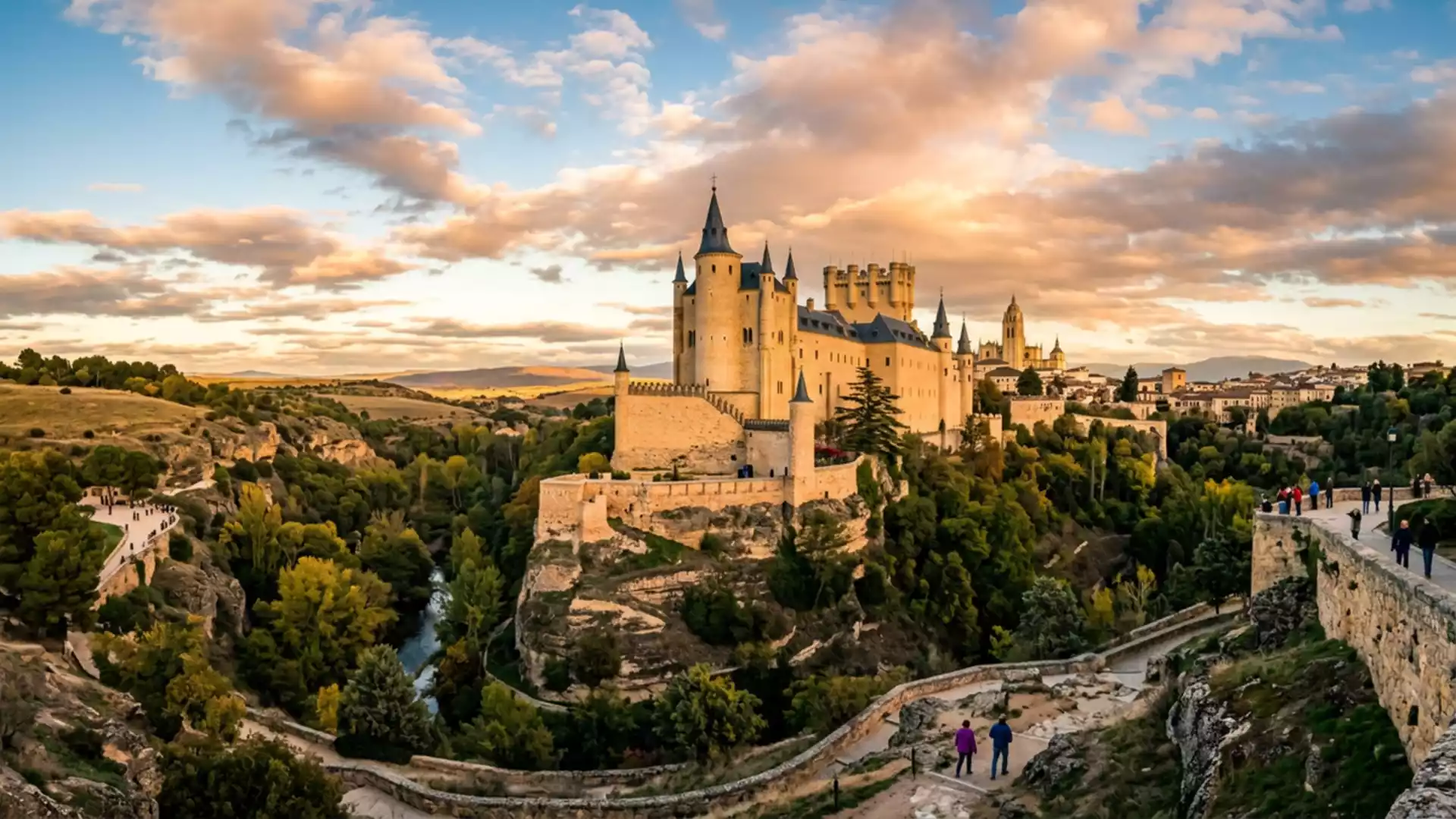
Alcazar de Segovia rises from a rocky headland above Segovia in Spain, a castle whose fortified silhouette and slate roofs draw together centuries of royal and military history in Castile.
A cliff-top fortress turned royal palace
Alcazar de Segovia stands on a high limestone outcrop at the western edge of Segovia, with its outer walls dropping steeply towards the valleys below the city. The site has long been associated with defence and power, and records from the early twelfth century refer to a fortress here that was already known by the Arabic-derived term 'alcázar'.Documents indicate that a fortress existed on this site by the early 12th century Over the following centuries the stronghold developed into a favoured residence of the monarchs of Castile, combining military walls and towers with ceremonial rooms and chapels inside.Alfonso VIII, Alfonso X and the Trastámara kings each reshaped the Alcazar as a castle-palace
The building took on its present character between the thirteenth and sixteenth centuries, as successive kings enlarged the palace and refined its architecture. Medieval stone curtain walls and towers form the core of the complex, dating from around the thirteenth century,with Gothic style noted for the castle while later phases under the Habsburg king Philip II in the sixteenth century added steep slate roofs and distinctive pointed spires that give the castle its fairy-tale outline.Philip II added the conical spires and the slate roofs From the outer moat and towers to the inner halls, Alcazar de Segovia reads as a three-dimensional record of Castilian power.
Architectural layers in stone, slate and heraldry
The architecture of Alcazar de Segovia reflects several styles layered over one another. The lower fabric of the castle, including the base of its towers and some ground-floor rooms, preserves Romanesque forms from the twelfth century, while upper halls and chapels display Gothic vaults and arches shaped during the thirteenth and fourteenth centuries.The principal rooms date from the 12th to 14th centuries and combine Romanesque and Gothic elements Decorative details in tilework and carved wood bring in Mudéjar influence, the craftsmanship of Muslim artisans working under Christian rule.The Alcazar of Segovia showcases Romanesque, Mudejar and Gothic influences Outside, the steep slate roofs and clustered chimneys belong to the sixteenth-century remodelling under Philip II, setting the castle apart from many other stone fortresses in Castile.
Inside, a sequence of halls illustrates the political reach of the kings who lived here. Alfonso X of Castile reshaped several key rooms in the thirteenth century, including a hall of kings that displays heraldic shields and representations of monarchs from Castilian history.Alfonso X created the Sala de Reyes and other main chambers in the thirteenth century Later Trastámara rulers such as Juan II and Enrique IV added or adapted royal chambers, throne rooms and galleries, emphasising Alcazar de Segovia as a castle-palace rather than only a frontier fortress.Juan II and Enrique IV oversaw the construction of prominent towers and state rooms Stone, timber and plasterwork combine throughout the interiors, with richly decorated ceilings reconstructing the atmosphere of late medieval court life.
From royal stronghold to artillery college and museum
Alcazar de Segovia has served varied roles within the history of Spain. In the later Middle Ages it acted both as a royal residence and as a secure fortress, guarding the western approaches to Segovia and providing quarters for the kings of Castile.The Alcazar served as a royal palace and fortress for the Castilian monarchs A pivotal moment came in December 1474, when Isabella was proclaimed Queen of Castile and León within the castle, an act that would lead towards the union with Aragon under the Catholic Monarchs.Isabella I was proclaimed Queen of Castile at the Alcazar on 13 December 1474 The building also housed royal treasures and served as a state prison during parts of its history,the Alcazar has been a royal palace, state prison and custodian of the royal treasury showing how its stonework was put to different uses in different eras.
In the eighteenth century the role of Alcazar de Segovia shifted towards military education. Under Charles III, the Royal College of Artillery was established within the castle in 1764, using its robust spaces for training officers and housing classrooms and arsenals.Carlos III located the Real Colegio de Artillería at the Alcazar in 1764 The college remained until a major fire in 1862 damaged much of the structure, leading to the relocation of the artillery school and a programme of reconstruction that rebuilt the castle in a romantic historic style towards the end of the nineteenth century.A fire in 1862 destroyed most of the structure, which was rebuilt about two decades later In the twentieth century the castle became a museum and home to the General Military Archive of Segovia,the castle houses the General Military Archive of Segovia and Alcazar de Segovia forms part of the wider UNESCO-listed ensemble of the Old Town of Segovia and its Aqueduct.Segovia, including the Alcazar, was inscribed as a UNESCO World Heritage Site in 1985
Visiting Alcazar de Segovia: what travellers from Western Europe should know
Alcazar de Segovia stands on a rocky spur at the western end of Segovia, in central Spain, beyond Madrid; mainline trains link Madrid and Segovia and local streets lead uphill towards the castle.
The fortress occupies elevated ground above the surrounding valleys, and access within the complex involves stone staircases, some of them narrow and steep, between the courtyards, halls and towers.
Segovia lies in the interior of the Iberian Peninsula at altitude, and weather on the exposed headland of the Alcazar can feel more marked than in lower districts of the city.
Segovia is in Spain, where the official language is Spanish and the currency is the euro.
Searching for Alcazar de Segovia on social platforms
These links open searches for Alcazar de Segovia on each platform.
Frequently asked questions about Alcazar de Segovia
Where is Alcazar de Segovia and what kind of place is it?
Alcazar de Segovia is a stone castle on a high spur at the western edge of Segovia in central Spain, combining fortress walls with a former royal palace.
What can visitors expect when they explore the castle?
Visitors encounter exterior towers, moats and slate roofs, along with interior chambers that include heraldic halls, chapels and former artillery college spaces arranged around courtyards.
What makes Alcazar de Segovia distinctive among Spanish castles?
Its position above converging valleys, its blend of Romanesque, Gothic and Mudéjar architecture, and its sixteenth-century slate roofs with tall spires give the castle a recognisable outline in Castile.
A note on cookies
Newshunt uses essential cookies to keep you signed in and to remember your language and country, so the site works the way you expect. With your permission, we'd also like to use analytics cookies to understand how people use Newshunt and improve it over time.
Accepting only affects analytics. To learn more, view our Privacy Policy or Terms & Conditions.
(0)Comments