


Proposed Kansas data center sits hundreds of yards from psychiatric hospital, raising safety concerns
Category: Health
Share
Archive
Like
BEAGLE, Kansas (KSHB) -- Clayton Sherlock spent 16 years caring for psychiatric patients at the Osawatomie State Hospital. Now, he is speaking out about a proposed data center he fears could harm the recovery of some of Kansas' most vulnerable residents.
"They are without question, some of the most vulnerable people within our state," Sherlock said.
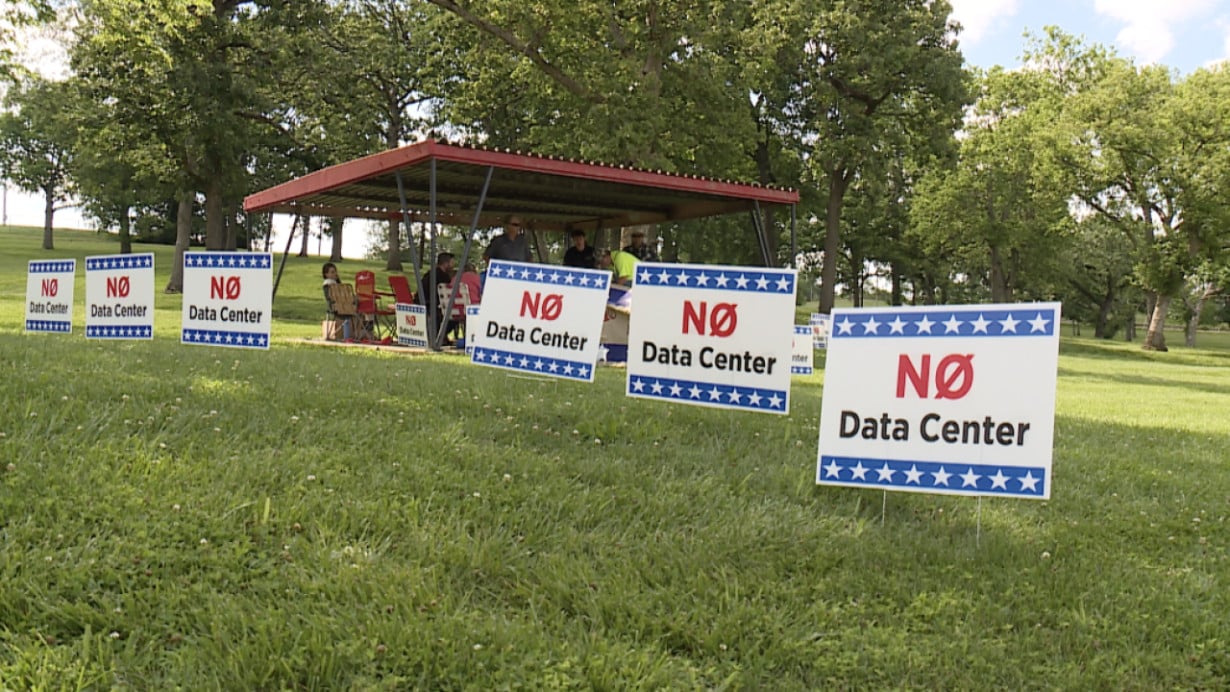
The proposed development, known as Project Catalyst, sits on a site that has grown from 115 acres to 283 acres — just a few hundred yards from the Osawatomie State Hospital, a taxpayer-funded psychiatric facility.
Sherlock, who worked as direct care staff in activities at the hospital, said the project's construction and prolonged operational noise could negatively impact patients living nearby.
"I've worked with a number of patients that had delusions about machinery," Sherlock said. "My concern with the data center is the construction to begin with, but then the continued operation I think could potentially interfere with their treatment."
Sherlock said noise, light, deep vibrations and machinery sounds can be incorporated into a patient's delusions or worsen psychosis. He also points to sleep as a critical factor in mental health treatment.
"Sleep is a huge issue when it comes to mental illness. Our patients need to be able to sleep and find rest," Sherlock explained. "In addition, for those patients that suffer from delusions or psychosis, there may be issues where noise, light, deep vibrations, deep bass sounds, kind of machinery sounds, fans roaring and that kind of stuff, that can pose problems for them because that can incorporate into their delusion."
Sherlock said his concerns are not on data centers broadly, but on where they are built.
"I am not opposed to data centers. They're a fact of life, they're going to be there, they're a part of modern-day living," Sherlock said. "What I am concerned about is the location of where they are built."
Nearly all patients at the Osawatomie State Hospital are court-committed, meaning they have no choice but to be there. Sherlock said that reality makes the state's obligation to protect them even greater.
"The state is required to ensure that patients within a facility who are involuntarily committed there have rights, have civil rights," Sherlock said. "My goal in bringing this to light is making sure those rights are protected."
In the past nine months, I asked the Kansas Department for Aging and Disability Services (KDADS) for comment multiple times about the data center proposal and have never received an answer.
I also reached out to Alcove Development on Friday afternoon with a list of questions about how it is working with the state and am expecting an answer following the holiday weekend.
KSHB 41 also pressed Osawatomie City Manager Bret Glendening directly by email, asking whether the city plans to evaluate potential impacts to patient safety, patient well-being, emergency response, noise, infrastructure strain, or overall compatibility with a psychiatric treatment campus — and whether the city had been in communication with KDADS or Osawatomie State Hospital officials about the proposal.
Glendening said the city had preliminary conversations with the state about the project and noted a presentation and question-and-answer session with hospital employees still needed to be rescheduled.
On the patient welfare concerns, he said they "have been determined not to be concerns for a variety of reasons." He instructed me to visit a Kansas City area data center — ones that are not comparable to the $1 billion, 283-acre campus proposal.
When I followed up asking who made that determination, whether any formal assessment had been conducted, and whether KDADS had formally communicated support or no objection to the project, Glendening said the developer is still engaged in studies.
"To date, everything that I have observed from the data centers I have visited, none of the concerns that have been shared are concerns of mine," Glendening wrote.
After I asked again what specific information, studies, expert input, or site visits informed that conclusion, and whether the city had received any written guidance from KDADS, hospital leadership, environmental consultants, or emergency management officials, Glendening again directed KSHB 41 to visit a data center.
"When I said, 'They aren't concerns of mine,' that's what I meant. They aren't concerns of mine," Glendening said.
The Osawatomie State Hospital is also one of the largest employers in the community.
Glendening did note that the city council and planning commission will have a role once a formal application is received, along with required studies. He said it would be irresponsible to speak on their behalf before that process plays out.
"I don't want to give the appearance that minds are made up and the project is moving forward without any studies being completed," Glendening said.
Glendening said one study — a traffic impact study — has been completed to his knowledge, and that many other studies are currently underway.
The concerns, however, are not new. Ian Day, who opposes the data center, raised a similar point at a public meeting KSHB 41 attended back in June.
"Here we are wanting to put one, people say hospital, an active psychiatric hospital," Day pleaded to Osawatomie city council.
KSHB 41 has been reporting on Project Catalyst since January, sharing the voices of neighbors, community opponents, elected city leaders, and Miami County, Kansas resident Mo Brings Plenty, known for his role on the Yellowstone TV show.
The developer of the project said it carries significant fiscal benefits for the area. The city of Osawatomie is expected to receive annual revenues of $30 million or more, including property tax, franchise fees and other local revenues — funds projected to flow directly into roads, public safety, parks and other quality-of-life services. Miami County is expected to benefit by more than $10 million annually, and USD 367, the Osawatomie School District, is projected to receive more than $10 million in annual property tax revenue.
Sherlock said those economic benefits do not diminish the responsibility owed to patients.
"The state has a responsibility, the city has a responsibility, the developer has a responsibility to ensure the fair and equitable treatment of these patients," Sherlock said.
This story was reported on-air by a journalist and has been converted to this platform with the assistance of AI. KSHB's editorial team verifies all reporting on all platforms for fairness and accuracy.
Please note: This story was provided to CNN Wire by an affiliate and does not contain original CNN reporting. This content carries a strict local market embargo. If you share the same market as the contributor of this article, you may not use it on any platform.
A note on cookies
Newshunt uses essential cookies to keep you signed in and to remember your language and country, so the site works the way you expect. With your permission, we'd also like to use analytics cookies to understand how people use Newshunt and improve it over time.
Accepting only affects analytics. To learn more, view our Privacy Policy or Terms & Conditions.
(0)Comments