


Scientists confirm century-old reports of glowing sea spiders in waters off Australia
Category: SciTech
Share
Archive
Like
"I believe I was a little bit crazy, but I like that."
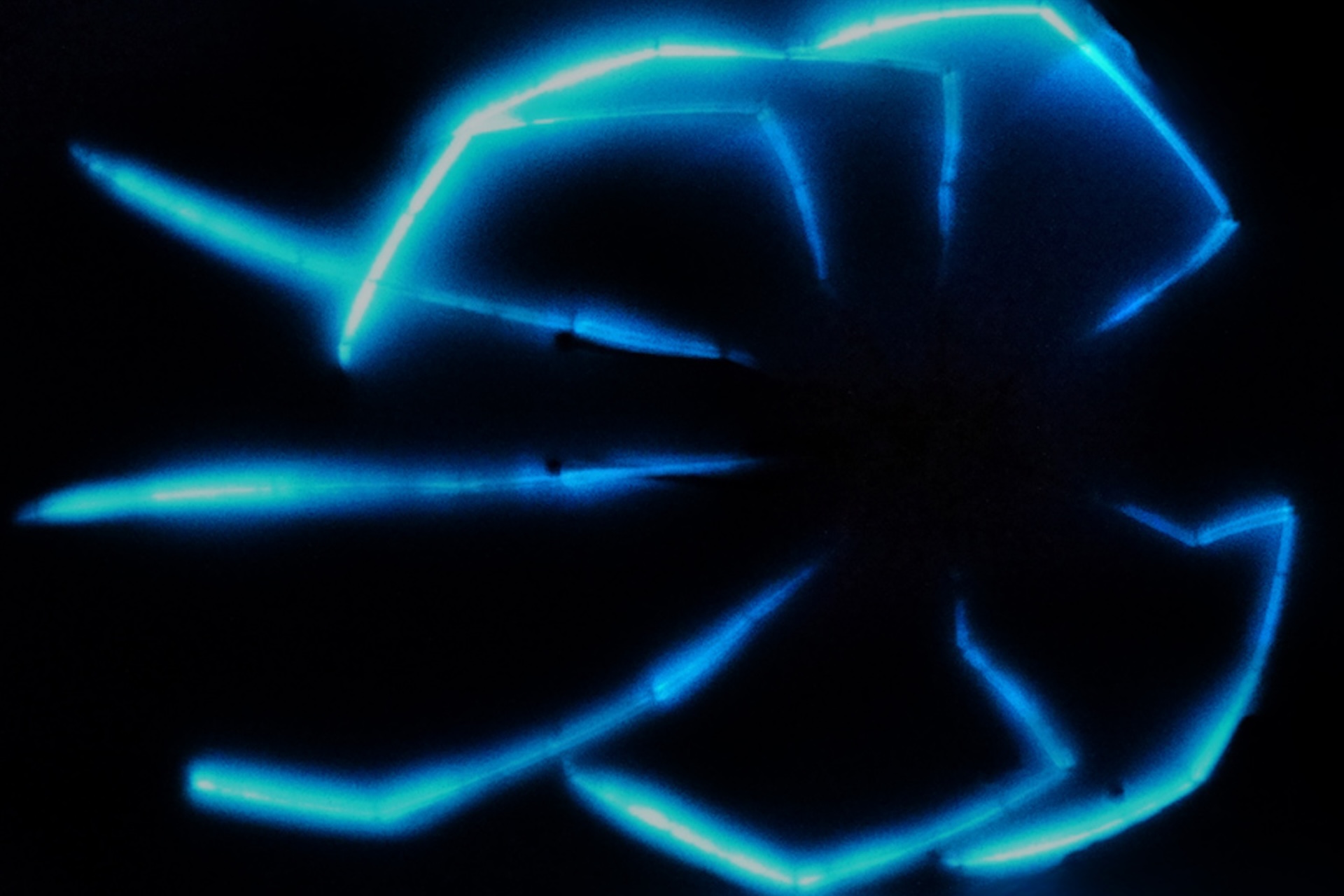
Photo Credit: Image © 2026 by Jérôme Mallefet is licensed under CC BY-NC-ND 4.0 (web)
Giant sea spiders off southeastern Australia have an unusual feature to match their impressive size: glowing legs that can measure 9.8 inches (25 centimeters) long.
The undersides of those legs account for most of the light the deep-sea animals produce, as documented in researchers' photographs.
Here's what to know
Researchers documented bioluminescence in two giant sea spider species, Colossendeis tasmanica and Colossendeis minor, according to Science News.
Occasional accounts of sea spiders producing light stretch back more than a century. Photographic evidence confirms those reports in findings published in the October issue of Deep Sea Research Part I.
A 2017 survey of an Australian deep-sea trench brought Jérôme Mallefet, a marine biologist at Belgium's Catholic University of Louvain, and his colleagues into contact with the glowing animals.
Animals suspected of producing light underwent testing in an improvised darkroom that Mallefet used aboard the RV Investigator, an Australian research vessel.
According to Science News, the expedition hauled up 25,000 specimens in nets from depths reaching nearly 16,400 feet (5,000 meters), giving the team a chance to study animals from an environment that is otherwise difficult to observe.
More background
According to Science News, light production occurs in roughly 76% of deep-sea creatures, and the trait is believed to have originated 540 million years ago.
Two of the bioluminescent sea spider species that were studied shared another trait with a third species that did not produce its own light: all three fluoresced green when Mallefet exposed them to ultraviolet and blue light.
While bioluminescence allows animals to produce their own light, the sea spiders' green fluorescence appeared under specific kinds of illumination.
Why sea spiders fluoresce remains a mystery to Mallefet. The trait also occurs in some amphibians and in platypuses under certain wavelengths of light.
What's being done?
Adding potassium chloride, a substance that stimulates light-producing cells, made them glow for up to 10 minutes, according to Science News. The largest sea spiders, C. tasmanica, also gave off a faint light when poked.
Mallefet located the brightest light in the same place as the animals' digestive tract: the undersides of their legs.
Whether diet supplies the spiders with their light-producing properties remains unresolved. The researchers suspect prey such as sea anemones could be the source.
The photographs do not establish what the glow does for the animals. Mallefet suggests the illuminated legs might help them spot prey on the seafloor, or the light might attract mates.
To document these animals, Mallefet had to spend long stretches in a chilly workspace aboard the ship.
"I spent most of my time in 6° Celsius [42.8°F], in a dark cold room," he said, per Science News. "I believe I was a little bit crazy, but I like that."
Where can I learn more?
Glowing sea spiders are just one of the unusual finds scientists have made while studying ocean life. These stories describe jellyfish-eating sea spiders, backward-walking fish, and a newly identified seahorse.
• In Canada's Salish Sea, tiny sea spiders suck jellyfish dry, including two species new to science.
• In the South China Sea, scientists filmed deep-sea fish walking backward for the first known time.
• In India's Tuticorin Harbour, a new seahorse species was found among discarded bycatch.
Get TCD's free newsletters for easy tips, smart advice, and a chance to earn $5,000 toward home upgrades. To see more stories like this one, change your Google preferences here.
A note on cookies
Newshunt uses essential cookies to keep you signed in and to remember your language and country, so the site works the way you expect. With your permission, we'd also like to use analytics cookies to understand how people use Newshunt and improve it over time.
Accepting only affects analytics. To learn more, view our Privacy Policy or Terms & Conditions.
(0)Comments