


The evening row
Category: Entertainment
Share
Archive
Like
Apologies to those who are expecting a piece about cycling - let me ease you into some rowing.
I head out to Beaumaris for the evening row, cycling along the narrow Llandegfan lanes with their hawthorn and blackthorn hedgerows thick with brambles full of blackberries. I race down Baron Hill, past the golf course and into Beaumaris, parking my bike out the back of the yacht club next to the black wooden cellar door, before walking across the green to the boat compound.
There are only two boats going out for this evening'sfitness row, and when I get to the compound, I find I'm in a boat with Cindy, Andrew, Alona, and Bob – all people I've rowed with before. After just a few weeks here, the crews are beginning to feel like friends. Tall Cindy in her 60s with short grey hair who's training to run the Great North in a few weeks time, retired Andrew who has bought a house as a doer-upper which is proving to be a bigger headache than he ever could've imagined, Alona who has recently escaped a marriage to a farmer in Birmingham leaving her kids behind and who has a bad back from years of horse wrangling, and Bob, a quiet man in his seventies who enjoys gardening and would love to be able to grow a decent crop of carrots.
Subscribe
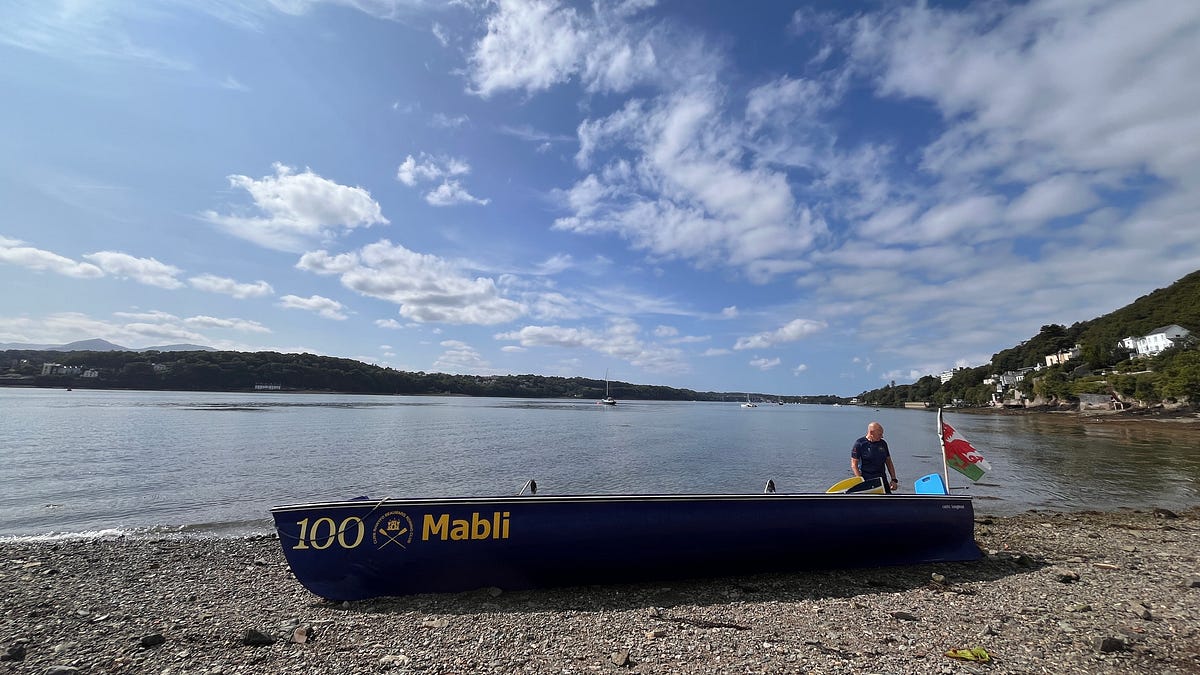
It's almost low tide as we wheel the boat down the beach along the concrete slipway then out across the sand and shingle, avoiding the worst of the mud. The wind is blowing south-westerly, channelled westerly by the Strait. We launch the boat, and Cindy holds it firm in the water while I drag the trolley well up the beach. The others are all in their places by the time I get back. I clamber into Cybi, secure my feet into the footplate with the Velcro straps, then place my oar in the rollock. Cindy is coxing today with Andrew in stroke. He sets a good pace as we head out into the Strait, pushing hard to clear Beaumaris pier, then making slow progress against the current, past the buoys and the moored boats, heading towards Menai Bridge.
Andrew points out a heavy-looking grey boat, with the name,The Ark,painted in white letters against its black hull.That's the club's bosun's boat. He looks after the buoyage in the bay too.
The buoyage?
Cindy explains how all the boats come off the water every October for the winter.It's too stormy here to have boats out all year.Then they're put out again in April, ready for the summer season.I like watching the buoys go out, it means that summer's here.
We keep rowing out of town towards Gallows Point - a grassy promontory on a rocky spit jutting out into the Menai Strait in front of the boat yards and the chandlery, with a name like something out of a pirate story. But this isn't a story. This is for real. Four men were hanged at Gallows Point during the 1700s. Joseph Jones for sacrilege (likely stealing from a church), Robert Ellis for burglary, John Hoult for highway robbery and John Williams for stealing sheep.
It's easy to imagine the condemned men walking down the road from town to their deaths, held tight by guards and surrounded by angry mobs of villagers. At the gallows they would have had one last glance across the Strait to the mountains of Eryri before they said their final prayer and prepared to meet that mythical boatman ready take them across the river Styx.
We pull harder on the oars against the tide, and I can hear Alona breathing deeply behind me. There's not so much chat this evening, we all seem focused on the physical task of rowing. Overhead a skein of geese shifts formation as it flies over the town, heading away from Penmon, up over Caer Mair estate then on across Ynys Môn.
After the Gaol was built in Beaumaris, the hangings moved there. William Griffith was hanged in 1830 for the attempted murder of his wife – he beat her violently and left her for dead, and even though she survived his cruelty, the crime was enough for him to hang.
Physical violence is easy to see, easy to document, easy to be horrified at. Psychological violence is harder to spot, harder for people to see, harder to understand.
Subscribe
A note on cookies
Newshunt uses essential cookies to keep you signed in and to remember your language and country, so the site works the way you expect. With your permission, we'd also like to use analytics cookies to understand how people use Newshunt and improve it over time.
Accepting only affects analytics. To learn more, view our Privacy Policy or Terms & Conditions.
(0)Comments