


What Remains of Riis?
Category: Entertainment
Share
Archive
Like
The Weekend Read
/ What Remains of Riis?
A new members' club has revived Riis Park's long-vacant bathhouse, reopening old questions about whom the People's Beach is really for.
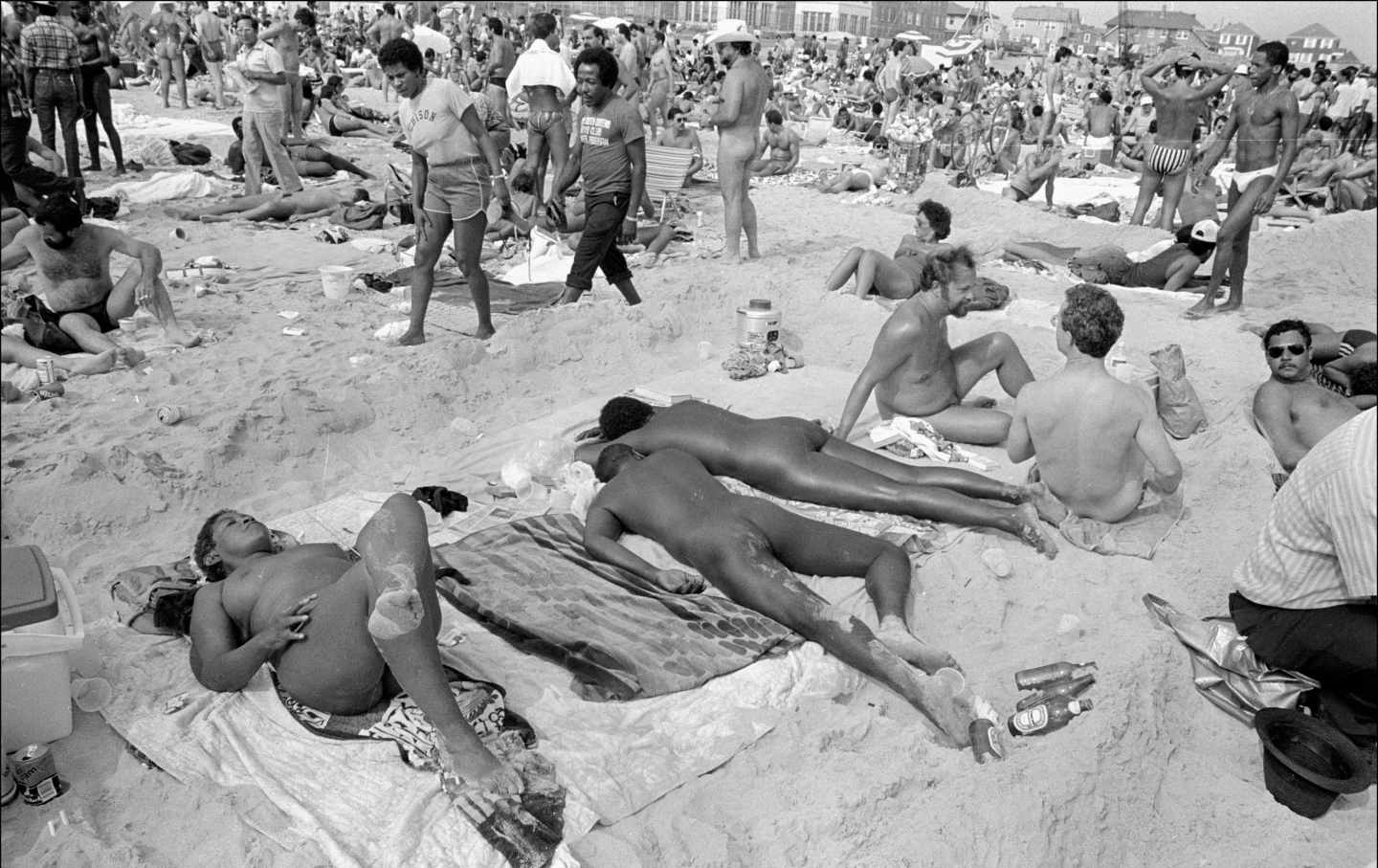
View of nude sunbathers on the beach at Jacob Riis Park in the Rockaways, New York, New York, August 1, 1982.
(Allan Tannenbaum / Getty Images)
I biked to the beach early Sunday morning, from my apartment in Bushwick through South Brooklyn and into Queens, crossing the narrow shared bike and pedestrian lane of the Marine Parkway Bridge, where a sign tells you to walk your bike but no one does. I arrived before nine, when the titular People of the People's Beach—Riis Beach, or Gay Riis—were not there yet, making it just the beach. So I continued west to Fort Tilden, a wilder stretch of sand hugged by scrub-brushed dunes, where being alone felt intentional, even desirable. I followed a concrete path until it ended at a bike rack, slipped out of my sweaty bike shorts, squeezed into a Speedo, and stretched out on the sand. I was alone until an older man passed me, ventured farther down the beach, stripped down, and settled into his secluded spot.
Suddenly, a Park Police officer appeared on the sand and raised a pair of binoculars, training them on the nesting nudist. After apparently confirming that the man was indeed naked, he stomped toward the unsuspecting sunbather. I thought maybe he would get a warning or a ticket—speed-trap style—for his indecent infraction. Instead, the officer made him gather his things, and the pair started heading back my way. A patrol car arrived as backup. Unsure of what to do, I started recording. I was the only person around as the skinny, sun-weathered man with stringy gray hair was escorted past me, handcuffed, and lowered into the back seat. A few minutes later, it was just me on the beach with several minutes of fucked-up arrest footage on my phone.
Fort Tilden feels like somewhere it should be okay to get naked, even though technically it isn't. The former military base, now part of Gateway National Recreation Area, is dotted with the ruins of concrete batteries covered in beach grass, giving the coastline the stolen valor of a WWII battlefield. Its emptier reaches, far from the family-friendly amenities of Riis, have long invited topless tanning, full frontal frolics, and the occasional dalliance in the dunes. I had considered a quick skinny dip after the hour-plus ride, but save for a split-second flash of flesh while I changed, I played it safe in my Speedo.
After crossing back over the bridge to bike home, I saw my busted beach buddy waiting alone at a barren bus stop. I stopped and told him I had seen the arrest. He said they had held him for three hours, that they had told him a child could have seen him (if that child had binoculars). He said he was going back to the beach because he didn't know what else to do. At the time, I was surprised he wanted to return. Looking back, I guess I understood.
I went back too. It was a good summer for a return to Riis. My job of nine years had been reduced from full-time to part-time, which meant more free time but less disposable income. Less disposable income meant I had to back out of a Grecian gay guy getaway, but I had started biking again and set about rediscovering the pocketbook-friendly pleasures of my city's unsung shoreline. I had frequented Riis and Fort Tilden throughout the 2010s, and I couldn't tell whether my interest had coincided with a particular cultural moment—post-Sandy, when MoMA PS1 began hosting art events and the satire Fort Tilden came out—or whether I had naturally aged out of A-train-adjacent beaches for more pedigreed havens: the Pines, P-town, Puerto Vallarta, Palm Springs, Purgatory, following the migratory lifecycle of the adult gay male.
But Riis had its own lifecycle of booms and busts. The city acquired the land for a public park in 1912, first called Seaside Park and later Telawana Park, after the last known descendant of the native Rockaway people. After Jacob Riis died in 1914, it was renamed for the muckraking journalist, who had championed its development as a park for the people of New York. Still largely undeveloped, the park became a naval air station during World War I and, in 1919, the departure point for the first successful transatlantic flight. Its Byzantine-inspired brick bathhouse was completed in 1932, then substantially expanded under Robert Moses in 1936 and 1937 using Works Progress Administration labor, adding Art Moderne elements and a 62-acre parking lot with room for 14,000 cars—then billed as the largest paved parking lot in the country.
What wasn't billed were the boys bound for Bays 1 and 2. By the 1940s, gay men, mostly white, were frequenting the eastern edge of Riis, in front of Neponsit Hospital; lesbians claimed a nearby strip of sand in the 1950s, and by the 1960s the beach had drawn increasing numbers of Black and Latino queer people. Trans beachgoers were part of the community by at least the 1970s. In 1966, the alternative guide New York Unexpurgated called it 'one of the best Gay Rivieras in the world,' adding that it was 'so crowded, nudes go unnoticed.'
Nudes were eventually noticed. In 1974, as Riis came under control of the National Park Service, The New York Times reported an 'effort to restrict the wilder sorts of social nonconformists who like to frequent the beaches of the park,' including the arrest of a nude sunbather and 11 men for disorderly conduct, part of what authorities described as a crackdown on 'behavior that might offend families who use the park.' By then, Riis was already in decline. The bathhouse fell into disrepair and would remain largely vacant for decades, despite plans for its rehabilitation being floated as early as 1988.
Decades later, the proposed demolition of Neponsit Hospital raised new concerns about the future of the gay beach. Opened for children with tuberculosis and later converted into a nursing home, it was abruptly evacuated by the Giuliani administration in 1998. For the next 25 years, the abandoned structure shielded the beach from the houses beyond until the city razed it in 2023, erasing one of the beach's most identifiable landmarks—and with it the 'Queer and Trans Power' and 'Know Your Power' tags spray-painted across its upper parapets. Around the same time, erosion forced the National Park Service to close Bay 1, pushing the gay beach farther west into Bay 2. And then came the members' club.
Given all the bad press, I expected to encounter a sea witch when I parked my Prius in front of the soon-to-open Rockaway Ocean Club. Instead, I met Ursula Damani, a cofounder of the new members' club opening inside the restored bathhouse. She greeted me with a big hug and noted our matching stripes—she wore a red-and-white romper; I wore a faded pink button-down and tennis shorts. She told me she was glad I had dressed for the beach. I admitted that I was wearing a Speedo underneath, revealing the temporary nature of my journalistic intent.
A note on cookies
Newshunt uses essential cookies to keep you signed in and to remember your language and country, so the site works the way you expect. With your permission, we'd also like to use analytics cookies to understand how people use Newshunt and improve it over time.
Accepting only affects analytics. To learn more, view our Privacy Policy or Terms & Conditions.
(0)Comments