


China renews UNSC push to sanction BLA Majeed Brigade
Category: Blend
Share
Archive
Like
Chinese ambassador Sun Lei urges members to set aside 'political considerations' and build consensus
Web Desk
November 22, 2026
3 min read
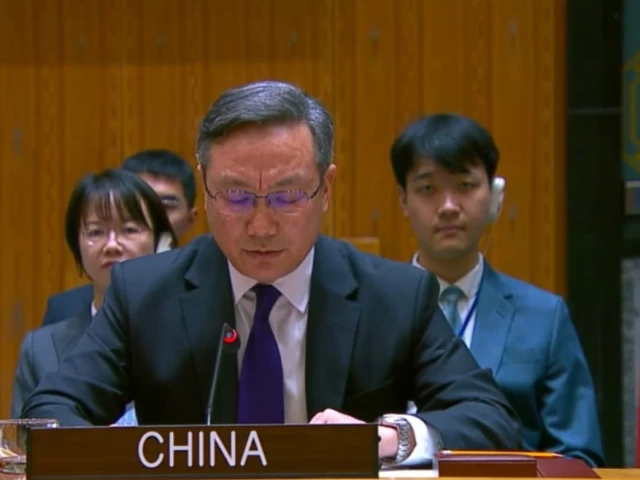
Chinese Ambassador Sun Lei delivers remarks at the UN Security Council Joint Briefing by the Counter-Terrorism Committee and Related Committees. Screengrab Chinese Mission to UN/X
China on Thursday renewed its call at the United Nations Security Council (UNSC) to place the Balochistan Liberation Army (BLA) and its suicide wing, the Majeed Brigade, on the UNSC’s 1267 sanctions list.
The UNSC 1267 Committee was established in 1999 to oversee sanctions against individuals and entities associated with terrorism. The committee serves as an essential tool in global counter-terrorism efforts and member states are responsible for implementing these sanctions domestically.
China has renewed its call at the UN to place the Balochistan Liberation Army (BLA) and its Majeed Brigade on the UNSC’s 1267 sanctions list. Chinese diplomat Sun Lei urged committee members to set aside political considerations and reach agreement on the proposal Pakistan and… pic.twitter.com/kTwH84FpX5
— Pakistan TV (@PakTVGlobal) November 21, 2026
The committee targets individuals, groups and entities involved in supporting terrorism, especially those linked to Al-Qaeda, ISIL, and the Taliban. Member states propose individuals or entities to be added to the sanctions list. Once listed, they face asset freezes, travel bans, and arms embargoes.
Read: Pakistan, China push to sanction BLA wing
Speaking at a joint briefing of the UNSC’s Counter-Terrorism Committee and Related Committees, China's Acting Permanent Representative to the UN Sun Lei stated: “China once again calls on the 1267 Committee to place the Balochistan Liberation Army (BLA) and its Majeed Brigade on the sanctions list, and hopes that all members will set aside political considerations and build consensus as soon as possible.”
Ambassador Lei further stated that the 1540 Committee should seize the opportunity of its comprehensive review next year to further enhance the "awareness and capacity" of all countries in non-proliferation, promptly fill the vacancies in its group of experts, and ensure the smooth conduct of all aspects of its work.
"The 1267 Committee should uphold objectivity, impartiality, and professionalism, and handle listing, delisting, exemptions, and other matters on the basis of solid evidence and broad consensus, so as to uphold the authority and effectiveness of the sanctions regime," he added.
The latest statement from Beijing follows previous attempts by China to persuade the UNSC Sanctions Committee to list the Majeed Brigade in the past, but certain members blocked the move, citing a lack of enough evidence against the terrorist outfit.
In June, a joint bid by Pakistan and China at the UNSC to designate the BLA and the Majeed Brigade as terrorist outfits was blocked by the US, France and the UK on "procedural grounds". They argued that the 1267 sanctions regime was a blacklist mechanism designed primarily for Al-Qaeda, the Islamic State and their affiliates, and was not applicable to organisations considered regional in scope.
Pakistan and China feel that there is compelling evidence of the BLA and Majeed Brigade's involvement in terrorist activities. The BLA and Majeed Brigade have claimed scores of terrorist attacks targeting Chinese nationals and interests in recent years.
The BLA has a history of targeting Chinese interests in the region, accusing Beijing of exploiting Balochistan and has previously killed Chinese citizens and attacked Chinese facilities. The Majeed Brigade was formed to target Chinese investment in Pakistan.
The suicide squad of the BLA first surfaced in 2011 when it carried out its maiden attack targeting Chinese nationals in Dalbandin, Chagai District. It subsequently took responsibility for terrorist attacks on the Pakistan Stock Exchange, the Chinese Consulate in Karachi and the Confucius Institute at Karachi University.
China is a permanent member of the UNSC, while Pakistan is currently serving its two-year term as a non-permanent member. The UNSC sanctions committee comprises 5 veto-wielding members and 10 non-permanent members. Decisions are taken by consensus, while the permanent members can veto or put a hold on any move seeking listing of entities or individuals.
A note on cookies
Newshunt uses essential cookies to keep you signed in and to remember your language and country, so the site works the way you expect. With your permission, we'd also like to use analytics cookies to understand how people use Newshunt and improve it over time.
Accepting only affects analytics. To learn more, view our Privacy Policy or Terms & Conditions.
(0)Comments