


The Stage You Thought You Finished is Probably the One You're Still In
Category: SciTech
Share
Archive
Like
For the next articles, this section will be a constant. I hope to be as personal as I can be so I'll start with a little update about me.
This past week, I spent more time in our Tre'dish warehouse than at my desk. I was dispatching and standing in the middle of it all as orders went out. Now that the summer is over, we're getting more recurring orders than ever and with them come new operational problems. You can't spot an operations problem in a spreadsheet, but you can see it clearly when it's happening right in front of you.
A few weeks ago, I shared therepeatable revenue roadmapand said we'd keep building on it. Here's the part that causes the most trouble when no one talks about it.
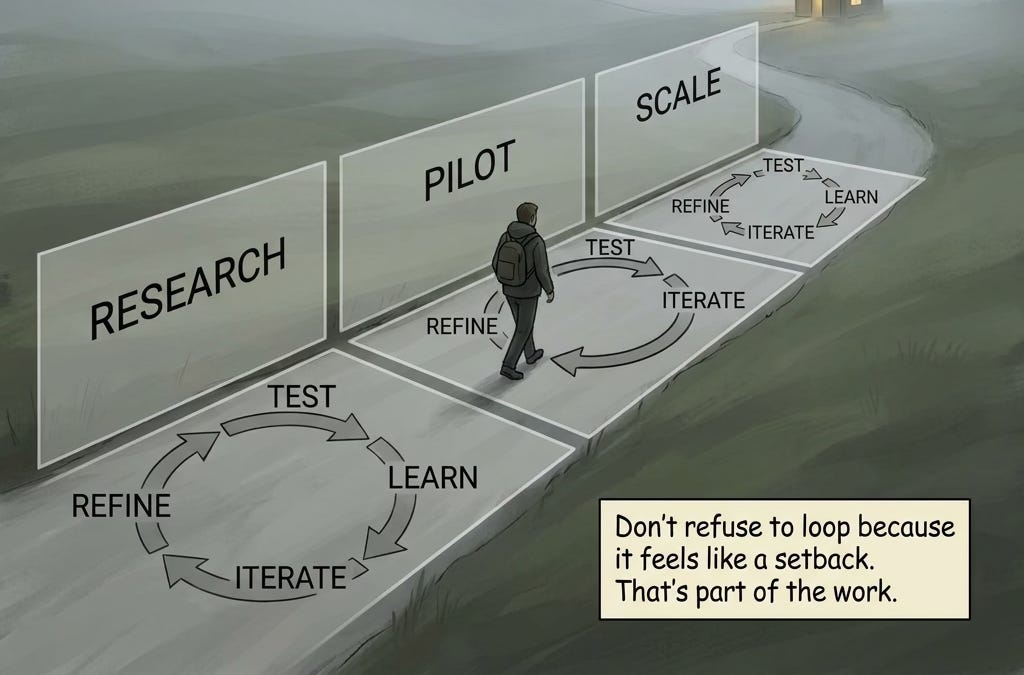
The roadmap looks like a straight line: idea, research, validation, pilot, POC, PMF, growth. Every version you've seen looks like a staircase, and staircases feel reassuring because they make it seem like if you keep climbing, you'll eventually get somewhere.
Then you start building and it doesn't feel like that at all. It feels like you keep landing back on a step you already cleared. You validated your idea. You were sure. And then three months into a pilot you find yourself opening a research doc again. And there's a quiet voice asking whether you've wasted the last quarter.
Here's something I've noticed over the years: founders often can't tell the difference between a stage that's truly finished and one that just seems finished.
Both of those are true at once and holding both is the whole skill.
The stages follow a real sequence. You can't validate a market you haven't researched. You can't run a meaningful pilot without knowing your audience. You can't scale something you haven't proven. That order matters, and you can't skip a stage just by working harder on the next one.
But within any stage, the work repeats. You test, get a partial answer, make changes, and test again. That doesn't mean you did the stage wrong. It's just how stages work. Each stage is a question you haven't answered yet and questions don't resolve on a set timeline.
So if you're in research and the numbers seem off, going back to check if you framed the market correctly isn't a setback. That's part of the work. If you're running a pilot and customers use your product in unexpected ways, taking time to understand why isn't a delay. That's exactly what a pilot is for.
The most common mistake I see most often is not founders who loop too much. It's founders who refuse to loop because looping feels like admitting the last six months didn't count. That's what turns a stage problem into a bigger mistake.
I had a company years ago where I was confident about the model. I had done the work. The economics held on paper and paper was the best information anyone had at that point.
Then we started running it and the numbers we got back weren't the numbers we modeled. Not dramatically. Just enough to be inconvenient rather than alarming, which is the hardest kind of signal to read. A number that's clearly broken tells you what to do. But a number that's just slightly off tells you almost nothing, and it can stay that way for as long as you let it.
What I eventually learned is that the size of the gap tells you very little about the size of the cause. When I went back and pulled that stage apart properly, there wasn't one problem underneath it. There were several, stacked, each one masking the next, and every one of them looked like the whole answer right up until I solved it and found what was underneath.
That took longer than I wanted. I've stopped treating that as a failure of speed, because some of it was just what the business demanded and no amount of urgency was going to compress it.
But I did take one thing from it that changed how I build. When a stage produces a result that's close to what you expected but not quite, that's the time to go back in and dig deeper. Not when it's obviously broken. Obvious comes late and by then you've built three more things on top of it.
There's a second piece to this and it decides how much any of the looping is worth.
Before you start, you have to understand the four walls of your idea. Not whether it's good. But how far it can expand.
Every idea sits inside a set of limits. Take a restaurant, for example. There's only so much revenue you can make in one physical space, no matter how good the food is or how well you run things. Everything has to go right just to reach the ceiling, and that ceiling doesn't move. That's what I mean by compressed four walls, and it's not really about the quality of the idea.
Now compare that to something with walls that can expand. Software can reach anyone. A product might start in one region and work just as well in another. Or maybe you have an offering that can grow from one thing you sell into three.
I'm not saying compressed ideas are bad. Some of the best businesses I know are lifestyle businesses run by people who chose that path and are truly happy. The four walls theory isn't about saying yes or no to an idea; it's about setting the right expectations.
Because here's what happens if you skip it. You build something with a hard ceiling, you loop and loop inside a stage trying to break through and you can't understand why nothing you try compounds. You start questioning your execution. You start questioning yourself. But the constraint was set the day you chose the idea and no amount of iteration inside the stage was ever going to move a wall you never measured.
So ask these questions early and honestly: What are the limits of what I'm building? What would it take to push those limits? Is that expansion worth the cost? If the answer is that the walls won't move, that's okay, as long as you and your team know it from the start.
If you're stuck looping inside a stage right now and it feels like failure, check two things before you conclude anything.
First, see if the result you keep getting is close to what you expected but not quite. That's a sign to go back and dig deeper, rather than just pushing forward.
Second, ask if the ceiling you keep hitting is really a stage problem, or if it's just the shape of the four walls you chose at the beginning.
These two questions have very different answers, and it's hard for anyone to tell them apart from inside their own company. That's not a criticism; it's just normally tough to see the walls when you're standing inside the room.
That's an honest place to be, and it's worth checking. AStartup Diagnosisis a one-time audit that shows where you are on the roadmap, what still needs to be validated at your stage, and whether you're building against a wall that won't move.
The most expensive months in a company are the ones spent executing well on the wrong stage. The diagnosis shortens your experiment period. What you save is months and the money those months cost you. For only $99.
See What's Still Unvalidated
Something new we're adding, and it'll stay in every issue from here. Each week we'll share one note from a reader that stood out to us.
This one came from, who writes about reducing regulatory complexity for small businesses and spent a Friday sharing the Dear Founder series with her own readers.
Vee: 'There is no lack of founder advice on Substack. What's different about Peter's work is the warmth and intelligence in his writing, that he completely gets the unglamorous part of building, the self-doubt that pops up no matter how long you've been doing it, the questions that guide him to clarity.
His Dear Founder series are my absolute favorites, like the piece below. Thanks for sharing your wisdom Peter.'
This is very sweet. Thank you, Vee. Founders rarely talk about the unglamorous parts, even though that's where most of the real work happens. Happy to know the Dear Founder series resonated with you.
Thanks for reading The Unstuck Entrepreneur! Subscribe for free to receive startup insights every Tuesday. From someone who has built and scaled 6 companies across completely different industries for over 28 years.
The Unstuck Entrepreneur is where we share lessons for founders in the quiet middle, that long stretch between early traction and repeatable revenue, when the work gets lonely and nobody warns you how heavy and uncertain it feels. This newsletter exists so early-stage founders like you would know you aren't building alone and to help you find your way to repeatable revenue.
Peter Hwang is a serial entrepreneur who has built and scaled 6 startups across multiple different industries over the past 3 decades. Over 28 years he has built companies in foodtech, equipment finance, energy, fundraising and analytics, cannabis, grocery supply chain and AI. He has successfully exited 4 out of 5 and is currently building his 6th startup.
He has scaled his 4th startup into becoming one ofNorth America's leading donor analytics and face-to-face fundraising companies, acquiring over 1,000,000 monthly donors across North America for charities including Unicef and Red Cross. He exited in an eight-figure deal with private equity. He also led his 5th company through to its IPO and was acquired for approximately $263 million.
A note on cookies
Newshunt uses essential cookies to keep you signed in and to remember your language and country, so the site works the way you expect. With your permission, we'd also like to use analytics cookies to understand how people use Newshunt and improve it over time.
Accepting only affects analytics. To learn more, view our Privacy Policy or Terms & Conditions.
(0)Comments