


iGPSPORT BiNavi review: a serious Garmin rival or budget compromise?
Category: SciTech
Share
Archive
Like
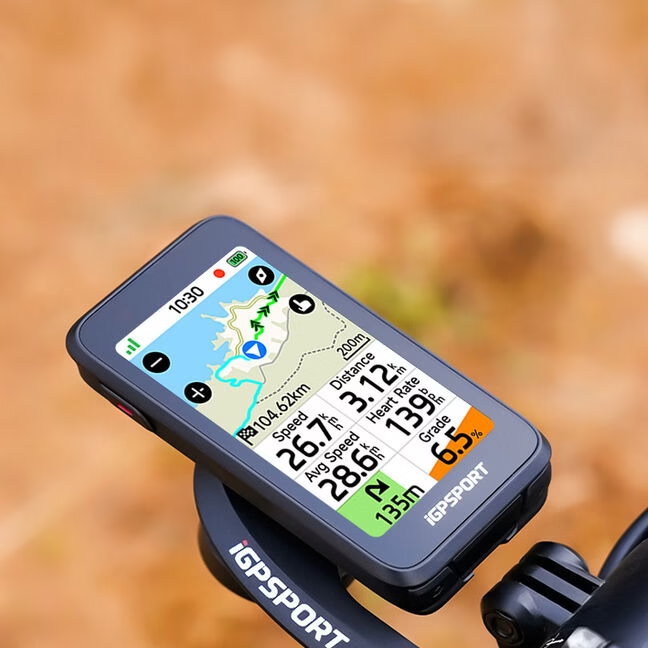
The iGPSPORT BiNavi sits in an increasingly interesting part of the cycling computer market. It is not trying to compete with the cheapest GPS units, where basic ride recording and breadcrumb navigation are enough. Instead, it goes directly after riders considering a Garmin Edge but wondering whether they really need to spend Garmin money.
The specification makes that comparison inevitable. There is a large 3.5-inch colour touchscreen, physical button controls, full mapping, turn-by-turn navigation, dual-band GNSS, ANT+ and Bluetooth sensor support, 32GB of storage and claimed battery life of up to 35 hours.
On the bike, the argument is more convincing than I expected.
The BiNavi does not quite have the refinement of Garmin's best computers. The software ecosystem is less developed, some parts of the interface take more getting used to and Garmin remains better when navigation becomes complicated. But those differences are concentrated around the edges of the experience rather than the fundamentals.
For following a route, seeing your data and getting through a long ride without worrying about the battery, the BiNavi is a genuinely capable cycling computer.
Check the current iGPSPORT BiNavi price on Amazon
iGPSPORT BiNavi specifications
Feature iGPSPORT BiNavi Display 3.5-inch colour touchscreen Controls Touchscreen and physical buttons Navigation Full maps and turn-by-turn guidance GPS Dual-band GNSS Storage 32GB Battery life Up to 35 hours Connectivity ANT+ and Bluetooth Charging USB-C Sensor support Heart rate, speed, cadence, power and compatible accessories Waterproofing IPX7
If you are still deciding whether you need a dedicated head unit at all, our guide to whether cycling computers are worth it covers the broader argument.
A big screen without an oversized feel
The 3.5-inch display is one of the BiNavi's strongest features.
There is plenty of space for mapping without the route disappearing underneath data fields and icons, while the screen remains manageable on a normal road-bike cockpit. It feels like a navigation-focused computer rather than a small data display that happens to contain a map.
That matters on unfamiliar roads.
At speed, you do not want to spend several seconds working out whether the road you need is the first or second turning at a junction. The larger display gives the map enough room to provide useful context around the route.
The colour rendering is clear and normal daylight visibility is good. It is not the brightest or most polished display in the category, but it has never felt inadequate for the job it is being asked to do.
The touchscreen is backed up by physical controls, which I prefer to a touch-only design on a cycling computer. Riding in Britain means gloves, wet fingers and rain are going to become part of the test eventually. Being able to fall back on buttons makes the BiNavi much easier to live with when conditions deteriorate.
Build quality is better than the price suggests
There is little about the physical unit that gives away its position below the premium brands.
The BiNavi feels solid, mounts securely and avoids the lightweight plasticky feeling that can still appear on cheaper computers. It is not luxurious, but I do not particularly want a luxurious bike computer. I want something that can spend several hours vibrating above the front wheel, get soaked and continue working.
It does that job convincingly.
The interface takes some familiarisation, particularly if you are arriving from Garmin and instinctively expect options to sit in familiar places. Once set up, however, normal ride operation becomes straightforward.
That is an important distinction. A different menu system is not necessarily a bad one.
Navigation is the reason to buy the BiNavi
If the BiNavi has one feature that makes the strongest case for spending the money, it is navigation.
Routes display clearly across the 3.5-inch screen and turn notifications provide enough warning to prepare for junctions rather than reacting as you reach them. Automatic map zooming helps when several roads converge, and the full map gives far more useful context than basic breadcrumb navigation.
For planned rides, it works very well.
That includes long road routes, gravel rides and simply loading a GPX before exploring roads you do not know particularly well.
This is the point where the BiNavi separates itself from cheaper GPS computers. A basic unit can record the same speed, distance and heart-rate data. Good navigation is much harder to fake.
The BiNavi feels like it was designed around finding your way first, rather than having mapping added late in development.
See the iGPSPORT BiNavi on Amazon
Going off route exposes more of the difference to Garmin
The navigation is good, but Garmin still has an advantage when the ride stops going according to plan.
The BiNavi supports automatic rerouting and can calculate a route back towards your original course. It works, but Garmin's mature navigation software remains better at handling some of the messier situations created by missed turns, deliberate detours and changes of destination.
That distinction will matter differently depending on how you ride.
If you normally create a route in advance, load it and then follow it, the BiNavi covers the job very well.
If you regularly abandon routes halfway through, search for new destinations on the road or want the computer to make sophisticated navigation decisions for you, the extra Garmin refinement becomes easier to justify.
Our Garmin Edge 840 Solar review gives a good indication of what the more mature Garmin experience offers.
Dual-band GPS performs well
Navigation is only useful if the computer knows where it is.
The BiNavi uses dual-band GNSS positioning, increasingly an expectation on better cycling computers and particularly useful when buildings, tree cover or terrain make satellite reception more difficult.
In normal road use, positioning is stable and the route marker behaves as expected.
There has been no regular tendency to jump onto neighbouring roads or leave the route floating somewhere beside the actual road, which is one of the quickest ways for a cheaper navigation computer to become irritating.
For most riders, GPS accuracy is likely to become something they stop thinking about fairly quickly.
That is exactly how it should be.
Sensor connectivity covers a serious training setup
The BiNavi is not only a navigation computer.
ANT+ and Bluetooth compatibility means it can sit at the centre of a fairly sophisticated bike setup, including heart-rate monitors, cadence and speed sensors and power meters.
That gives it much broader appeal than a navigation-focused recreational unit.
A rider training with power can use the BiNavi without giving up the fundamental data they would expect from a Garmin or Wahoo. Equally, somebody simply pairing a heart-rate strap and cadence sensor is not confronted with an unnecessarily complicated system.
It also works with popular services including Strava, Komoot and TrainingPeaks, which covers much of the day-to-day workflow riders are likely to need.
Record the ride, sync it and move on.
The iGPSPORT app remains the bigger compromise
The difference from Garmin becomes more noticeable once you finish riding.
Garmin Connect has had years to develop into an enormous training, health and device ecosystem. Anyone using a Garmin watch, cycling computer, smart scales and other accessories already has a substantial amount of information tied together in one place.
iGPSPORT cannot match that depth yet.
Its app does what it needs to do, including configuring the computer, managing routes and syncing activities, but the experience is less mature.
Whether that matters depends heavily on what you expect from a bike computer.
I tend to judge these devices primarily by what happens while I am riding. If the route is clear, the sensors work, the data is recorded correctly and the activity ends up where I want it afterwards, most of the job has been completed.
Riders who spend as much time analysing their Garmin ecosystem as actually looking at the head unit will notice the difference more.
Battery life is a genuine strength
The claimed maximum battery life is up to 35 hours, which puts the BiNavi comfortably into long-ride territory.
Real-world runtime will always depend on screen brightness, navigation, sensors and how heavily the unit is being used, but the important part is that charging does not become a constant concern.
That gives the BiNavi obvious appeal for endurance riders.
A six-hour ride should not make a bike computer nervous. Neither should a full weekend of normal riding if you forgot to plug it in on Friday night.
It is also useful for touring, audax riding and long-distance events where navigation is likely to remain active for much of the day.
The battery is charged over USB-C, so there is no need to keep another ageing cable standard around specifically for the bike computer.
How does it compare with cheaper alternatives?
The BiNavi is not the cheapest route into colour mapping.
That is important because riders considering iGPSPORT rather than Garmin are probably already willing to look beyond the biggest brand names.
For example, the Magene C506 offers a surprisingly strong feature set at a considerably lower price. It makes sense if compact size and value are more important than having a large navigation display.
The Magene C606 moves closer to the same navigation-focused territory and is another option worth considering.
The BiNavi's advantage is that the 3.5-inch screen makes mapping feel central to the product.
If following routes is only something you occasionally do, spending less may make sense.
If navigation is one of the main reasons you are buying the computer, the BiNavi justifies moving further up the range.
What the iGPSPORT BiNavi does particularly well
There is no single clever feature that makes the BiNavi work. Its strength is getting the important things right at the same time.
The screen is large enough to make maps genuinely useful. That immediately improves the experience of following unfamiliar routes.
Navigation works properly. Turn instructions, mapping and rerouting move it well beyond a basic GPS computer.
Battery life is strong. Long rides do not require aggressive battery management.
The hybrid controls make sense. Touch works when you want it, while buttons remain available when rain or gloves make touchscreens less appealing.
Sensor support is comprehensive. There is no need to abandon power, heart rate or other normal training data simply because the computer costs less than a premium Garmin.
The price remains competitive. That is ultimately what turns a good cycling computer into an interesting one.
Check the latest BiNavi price and availability on Amazon
Where does the BiNavi fall short?
The limitations are mostly about polish rather than missing fundamentals.
Garmin has the better overall ecosystem.
Garmin's navigation behaviour remains more mature.
Some of the BiNavi's menus could be more intuitive, while the app does not have anything approaching the depth of Garmin Connect.
There are also riders for whom brand confidence itself has value. Garmin and Wahoo have spent years sitting on handlebars across millions of rides. iGPSPORT is asking buyers to trust a less familiar name with one of the most important devices on the bike.
That is a legitimate consideration.
What I do not get from the BiNavi is the sense that the low price has created one fatal weakness.
The compromises are spread around smaller details rather than concentrated in something that ruins the product.
iGPSPORT BiNavi versus Garmin Edge 840
The Edge 840 is probably the comparison that explains the BiNavi best.
The Garmin is the more complete device.
Its ecosystem is deeper, its mapping and rerouting are more polished and its training features go further. Riders already invested in Garmin Connect also gain an integration benefit that cannot easily be reproduced by looking at the hardware specifications alone.
But the BiNavi forces a second question.
How much of that do you actually use?
If your normal ride consists of loading a route, pairing a heart-rate monitor or power meter, following your data screens and uploading the finished activity afterwards, the gap suddenly feels much smaller.
That makes the price difference important.
The Edge 840 Solar impressed me because of how complete it is. The BiNavi impresses for almost the opposite reason: it covers so much of the useful experience without requiring the same investment.
Neither automatically makes the other a bad purchase.
They suit different priorities.
Who should buy the iGPSPORT BiNavi?
The strongest case is for riders who want proper navigation without premium-brand pricing.
It would be particularly well suited to:
Road riders regularly following GPX routes
Cyclists exploring unfamiliar areas
Sportive and endurance riders
Gravel riders who value a large map
Riders upgrading from phone navigation
Cyclists moving beyond a basic GPS computer
Anyone wanting power, cadence and heart-rate support without paying flagship prices
There is also an obvious appeal for riders whose bike setup is already becoming expensive.
Not every component needs to be the premium option simply because a premium option exists.
If spending less on the computer leaves more budget for tyres, clothing, travel or simply riding the bike, the BiNavi gives up relatively little in the areas that matter once you are actually outside.
Buy or check the current iGPSPORT BiNavi price on Amazon
Who should stick with Garmin?
If you already have several Garmin devices and use Connect heavily, changing for the sake of saving money makes less sense.
The same applies if you want the most refined navigation possible or regularly create and alter journeys while riding.
Garmin still provides the safer premium recommendation. It has more history, a broader accessory ecosystem and more mature software.
The BiNavi is not better simply because it is cheaper.
It is interesting because the lower cost does not produce anything like a proportional drop in capability.
Verdict: serious Garmin rival or budget compromise?
The iGPSPORT BiNavi is a budget compromise, but that description undersells it.
Every cycling computer involves compromises somewhere. Garmin charges more in exchange for an extremely mature platform. Smaller manufacturers have to decide which parts of that experience they can reproduce while keeping the price attractive.
iGPSPORT has made sensible choices.
The BiNavi has a properly useful 3.5-inch screen, strong navigation, dual-band positioning, comprehensive sensor support and enough battery life for rides far longer than most cyclists will routinely complete.
Where it loses ground is software refinement and ecosystem depth.
That is a trade I suspect plenty of riders will happily make.
The result is not a cheap Garmin. It is a capable cycling computer in its own right that happens to cost less than the established premium alternatives.
For somebody already embedded in Garmin, I would probably stay there.
For somebody starting from scratch and primarily interested in maps, data and long battery life, the BiNavi deserves to be on the shortlist.
Grade: 4/5
Check the current iGPSPORT BiNavi price on Amazon
For more comparisons and equipment testing, see ProCyclingUK's cycling tips and reviews.
A note on cookies
Newshunt uses essential cookies to keep you signed in and to remember your language and country, so the site works the way you expect. With your permission, we'd also like to use analytics cookies to understand how people use Newshunt and improve it over time.
Accepting only affects analytics. To learn more, view our Privacy Policy or Terms & Conditions.
(0)Comments