


You're not getting interviews.
Category: SciTech
Share
Archive
Like
In this piece, I want to show you what the no actually looks like from the side that sends it, why nobody in the building can tell you what screened you out, and the one question that forces a person back into the loop.
Sunday night, laptop on the kitchen table, going through applications because the week won't have room for it.
Two of them had the same sentence. Not a similar sentence. The same one, comma for comma, from two people in different countries.
I read it three times to be sure.
Then I opened my own rejection text. The one I keep saved and paste in, name swapped, everything else untouched. Warm, polite, says nothing. I'd sent it eleven times that month.
They wrote theirs with a machine. I answered with a script.
There's a phrase going around for this. People are calling it the doom loop: you automate applying, we automate screening, both sides escalate, everybody drowns. It's directionally right. I've watched my own funnel do exactly that.
But the loop framing makes it sound like two equal machines pointed at each other, and from where I sit, that's the part that's wrong. Your machine has your name on it. Mine doesn't have anybody's.
The candidate tooling is not a secret.LazyApplysells a tier that advertises 1,500 applications a day.Simplifyautofills your details across more than 100,000 company career sites. You can run a job search now without reading a single posting.
The employer tooling is not a secret either; it's just quieter.HireVueruns the interview.Workdaysells what its own page calls unbiased, AI-driven candidate grading. In October 2025, Workdaybought Paradox, so one vendor now owns both the grading and the chatty assistant that greets you at the door. EvenGreenhouse, which publishes the research I'm about to quote, sells AI interviews.
The scale has moved fast. In Greenhouse's 2026 survey of 2,950 job seekers,63% had been interviewed by an AI, up 13 percentage points from six months earlier. Seventy per cent were never clearly told upfront that AI would be evaluating them. For one in five, it became clear only once the interview had started. Half never heard anything back at all.
Here's the asymmetry nobody mentions. Your use of AI has an author. It's you. You can be asked about it in a room, and companies have started writing policies saying exactly when it's allowed.
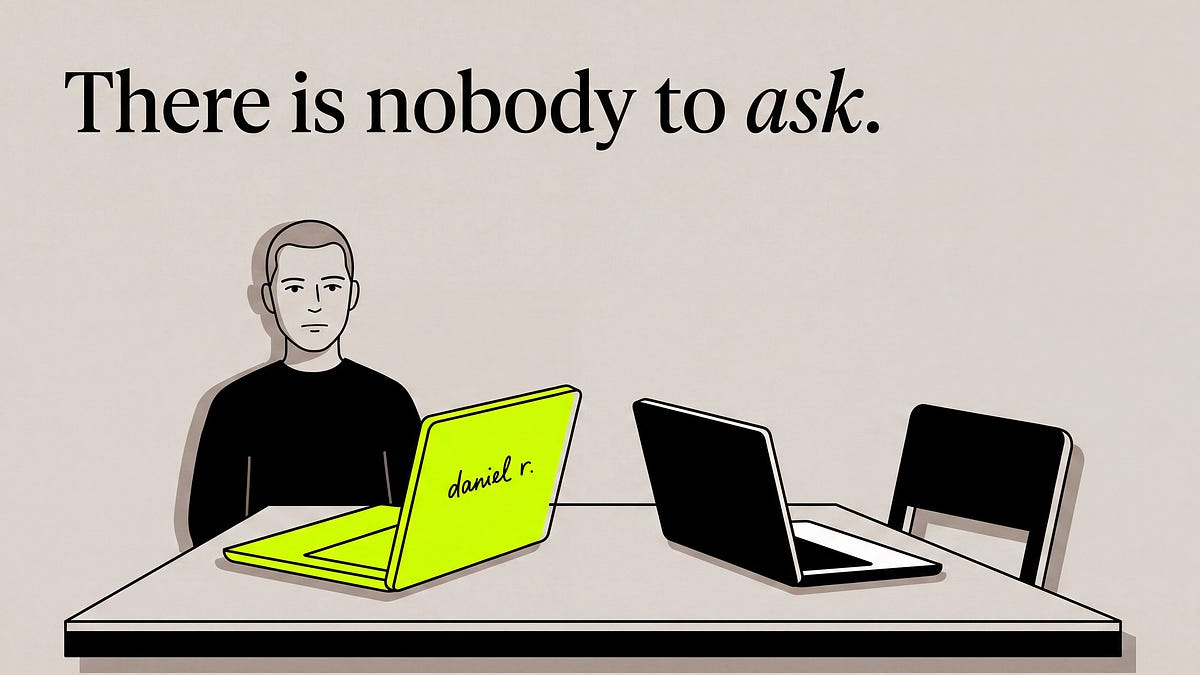
My side's use of AI has no author at all.
That's not a moral difference. It's a structural one, and it's the reason this gap doesn't close on good intentions.
Walk the chain at a normal company and see if you can find the person who chose it.
The person who bought the applicant tracking system left two years ago. The recruiter inherited its settings and has never opened them. Finance set the salary band before the role existed. And I wrote the job description in about twenty minutes, between two other meetings, borrowing three lines from the last one because it was already open in another tab and the meeting was about to start.
Then a model scores every applicant against that twenty-minute document.
Nobody in that chain decided anything. We each did one small reasonable thing and a filter came out the other end.
Greenhouse asked the other side of the table about this. Among the recruiters and hiring managers they surveyed,only 21% said they were very confidenttheir systems weren't screening out qualified candidates. A quarter said they weren't confident at all. Eight per cent said they had no idea what their algorithms prioritise.
That's a measure of how sure we feel, not of how many good people got cut. Nobody has published that second number. The people running the screen are reporting, in a vendor's own survey, that they cannot see inside the thing making the first cut, and the industry has no figure at all for how often it's wrong.
Meanwhile,three in four companieslet AI reject candidates without human review, in a 2025 survey of 1,399 managers. Only 26% require a person to sign off on every rejection.
So when your application dies, it might be a model. It might be a fifteen-year-old if-then rule nobody remembers writing. It might be a tired recruiter who stopped reading properly at number ninety.
You will never find out which, and neither will I. That's the thing I've started calling the unsigned no. By the time anything reaches my desk the shortlist already exists, which is the same reasonthe portfolio review stopped deciding anythingwhile everyone kept polishing for it.
Here's the part my side doesn't say out loud.
A rejection nobody authored is a rejection nobody has to feel.
I've approved shortlists without asking what was cut to make them. I've never once read a rejection from my own company. The only 'no' I have personally authored, in my own words, with my name on it, is the one I give to the six people who make it this far on my calendar.
Everyone else got the script.
Nothing here makes anyone a villain. It's a convenience, and a convenience is much harder to fix, because nothing in the process punishes it. The flood is real:67% of HR leaders sayreviewing AI-generated applications has slowed their hiring down, and one in five report delays of more than two weeks. So we reach for more automation, which makes the pile more anonymous and the next one easier to send.
What the loop actually does is strip out the moment where somebody has to look at a person and decide.
That moment can be put back. It costs one person about ten minutes.
'Nobody tells you' is a dated fact, and the dates are worth knowing.
New York City hasrequired employers to tell youwhen an automated tool screens you, and to publish a bias audit, since July 2023.
Colorado passeda law about exactly thisin 2024. It was pushed back, then pushed back again, then repealed and rewritten asSB26–189, signed in May 2026, with the duties now starting in January 2027. Three years from signature to effect, and counting.
The pressure that's actually moving is legal, not ethical. Mobley v. Workday is nowa nationwide collective actionover algorithmic rejection at scale.
Hilke Schellmann, the investigative reporter who spent years testing these tools herself, has been blunt about why this stays dark:vendors don't want to reveal what's in the black box.
Which brings it back to authorship. Your AI use gets policed because it has a name attached. Ours doesn't, so nothing forces disclosure except a statute, and the statutes keep slipping.
Name a thing, and someone becomes responsible for it. That's most of the fix.
I want to be honest about the limits of my own argument, because the doom version of this is easy to write and I don't fully believe it.
Nobody has published how often AI screening rejects someone who should have got the call. The Greenhouse figure measures how confident hiring managers feel, not how many good people were cut. I'd be careful with anyone who quotes it the other way, including me.
It's also possible the machine is fairer than I am on a Sunday night at the kitchen table, eleven rejections deep. I don't screen well at that hour. Nobody does.
And zoom out, and the sky isn't falling. The Budget Lab at Yale, looking at actual employment data, finds the labour markethas not experienced a discernible disruptionfrom AI. Whatever is happening to you is happening in the hiring process, not in the economy.
What AI can do here is rank 400 applications against a job description in under a minute, and do it more consistently than a human on the 90th file.
What it can't do is tell you that the job description was written in twenty minutes by someone who hadn't met the team yet.
It optimises the filter. It cannot audit the thing it's filtering against. That part was always ours, and we haven't done it much.
If you get to a human, ask this:
Who wrote this job description, and what would make you say yes to someone who doesn't match it?
It's a fair question, and it sounds like curiosity. It is also, quietly, the hardest question you can ask someone in my chair, because it can't be answered without authorship. If I wrote the description, I have to defend a document I spent twenty minutes on. If I didn't, I have to admit I'm hiring against someone else's guess.
Either way, a name lands on the decision. Often mine.
Watch what people do with it. The ones who answer straight away have thought about who they're looking for. The ones who go quiet are about to go and open the reject pile, which is the outcome you actually wanted.
Hiring stopped being a series of decisions somewhere in the last few years and became an infrastructure. Infrastructure runs whether anyone is watching or not, and it has no opinion of you.
AI will keep getting better at sorting the pile. It will get faster, cheaper, and more confident, and none of that will put a signature on the bottom of the letter.
Somebody still has to be willing to own the no. That has never been a technical problem.
Written from the hiring side. Names and details are changed, and some scenes are composites.
♻️ If this said the thing you've been thinking, repost it with a line on why it hit — your note is what makes your followers stop and click.
Read next:
Further reading:
Greenhouse: 63% of job seekers have faced an AI interview
NYC: Automated Employment Decision Tools (Local Law 144)
Holland & Knight: Federal court allows collective action over algorithmic hiring
The Budget Lab at Yale: Evaluating the impact of AI on the labor market
Hilke Schellmann on what's inside the hiring black box
A note on cookies
Newshunt uses essential cookies to keep you signed in and to remember your language and country, so the site works the way you expect. With your permission, we'd also like to use analytics cookies to understand how people use Newshunt and improve it over time.
Accepting only affects analytics. To learn more, view our Privacy Policy or Terms & Conditions.
(0)Comments