


Islamabad's drowning habit
Category: Blend
Share
Archive
Like
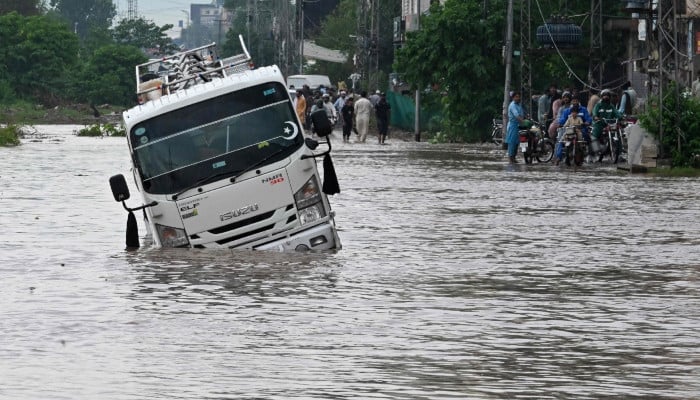
A van is seen stuck amid a flooded street after heavy monsoon rainfall in Islamabad on September 1, 2026. — AFP
Ten feet: that is how high the water rose in Rawalpindi's Leh Nullah before dawn broke over the capital two weeks back, turning Murree Road and Bhara Kahu into rivers and trapping commuters where they stood. No cyclone made landfall. No unprecedented deluge was recorded. This was an ordinary monsoon downpour, and it was enough, once again, to bring Pakistan's capital region to its knees.
Before anyone reaches for the phrase 'natural disaster', it is worth being precise about what actually happened. The rainfall itself was a natural hazard; the scale of disruption that followed was shaped by how the city has been planned, built and managed. This was an entirely foreseeable monsoon spell meeting a drainage system, a set of encroached waterways and a planning culture that had four prior summers to prepare and chose, in each of them, to be surprised instead. Calling that nature's fault is not humility. It is an alibi.
There is also a physical reason 'ordinary' spells now behave like extraordinary ones. A warmer atmosphere can hold roughly seven per cent more water vapour for every degree Celsius of warming, and that extra moisture does not fall gently; it is released in short, violent cloudbursts rather than the steadier rain older drainage systems were built to handle. Islamabad's infrastructure is not just poorly enforced. It is calibrated to a climate that no longer exists. That does not excuse four summers of institutional shrugging. It does mean the goalposts have moved, and pretending otherwise is its own kind of denial.
That distinction changes where the accountability sits. Islamabad does not flood because the sky has singled it out. It floods because the city has built, permit by permit, on the assumption that this year's rain would behave better than last year's. It never does. Streams that once carried water out of the capital have been narrowed, built over or turned into dumping grounds by developers whose projects encroached on natural drainage channels, while enforcement repeatedly failed to prevent it.
Research on the Lower Indus below Kotri Barrage has found that sediment deposition there has reduced the flood-carrying capacity of that river reach by close to 18 per cent: a striking illustration of how sediment accumulation and upstream human intervention can silently erode a river system's ability to handle floods.
Islamabad's own seasonal streams face a different but related set of pressures: encroachment, narrowing, and drainage never designed for today's rainfall intensity. Forests on the Murree hills have been stripped of the root systems that once held slopes together- witness the building that came down on the Murree Expressway last month, taken out not by fate but by a landslide, already weakened by deforestation. This is engineering handed over to politics, and politics losing, on schedule, every single year.
Here is the harder truth Islamabad's planners would rather not sit with: this is the one Pakistani city with no excuse of poverty or capacity to hide behind. Karachi can point to a broken tax base and a fractured municipal structure split across a dozen competing authorities. Islamabad cannot. It has the Capital Development Authority, the best-funded, most heavily regulated urban authority in the country, and that authority still cannot keep a single suburb dry through one monsoon spell. What does it say about a state's priorities when its own capital cannot manage the one recurring disaster it has had eight decades and every available resource to prepare for?
The coverage that follows each of these spells will, as always, tally the obvious ledger: how many roads submerged, how many hours before pumps arrived, how many rupees in damaged property. That ledger is legitimate. It is also the wrong one to dwell on. The real cost of a capital that floods every monsoon is not counted in submerged underpasses; it is the small business in Saidpur that does not reopen, the school day in Bhara Kahu that does not happen, the trust in local government that erodes a little further with each ignored warning. Pakistan's clearest climate writers have made this point about the country's floods generally; it applies with particular force to a city wealthy enough to know better.
Part of the answer is structural, and it is not unique to Islamabad. Drainage, roads, water supply and disaster response sit in separate departments – CDA, the Rawalpindi Municipal Corporation, the Cantonment Board, the Metropolitan Corporation – that rarely coordinate before a flood and mostly trade blame after one. Each treats the storm as an event to be survived rather than a condition to be designed around. Drains get cleared once the rain has already started falling. Pumps arrive once roads are already underwater. That is just crisis management wearing preparedness as a costume.
And yet the proof that Islamabad knows better is sitting in its own rulebook. Since a March 202G directive, the CDA has made rooftop rainwater harvesting mandatory for all new construction in the capital and has moved to expand recharge infrastructure, including new recharge wells and storage tanks. The problem, then, is no longer a lack of recognition. It is whether enforcement can reach the city's existing housing stock and scale to match the size of the risk- extending to drainage and encroachment the same discipline now applied to rooftops.
Other capitals facing identical physics have shown exactly what a serious response looks like, and none of it required inventing new technology. Copenhagen did not answer its catastrophic 2011 flood by laying bigger pipes and calling it solved. It rebuilt its relationship with rain – parks engineered to flood safely, public squares that double as reservoirs, tunnels that store and reuse stormwater rather than expelling it toward the nearest river. The redesign was not cheap, but it reflected a decision to treat flood resilience as long-term infrastructure rather than emergency expenditure. China wrote the same philosophy into national policy a decade ago, turning flood-prone Wuhan into proof that concrete is not the only material a city has to build with.
What unites these examples is not the engineering, which is available to any government willing to commission it. It is a single decision, made once and defended for decades, that flooding is a design failure to be corrected rather than a weather event to be endured.
So, what should happen now, before the next spell arrives- not eventually, but this monsoon season? Three commitments would do more than any press conference promising vigilance.
First, universalise what Islamabad has already legislated city-wide but not yet enforced. Extend the CDA's rainwater-harvesting mandate to every commercial development and government building in the capital, where paved surfaces generate the most runoff and compliance is easiest to audit – and back it with the same urgency currently reserved for pumping streets dry after the fact.
Second, give the city's waterways legal teeth. Declare the buffers around Leh Nullah and the capital's seasonal streams formal no-build zones, with encroachments cleared on a published, enforceable timeline rather than announced after each disaster and forgotten before the next.
Third, end the jurisdictional theatre. Merge stormwater planning across the CDA, the RMC and the Cantonment Board into a single basin-level authority, because water recognises none of the administrative boundaries these bodies guard so carefully. Residents need real-time flood warnings, automated alerts and pre-agreed road-closure and evacuation protocols- not a press release after the water has already risen.
None of this is beyond Islamabad's means. All of it is within reach of a city that already has the budget, the regulatory authority, and, buried in its own building code, the right instincts. What it has lacked is the discipline to act on what it already knows before the water rises, rather than mourn what it lost after it recedes.
Copenhagen needed one flood to commit to a hundred years of correction. Islamabad has had four – and is waiting for the next to teach it the same lesson.
The writer is a policy analyst and researcher with a Master's in public policy from King's College London.
Disclaimer: The viewpoints expressed in this piece are the writer's own and don't necessarily reflect Geo.tv's editorial policy.
Originally published in The News
A note on cookies
Newshunt uses essential cookies to keep you signed in and to remember your language and country, so the site works the way you expect. With your permission, we'd also like to use analytics cookies to understand how people use Newshunt and improve it over time.
Accepting only affects analytics. To learn more, view our Privacy Policy or Terms & Conditions.
(0)Comments