


What the Camera Taught Me About Looking at My Own Life
Category: Entertainment
Share
Archive
Like
I've been a photographer for long enough that I don't think I know how to turn it off anymore. I walk into a room and notice the light before I notice almost anything else. I notice where it falls, whether it's soft or hard, whether someone should move three feet to the left. I notice the reflection in a window, the way late-afternoon sun catches the edge of someone's hair, nervous hands, flowers that have started to bend over the side of a vase. I notice the person laughing at the edge of the photograph while everyone else is looking at the camera.
It's my job to notice. But somewhere along the way, the camera taught me to look at my own life that way, too. And I think that might be one of the greatest things photography has ever given me.
Wedding photography teaches you this very quickly. The obvious photograph is rarely the only photograph. Yes, the bride is walking down the aisle, but her dad is squeezing her hand. Her grandmother is already crying. Someone's little boy is sitting backwards in his chair. The groom's mother is looking at her son instead of the bride. There are a hundred tiny stories happening around the thing everyone thinks they're supposed to be looking at, and after enough years behind a camera, you learn to watch the edges.
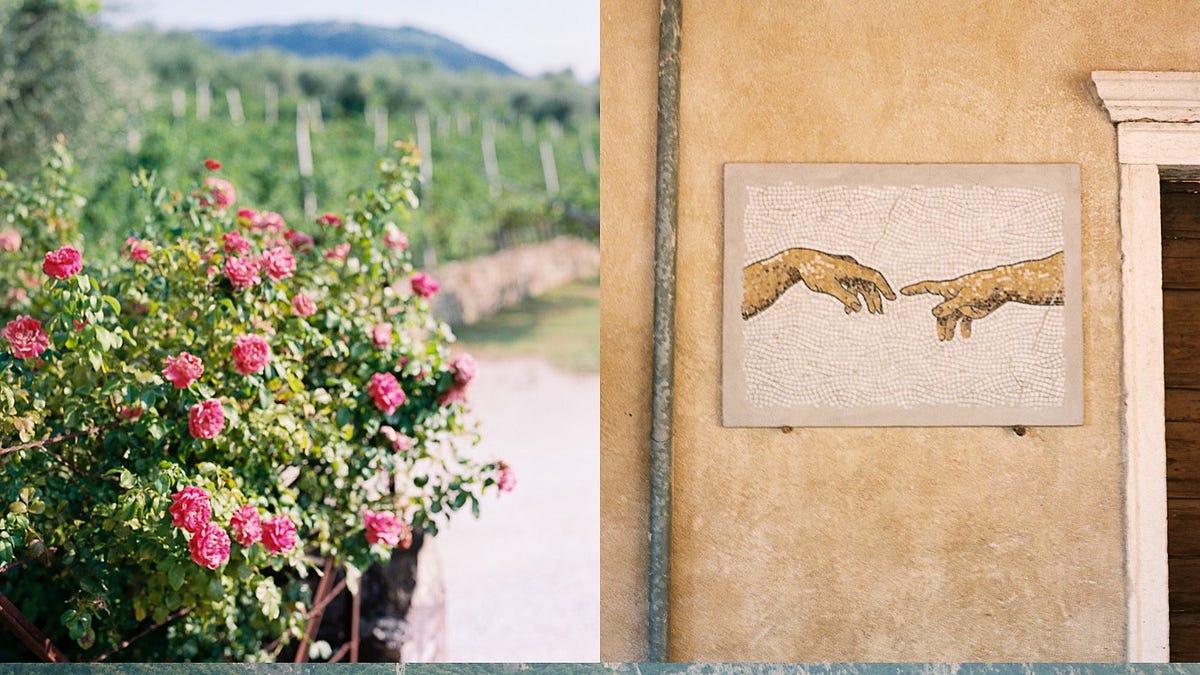
I think life is like that, too. We spend so much time looking directly at the big things: the trip, the wedding, the birthday, the accomplishment, the beautiful dinner reservation, the place we've been waiting months to see. And then I come home from Italy with rolls of film and realize one of my favourite photographs is light falling across a wall. Or my boys walking ahead of me. Or an espresso cup on a tiny table. Something I almost didn't photograph becausenothing was happening.
Except, of course, something was.
My life was happening.
Photography has made me very fond of ordinary things. I love beautiful things, unapologetically. Renaissance paintings and marble sculptures and enormous galleries. Beautiful hotels and turndown service. Garden roses. Italian churches. Flowers spilling from baskets. Really good glassware. Cars that make me stop mid-sentence. Beauty for beauty's sake. I will happily cross a city to see a painting and then spend twenty minutes photographing the way the light hits the café table afterward. I don't see a contradiction there. Maybe that's the photographer in me.
Because the camera has made me understand that something doesn't have to be important to be worth noticing. Sometimes the photograph is my son standing in front of something extraordinary. Sometimes it's tomatoes still warm from my garden, linen curtains moving through an open window, or the way my coffee looked that morning. Not everything needs to become a metaphor. Some things are allowed to be beautiful because they are beautiful. Some things are worth remembering simply because they were mine.
Or better. Probably better.
When I shoot digital, I can make hundreds of photographs without thinking very much about the cost of an individual frame. Film is different. There are sixteen frames on a roll of 120, which means at some point I have to decide:is this worth one?I love that question. Not because every frame needs to be perfect — God, no. I have paid actual money to develop photographs of the inside of my camera bag — but because film asks me to commit.
I meter the light. I compose. I make the photograph. And then I move on.
I can't look at the back of the camera to make sure I got it. Sometimes I don't see the photograph for weeks. There's something incredibly freeing about that. You have to trust your eye and let the moment be over. I wish I were always as good at doing that in the rest of my life.
Photographers also become a little ridiculous about light. I have absolutely rearranged plans around sunset. I know when a room is going to photograph beautifully before I've properly entered it. I will choose the seat beside the window. Always. But the longer I photograph people, the less interested I am in perfection. Perfect light is lovely. Interesting light is better. Give me something streaking through half-closed curtains. A little motion blur. Film grain. A double exposure that did something I hadn't intended. A photograph that technically missed and somehow feels more like the memory than the perfect frame beside it.
I think I used to believe a good life would look a little like good light: even, flattering, predictable, everything illuminated exactly as it should be. I don't anymore. Some seasons are bright. Some are strange. Some are so overexposed you can barely see what happened. Some feel like standing in the dark waiting for your eyes to adjust.
That doesn't necessarily make them bad photographs. Or bad lives.
This is probably the thing I know most certainly after years of photographing people: the photograph after the photograph is often the one.
I give a little direction. Someone thinks we're finished. Their shoulders drop. They laugh. They look at each other. A hand reaches for another hand without being asked. And there you are.
It's why I've never been interested in making people perform perfection for me. I'll direct. I'll move you into beautiful light. I'll fix the thing that will bother you later. I'll tell you what to do with your hands because no human being suddenly knows what to do with their hands when a camera appears. But then I wait, because people are endlessly more interesting when they stop trying to look interesting.
I'm starting to think the same is true of entire lives. Maybe we're most ourselves in the parts we don't think are worthy of presentation: driving somewhere with the boys, cutting flowers from the garden, standing barefoot in the kitchen, laughing with a friend until whatever story we were trying to tell becomes completely unintelligible. Walking through a museum and finding the one painting I can't stop staring at. Sitting beside the water eating something delicious. None of it particularly impressive. All of it mine.
And having children has made me understand this differently. There's a strange thing that happens when you photograph your children for years. You think you're documentingthem, and then one day you look back and realize you were documenting a life that no longer exists. Their little hands. Their missing teeth. The way they stood beside you. The toys on the floor you probably wanted someone to pick up. Then suddenly they're taller. Their voices are different. They have their own interests and opinions and plans. They walk a few steps ahead of you now.
And you would give almost anything to step back into one completely ordinary Tuesday you barely noticed at the time.
Not the birthday. Not Christmas.
Tuesday.
That realization has changed me. I still photograph the big things, of course I do, but I'm much more interested now in keeping evidence of the ordinary.
Because ordinary is only ordinary while you're inside it.
People talk about photographers havingan eyeas though it's something you're born with. Maybe part of it is. But I think most of an eye is built through attention. You look, and then you look again. You learn where the light is. You learn what disappears quickly. You learn that the photograph everyone else walks past might be the one you love most.
And eventually you start doing it without the camera.
That's the part I'm most grateful for. Photography has given me beautiful work and taken me to extraordinary places. It has put me inside rooms and gardens and churches and celebrations I might never have seen otherwise. But more than that, it taught me that paying attention is its own kind of gratitude.
Not the forced kind. Notyou should be grateful for what you have.
Just:
Look.
This is your life.
The flowers are blooming. The light is good. Your boys are laughing in the next room. Your coffee is still warm. Someone you love is sitting across from you.
Take the photograph if you want to.
But mostly, notice it.
Subscribe now
A note on cookies
Newshunt uses essential cookies to keep you signed in and to remember your language and country, so the site works the way you expect. With your permission, we'd also like to use analytics cookies to understand how people use Newshunt and improve it over time.
Accepting only affects analytics. To learn more, view our Privacy Policy or Terms & Conditions.
(0)Comments